Being a journalist today is hard work. While getting it right and working under intense deadline pressure has always been part of the challenge, journalists today face increasingly difficult expectations from newsroom bosses, attacks from members of the increasingly partisan audience, and social media minefields where a misstep is rewarded with professional injury or death.
The school shooting this week gave us plenty of examples of good journalism performed by dedicated journalists. It also gave us reason to pause and reflect on what can go wrong when journalistic ethics are compromised. Let’s start with the good.
Data journalism and interactive technologies give us new ways to visualize old problems. The Washington Post gave us an excellent example in the form of a webpage that updates statistics about mass shootings.
Some of the reporting was done by students who were under attack. To better understand the horror experienced by students, read this series of text messages exchanged between two sisters.
But when students were contacted by members of the media while still in an active shooter situation, objections were raised…and justifiably so. Putting people at risk for the sake of a scoop is clearly unethical and directly contradicts the Society of Professional Journalists code of ethics, specifically the directive to Minimize Harm.
Another problem with using source material generated by eye-witnesses is that there may be graphic images and sounds that may contribute to the trauma experienced by survivors. Poynter, a leader in journalistic ethics, provided a very thoughtful analysis of Wednesday’s coverage and asked important questions that all journalists need to consider before rushing to publish.
And finally there is the increasingly distressing problem created by fake news. Some of the fake news is predictable “spinning” by political agents or PR hacks advocating for their particular cause or position. One example is the claim circulating on social media that there have been 18 school shooting since Jan 1, 2018. That claim was debunked by a story in the Washington Post. There’s also been reporting of Russian troll farms using the event to further their campaign intended to divide and mislead the American public.
But perhaps the most alarming instances of fake news related to the Florida school shooting are the fake tweets that were intended to implicate a working journalist in the very kind of unethical behavior described earlier in this post. According to Poynter,
One of Harris’ early replies quickly went viral. Within 45 minutes, she was getting a barrage of harassment from random Twitter users. Someone made a screenshot of a fake tweet alleging that she had asked someone for photos or videos of dead bodies. She decided to ignore the hoax and report it to Twitter instead.
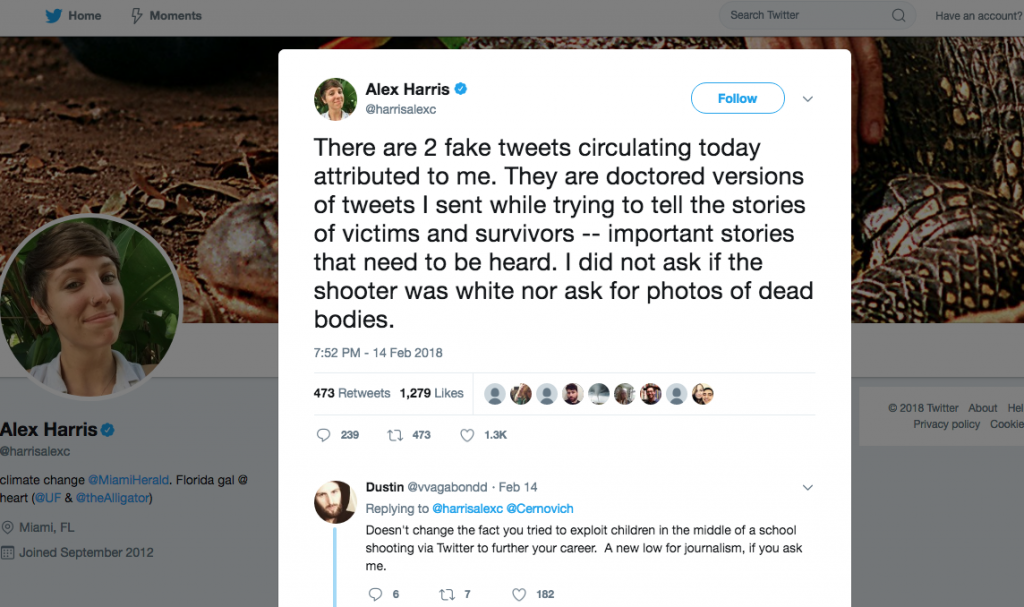
According to Jane Lytvynenko of Buzzfeed,
While traditional fake news stories have a financial incentive, amassing advertising revenue by monetizing page views, Lytvynenko said the motivation for creating fake tweets is less clear. While creating them could be politically motivated, there’s also the possibility that the people behind them are just bent on destruction.
There is virtually NO defense against misinformation motivated by that kind of animus.
 The 2018 Winter Olympic Games, aka XXIII Olympic Winter Games, are underway in