The folks at Humane Tech have been warning us about the dangers of social media, and recent events seem to be lending support for their concerns. Here’s a trailer for an upcoming documentary on Netflix.
Check out their website for more information, and to sign up to learn more.
The motion picture industry has been put on hiatus by the Covid-19 pandemic and theaters that have been closed for many months are only now starting to slowly reopen. With few exceptions, e.g. Tyler Perry’s studio outside of Atlanta, film and TV production has ground to a halt over recent months. To put it in perspective, by this time last year domestic box office had surpassed $11B. This year they are struggling to break $2B. But now, as production is beginning to resume and movie theaters are beginning to reopen, safety protocols are the focus of attention.
According to Axios, executives from the largest theater chains are introducing safety protocols that they believe will encourage folks to return to movie theaters. The CinemaSafe campaign is fairly routine stuff, but if all goes well, and Covid-19 cases continue to drop, they’re hoping that movie buffs will return to being comfortable sitting down with a tub of popcorn to enjoy the big-screen experience. I don’t know about you, but I’m looking forward to Christoper Nolan’s “Tenet” set to be released over Labor Day weekend. If you go expect the following: masks, social distancing, reduced capacity (40%-50%), upgraded air filtration systems, and touch-less ticket sales.
For those who have only been playing video games for a few years, you might not fully appreciate just how far computer graphic technologies (hardware and software) have come. But if you want to see for yourself, the release of the latest version of Microsoft’s Flight Simulator is a great case study.
From the earliest days with crude monochromatic vector drawings to the modern day visuals that look like a feature film, video game graphics have soared to new heights. From vector graphics to full-motion video, and from 2D to 3D (and beyond with VR), faster processors and graphics accelerator cards have changed the look and feel of modern game play. Alvy Ray Smith famously said, “Reality is 80 million polygons per second.” It appears that we’re approaching reality at warp speed.
In what may be the greatest TV commercial of all time, Apple introduced the macintosh computer to Super Bowl viewers in 1984. Flash forward more than 35 years to the present where Epic Games has turned the table. According to their website…
Apple has blocked Fortnite from the App Store, removing everyone’s ability to install and update the game on iOS devices, while instructing Epic to “remove the ‘Epic direct payment’ feature”. Apple is keeping prices high so they can collect 30% of your payments, and is blocking Fortnite in order to prevent Epic from passing on the savings from direct payments to you! Join the fight against @AppStore on social media with #FreeFortnite
The Apple App Store has been a tightly controlled asset for many years, contributing to Apple’s dominance in the mobile gaming market. Maybe this is part of the reason why Apple is approaching a net value of $2 Trillion. With Epic Games worth a tiny fraction of that amount, this could be shaping up to be an epic David v Goliath battle, and if history is any indication, it may be wise to put your money on the underdog.
UPDATE: Spotify and Match Group (dating app powerhouse) are showing support for Epic Games by speaking out against Apple’s 30% “App Store tax.” It’ll be interesting to see who else jumps on this train.
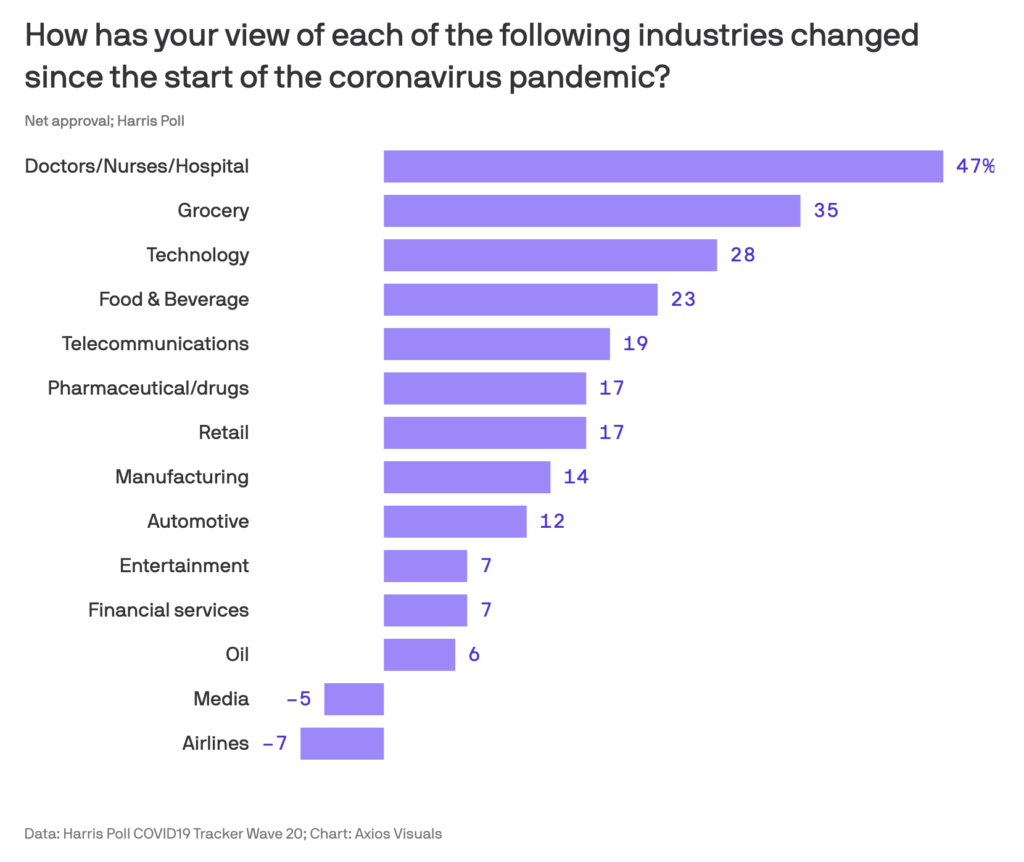
The Covid-19 pandemic has had a dramatic effect on so many things, including the reputations of various businesses. According to a recent poll by Axios/Harris, most major industries in the US have received a positive bump. Ones that took a hit: media and airlines.
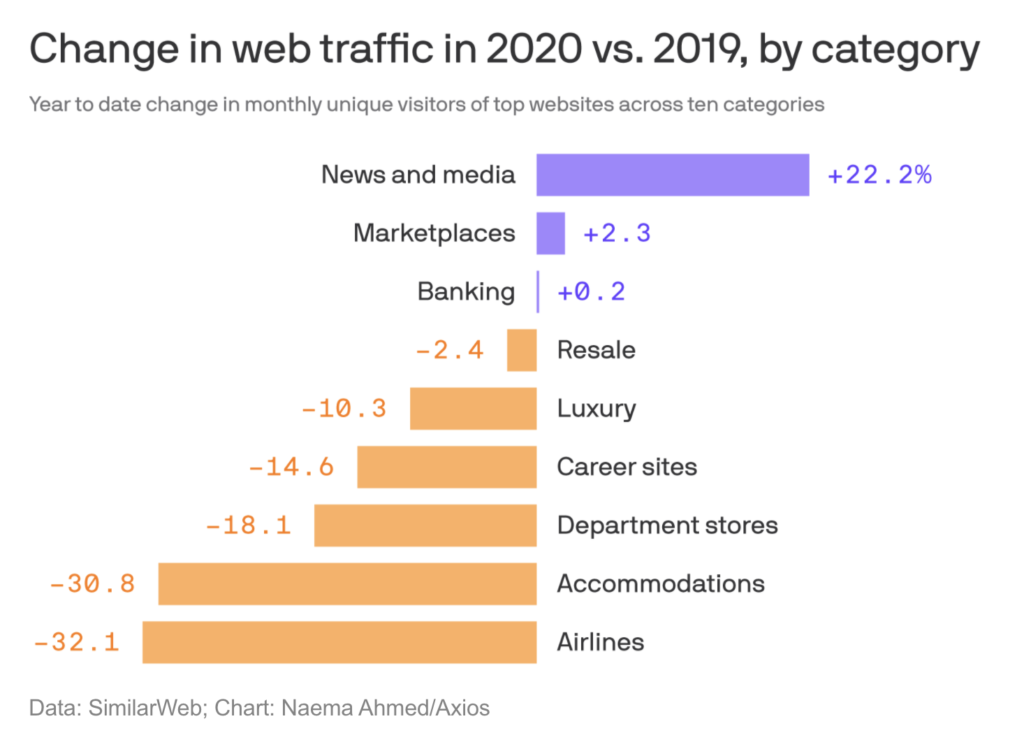
For those of us working in the media industries, we’ve got our work cut out for us to regain the trust and confidence of the American people. And as you can see from the following graph, there is demand for news and media. So while consumers may not have high regard for media companies, they are still seeking out relevant news and information.