
No Universal Right to be Forgotten

Alphabet, parent company of Google, won a legal victory this week. According to The Guardian newspaper, “in a landmark ruling on Tuesday, the European court of justice said search engine operators faced no obligation to remove information outside the 28-country zone. It however said search engines must “seriously discourage” internet users from going onto non-EU versions of their pages to find that information.”

The Right to be Forgotten is a concept that gained legal traction in 2014 when the European Union supported the request of an individual who wanted the search engine to scrub old, unflattering information from showing up in search results. Advocates for privacy argue that individuals should have the option to move on after an unfortunate experience or to be protected from false information that others have posted on line. But digital footprints are not easily swept away, at least not without the help of the big search engines…of which Google is the world leader.

“Google says it has received 845,501 ‘right to be forgotten’ requests in the past five years, leading to the removal of 45% of the 3.3m links referred to in the requests. Although the content itself remains online, it cannot be found through online searches of the individual’s name.”

The Guardian

According to the court’s ruling, “The balance between right to privacy and protection of personal data, on the on hand, and the freedom of information of internet users, on the other, is likely to vary significantly around the world.”
What’s Going on at the New York Times?

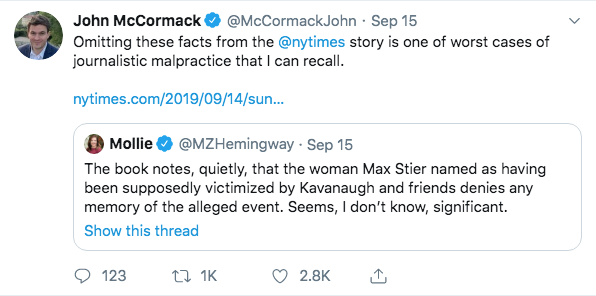
In a stunning display of poor editorial choices last weekend, the New York Times appears to have done serious harm to the integrity of their own brand, and of journalism at-large. In a tweet and a piece published on Sunday, the NYT managed to offend both defenders of Supreme Court justice Brett Kavanaugh and his most ardent critics.

The controversy over recently nominated justice Kavanaugh is well known, as is the political angst felt by many on the left over the current administration’s success in appointing conservative justices at all levels of the judiciary. The fact that two NYT journalists found evidence of new accusations against Kavanaugh and published a book about their research was not surprising to many who believed that Kavanaugh’s appointment over the objections of Christine Blasey Ford was a miscarriage of justice.

But what was surprising, even to fans of the New York Times, is that the recently published review of the book failed to disclose that the woman at the center of the new allegations denies any knowledge of the event and was unwilling to talk to the reporters. And another controversial matter that was ignored was that the person bringing the accusation was a member of Bill Clinton’s legal defense team when he was accused of sexual misconduct.

None of these facts proves or disproves the accusations, but the failure of the New York Times to disclose these facts to the public goes against every rule designed to protect journalistic integrity and fairness. When a trusted institution like the New York Times makes mistakes of this magnitude, and fails to offer satisfactory explanations that might defuse the appearance of bias, it does harm to journalism and journalists everywhere.

And just to make sure that everyone had something to complain about, a [now deleted] tweet from the New York Times managed to offend the sensibilities of everyone who thinks that sexual assault is anything but “harmless fun.”

https://www.politico.com/story/2019/09/16/new-york-times-brett-kavanaugh-book-1498153
Read more at Politico: https://www.politico.com/story/2019/09/16/new-york-times-brett-kavanaugh-book-1498153

Cokie Roberts Will be Missed

Longtime NPR and ABC News reporter and correspondent Cokie Roberts died last week and her presence will be sorely missed by those who believe in journalism. A woman who rose to prominence in a male-dominated industry, Roberts was an advocate for journalists at large, and for female journalists when their numbers were few.

According to NPR, “Roberts won numerous awards during her long career in journalism, including three Emmys and the Edward R. Murrow award. She was inducted into the Broadcasting and Cable Hall of Fame. She was recognized by the American Women in Radio and Television as one of the 50 greatest women in the history of broadcasting.”

Her advice to young journalists still rings true today…”Don’t get all involved in the politics of your institution, or competition in your institution. Just do your work and get it on the air, and then people will see if you’re good,” she said.

Why Local Investigative Journalism Matters

Last month in Colorado Springs, 19-year old De’Von Bailey was shot and killed as he ran from police. Bailey and his cousin were stopped by police after a 911 caller reported an armed robbery in the area. After being stopped (but before being patted down) Bailey fled. According to police, the shooting occurred after Bailey reached for what was later identified as a gun.

Still frame from bodycam footage just before the shooting of De’Von Bailey. Link to video is to the right.

The Gazette newspaper in Colorado Springs published edited and condensed body camera footage of the incident. You can see it here, but be warned that the footage is graphic and disturbing.

Bailey’s death is a tragic outcome of a very unfortunate event and it is critically important to understand how and why the shooting occurred if we are to understand how to prevent similar incidents in the future. According to the Gazette, 5 of 7 police-involved shootings in Colorado Springs in 2019 have resulted in fatalities. Community activists in Colorado Springs point to a number of similar events around the country in recent years where police use of deadly force resulted in the death of minority suspects. Other names you might recognize include Michael Brown of Ferguson and Eric Garner of New York City.

The highly-respected journal Nature recently published an article calling attention to the shortage of scientific data on the topic of police use of lethal force. According to the article, “In the United States, police officers fatally shoot about three people per day on average.” And while it is essential that objective research be gathered, analyzed and published it is also critically important that journalistic investigations continue to shine a spotlight on any sign of injustice and abuse of power. This is why local journalism exists and why it matters.

To carry out their duty journalists must be dogged and relentless in their pursuit of truth. And once they find truth, they must present it to their readers/listeners/viewers in a way that is informative, compelling, and unbiased. Anything less is an abdication of their purpose and mission.

I’m being honest when I say that I don’t know enough about this tragic event to have formed a strong opinion on whether this shooting was justified. I hope that investigative journalism, and an independent investigation, will step up to provide the necessary context to help us process this tragedy. Without that we will be left to our own biases and interpretations of what happened on that evening of August 3rd in the 2400 block of East Fountain Blvd. in Colorado Springs.

Additional links to media coverage of the shooting

css.php