What’s up with GameStop?

In case you haven’t heard, the video game store GameStop has been the talk of the town, especially if your town is an “online reading club” called Reddit. If you’re wondering what that quote is all about, enjoy this short video tweet.

Okay, that was fun, but seriously, what’s going on. Without getting bogged down in the complexities of wall street shenanigans, one lesson to take away from #gamestopgate is the enormous power of collective action organized by online forums (in this case Reddit) and the larger social media communities that jumped into the pool.

Here’s a more detailed explanation…

Robinhood democratized stock trading for the masses, and social media gave them a way to communicate and organize around a trending topic. This kind of power, rarely available to the average consumer, will become more and more common as the internet becomes injected into every area of life. Last year it was crowd-sourced journalism and police reform. This week it is “short squeezing” a video game stock and the hedge fund investors who were betting on its demise. Next month it may be decentralized healthcare and vaccine distribution. Every service that was formerly controlled by titans and elites can be disrupted by internet-empowered citizens with either a common goal or grievance. Hold on to your hats.
Bernie Sure Gets Around

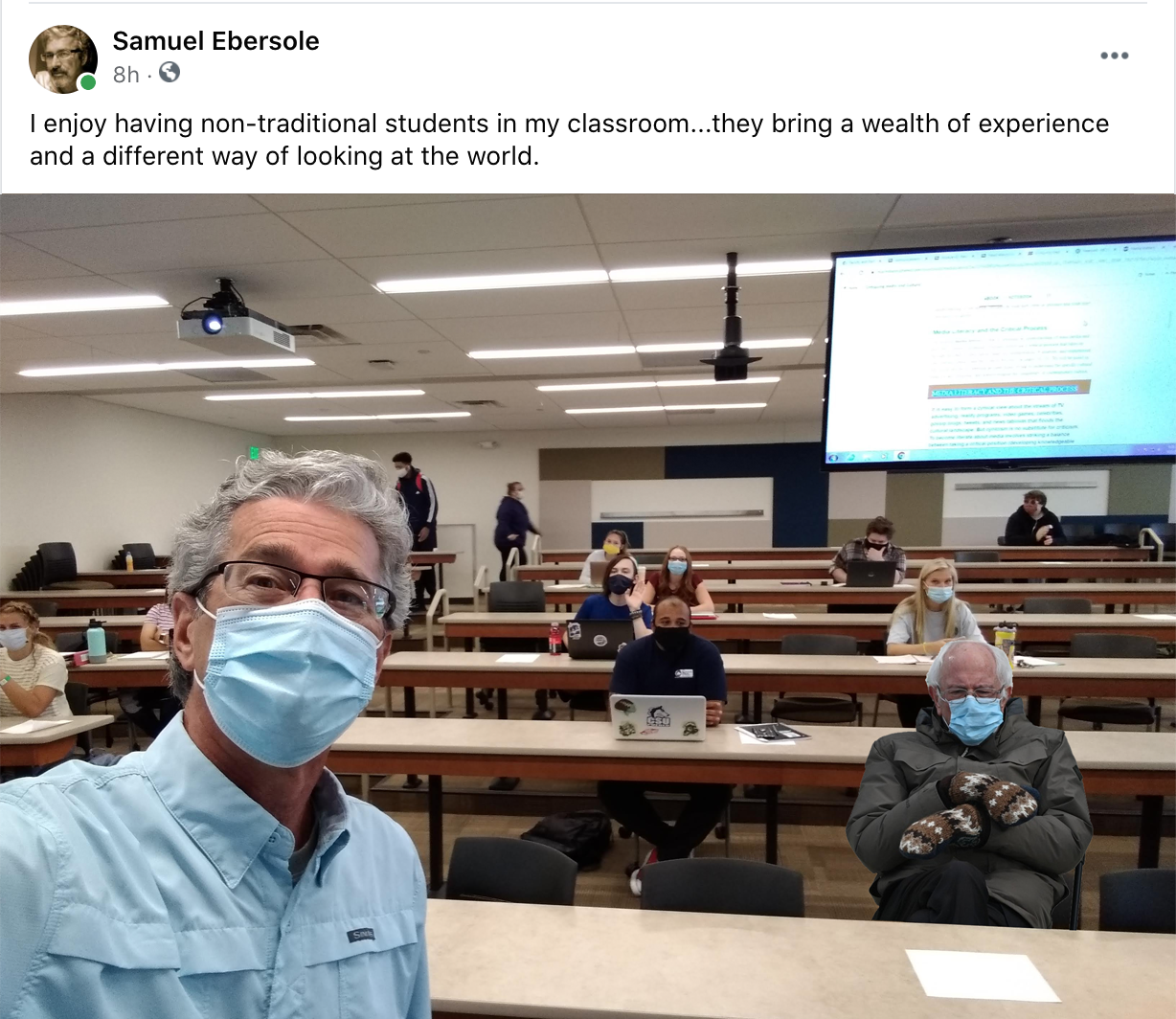
Have you seen Bernie Sanders recently? How could you miss him? He’s everywhere…including in my classroom.

Bernie Sanders sitting in on my Media & Society class

Of course Bernie wasn’t a student in my Media & Society class from last fall, but that’s what’s so fun about this meme. It is instantly recognizable, relatable, and can be adapted to almost any setting. And Bernie’s body language is also open to interpretation. His pose could be read as bored, sad, or grumpy. And don’t forget the mittens.

According to RollingStone magazine, the photo was taken by Brendan Smialowski, a former sports photojournalist from Connecticut who documents politics for wire service Agence France-Presse. And according to Wired magazine, the Bernie meme is an indication of a “cultural reset”… a defining moment when you can feel a change or shift is happening. And this change came with a bit of levity. According to Wired, “The internet has had some good ones [memes] over the past four or five years, but often, amidst the political bickering, it’s been hard to know when to interject with a joke. On Wednesday morning, people let ’em rip—and suddenly the thing keeping everyone warm was laughter.”

Big Tech, Political Polarization, and the Assault on Democracy

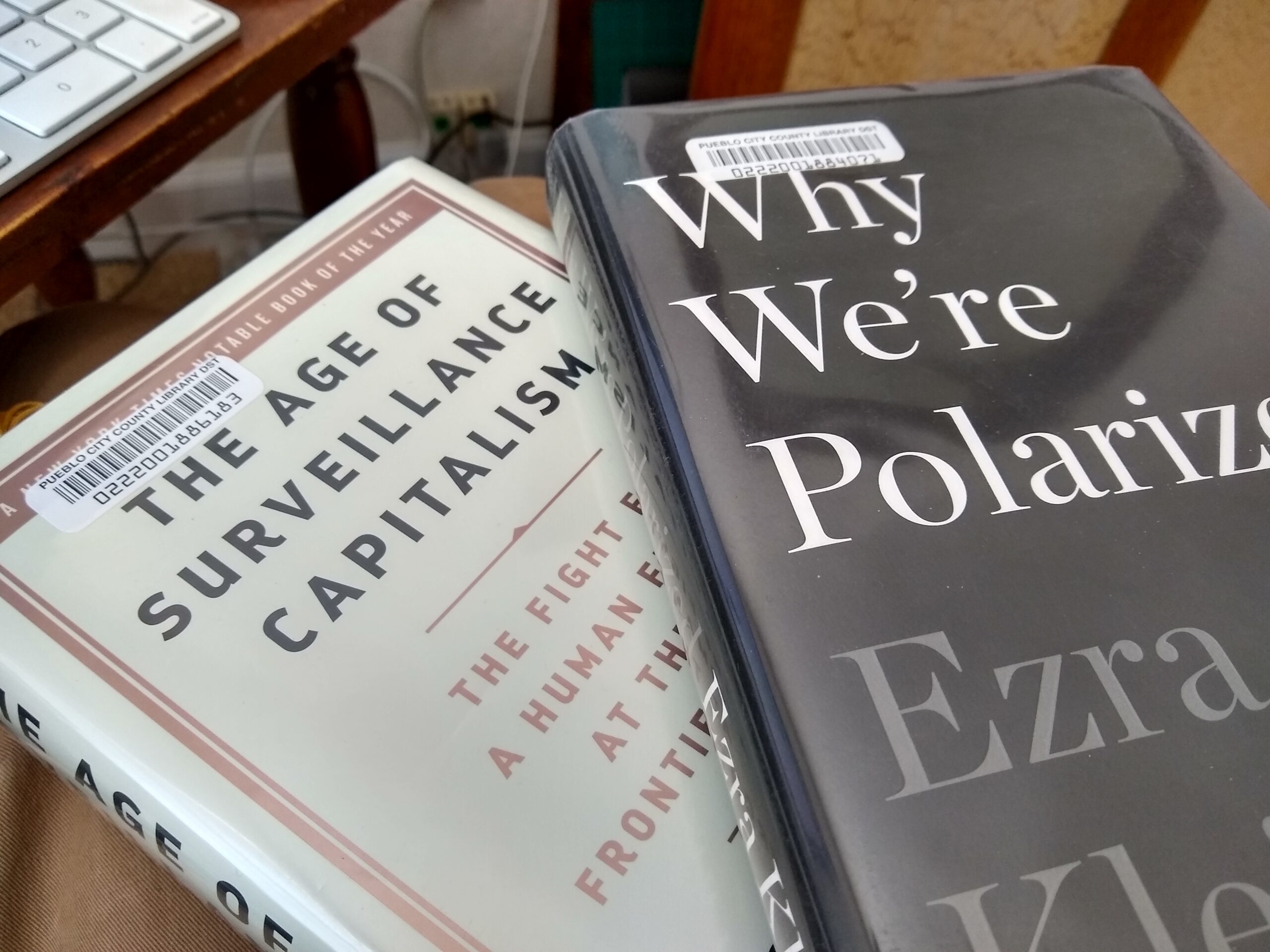
The Age of Surveillance Capitalism by Zuboff and Why We’re Polarized by Klein

I’ve been catching up on some reading over the holiday break and two books that caught my attention are proving to be quite helpful to understanding the recent events in our nation’s capitol. What we’re witnessing is shocking, but not surprising, to those who have paid attention to the ever-increasing power exerted by Big Tech over every detail of our lives, including our political identities.

Big Tech is shorthand for the companies that control much of our everyday lives through their use of software and hardware designed to capture and hold our attention. And speaking of attention, if I were to add another recent title that addresses this concern it would be The Attention Merchants, by Tim Wu.

By gathering the massive amount of data generated every minute of every day by billions of users, these companies have tapped into a resource that they have turned against us to predict and control our future behavior. Siloing, creation of filter bubbles, nudging users towards certain behaviors, shadow-banning (and now more overt actions to disenfranchise users) are just some of the ways that Big Tech is meddling in the political process. If that sounds like a radical conspiracy theory to you, I urge you to read these books and then we can have a conversation.

And while all of us can agree that what transpired this past week in the halls of congress was both dangerous and disgusting, reasonable people continue to disagree about how to respond to controversial political speech on the leading tech platforms. The ban of the President of the United State by numerous platforms, regardless of your opinions about Trump himself, is cause for concern and should not be taken lightly.

Similarly while the attack on right-wing alternative platforms, e.g. Parler, by Amazon, Apple and Google, may feel like a reasonable and perfectly legal response to unhinged speech that calls for political violence, the danger is to further marginalize and force underground a movement that has enormous popular support.

I’m not suggesting that racists, white-nationalists, and anarchists should have a seat at the table, but I am suggesting that unelected leaders of a few massive tech companies cannot be trusted to make decisions about who gets to participate in our political discourse. This time they may appear to be on your side, but what about when the tables are turned? We’ve given these tech platforms enormous power over the future of our democracy…and that makes me very concerned.

css.php