When is it Okay to Lie to Get the Story?

Journalism is all about finding and reporting the truth. And historically, to get to the truth, some journalists have resorted to telling lies. The history of yellow journalism, muckraking, and investigative journalism is filled with stories of reporters going to all lengths to get the scoop.

Renowned journalist Nellie Bly famously feigned insanity to gain access to the Women’s Lunatic Asylum just so she could report on the deplorable conditions experienced by its patients. A sting operation set up by the Chicago Sun-Times led to a series of reports about corruption and scandal that nearly won a Pulitzer Prize until the ethical questions surrounding the tactics used became a distraction. And just in the last few days we’ve been made aware of a clandestine attempt by Project Veritas to expose biased reporting on the part of the Washington Post newspaper.

What all of these incidents have in common is the use of deception to gain access to secret information with the goal of exposing corruption and outing bad characters. Where they differ is motive and outcome. In the case of the latest attempted sting, the target actually came out on top…and from all appearances was the party on the side of truth. While previous undercover investigations by Project Veritas may have exposed crooked dealings and bad characters, it appears this time that the Washington Post was vindicated and the undercover Project Veritas “reporter” exposed as the unethical party.

While the history of journalism has plenty of examples both of favorable and unfavorable outcomes when deception is part of the reporting strategy, there seems to be growing unease with the practice. An excellent piece by Jack Shafer at Politico includes this warning…

But if the press starts sanctioning the telling of lies and staging scenarios to get stories, what’s the next step? Wiretapping? Break-ins? Extortion? The employment of call girls? Other assorted dirty tricks? All of these methods would reap rich results, but at a cost that’s morally prohibitive.

Sometimes you just have to play by the rules and hope that the good guys win in the end. And regarding the rules, there actually are a list of ethical guidelines that have been developed to ensure that journalistic deception, when absolutely necessary, doesn’t go off the rails. Again, Jack Shafer writing at Politico…

Even the high priests of journalistic ethics at the Poynter Institute allow for pure deception, high misrepresentation and hidden cameras in reporting. The circumstance must be isolated; the information gathered must be profound; all other alternatives must have been exhausted; the journalists must be willing to disclose their deceptions and justify them; and the harm prevented by the scoop must outweigh the harm caused by the deception.

Thanksgiving Week Update

Although we’re off this week, breaking news is not letting up. Here’s a quick recap of media-related news stories of interest to Media & Society…

  • Charlie Rose (CBS, PBS) and Glenn Thrush (New York Times White House correspondent) are new additions to the growing list of media professionals accused of sexual harassment or misconduct. Both have been suspended.
  • The Department of Justice is attempting to block the proposed $85 billion deal between AT&T (a telecom company) and Time Warner (a content producer) on the basis of anti-trust violation. This is despite a similar deal in 2011 when Comcast bought NBC/Universal.
  • FCC Chairman Ajit Pai is considering a roll-back of Net Neutrality policies that were put in place during the Obama administration. More at Politico.
  • Multiple former insiders at Facebook are coming out to accuse FB of building a platform designed to compromise its users. Former engineers, designers, and investors are admitting their own involvement in aiding the tech giant in creating something that has become too big and too powerful for our own good. The person who created FB’s “like” button was quoted as saying, “It is very common for humans to develop things with the best of intentions and for them to have unintended, negative consequences.” There’s an old saying, “Confession is good for the soul.”

Happy Thanksgiving to you and yours!


Paying for Media

Paying for media is both unavoidable and, at the same time, pretty unusual. All media content is paid for by someone, but for the end user that “cost” is not always visible. It used to be very obvious every time you bought a book or a movie ticket or a CD (remember those?). But most folks don’t buy books, movie tickets or CDs anymore. And a lot of our media content appears to be free. It’s not, but the cost is hidden from view and only apparent in the form of annoyingly-hard-to-avoid advertising.

According to an article in Politico, some of this is changing. Partly because of the gradual acceptance of online services that have a small monthly fee (e.g. Netflix and ad-free streaming music services) Millennials are starting to consider paying for other forms of media.

The other contributing factor that the article identifies is the election of President Trump. It appears that online journalism is getting a boost from those opposed to Trump, and that has been good news for online news providers…especially those that have taken an aggressive stance  to the current administration. The ideological factor is substantial according the following excerpt from the article.

Newman said that 29 percent of Americans responded to the survey that their reason for paying for news was, “wanting to help support or fund journalism,” which was twice the average for all countries included in the study. Americans on the political left were four times more likely than those on the right to cite supporting journalism as their reason for paying, Newman said.

But there are still concerns. Again, according to Politico…

For all the good news, the truth remains that those willing to pay for journalism still represent a relatively small group—according to the Reuters Institute study, 84 percent of Americans do not pay for online news. Subscriptions are not cheap, and Newman pointed out that there is danger in quality journalism becoming an increasingly elite product. “The danger is that you get a two-tiered system,” he said.

This notion of two classes–information “haves” and information “have nots”–is disconcerting for those who see income inequality as a barrier to political engagement.

Still, for an industry that has been pummeled for more than a decade by terrible financial news and, for the last 10 months, by the President of the United States, the growing willingness of millennials to open their wallets is welcome news.


Celebrity Endorsements

HuffPo recently published data reported by HopperHQ about rates charged by celebrities for social media endorsements. Here’s a list of some of the top dealmakers.

  1. Selena Gomez – 122 million followers – $550,000 per post
  2. Kim Kardashian – 100 million followers – $500,000 per post
  3. Cristiano Ronaldo – 104 million followers – $400,000 per post
  4. Kylie Jenner – 95 million followers – $400,000 per post
  5. Kendall Jenner – 81.7 million followers – $370,000 per post
  6. Khloe Kardashian – 68 million followers – $250,000 per post
  7. Kourtney Kardashian – 57.8 million followers – $250,000 per post
  8. Cara Delevingne – 40.4 million followers – $150,000 per post
  9. Gigi Hadid 34.7 million followers – $120,000 per post
  10. Lebron James – 30.7 million followers – $120,000 per post

As you can see it is largely a numbers game with a couple of notable exceptions, e.g. Kim Kardashian punches above her weight with a cool $500K per post to reach her 100M followers.

Just in case you, or anyone you know, have a plan to become one of these influence marketers, just remember that there are a few million folks in line ahead of you. You should probably have a plan B just in case.

Are the Media Complicit in Harvey Weinstein’s Sexual Abuse?

The avalanche of accusations against movie mogul Harvey Weinstein continued unabated this week as more women came out to accuse him of  sexual harassment, groping, and even rape. In hindsight it appears that the only people in Hollywood who didn’t know about Weinstein’s behavior were members of the media. Or worse…perhaps they did know but couldn’t bring themselves to report it.

The abuse by Weinstein was so well known in Hollywood that it even served as a joke by Seth MacFarlane on the 2013 Academy Awards  telecast. While McFarland describes the joke as “a hard swing in his [Weinstein’s] direction”, others are describing MacFarlane’s joke as just another example of not taking these allegations seriously. Here it is…you decide:

https://youtu.be/KCNvREKTnQc

This kind of behavior is, sadly, not new. The infamous Hollywood “casting couch” has never been so clearly revealed to anyone who cares to look past the flimsy curtain. The sad reality is that men in positions of power have been able to prey on victims who are afraid to report the crimes.

What is new here is the scope and size of the offense, and the reach and influence of the perpetrator. Few media moguls are as big as Harvey Weinstein. According to a report by PBS, “Between his work at Miramax and The Weinstein Company, which he co-founded, Weinstein’s films have received more than 300 Oscar nominations and secured 81 wins for films like ‘Pulp Fiction,’ ‘Sling Blade’ and ‘Shakespeare in Love’”.

Weinstein’s clout was not just felt in Hollywood, but also New York (the center of the news media), and Washington D.C. A long time political donor to Democratic politicians, the Clintons and Obama counted on Weinstein to deliver both dollars and votes. Michelle Obama called Weinstein “a wonderful human being, and good friend” and the Obama’s daughter Malia worked as an intern in his office.

But what really has people scratching their heads is the official silence from news organizations. Why did it take so long for the story to break in The New Yorker? Decades after the fact, reporters are now telling stories of how their reporting on Weinstein was spiked by editors and publishers who didn’t want to offend Weinstein. Why would media outlets that take seriously the oath to “seek the truth no matter where it leads” turn away when the path leads to Weinstein’s door?

According to recent reports, the sexual assault allegations have exacted a toll. Weinstein was fired by his production company, his wife left him, political friends have denounced him, and he has been expelled from the Academy of Motion Picture Arts and Sciences. But for the many women who were harmed by Weinstein, this is only the beginning of justice being served.

Update: After posting this I ran across this article in the Weekly Standard. More food for thought.


Fake News, Social Media, and Russian Influence

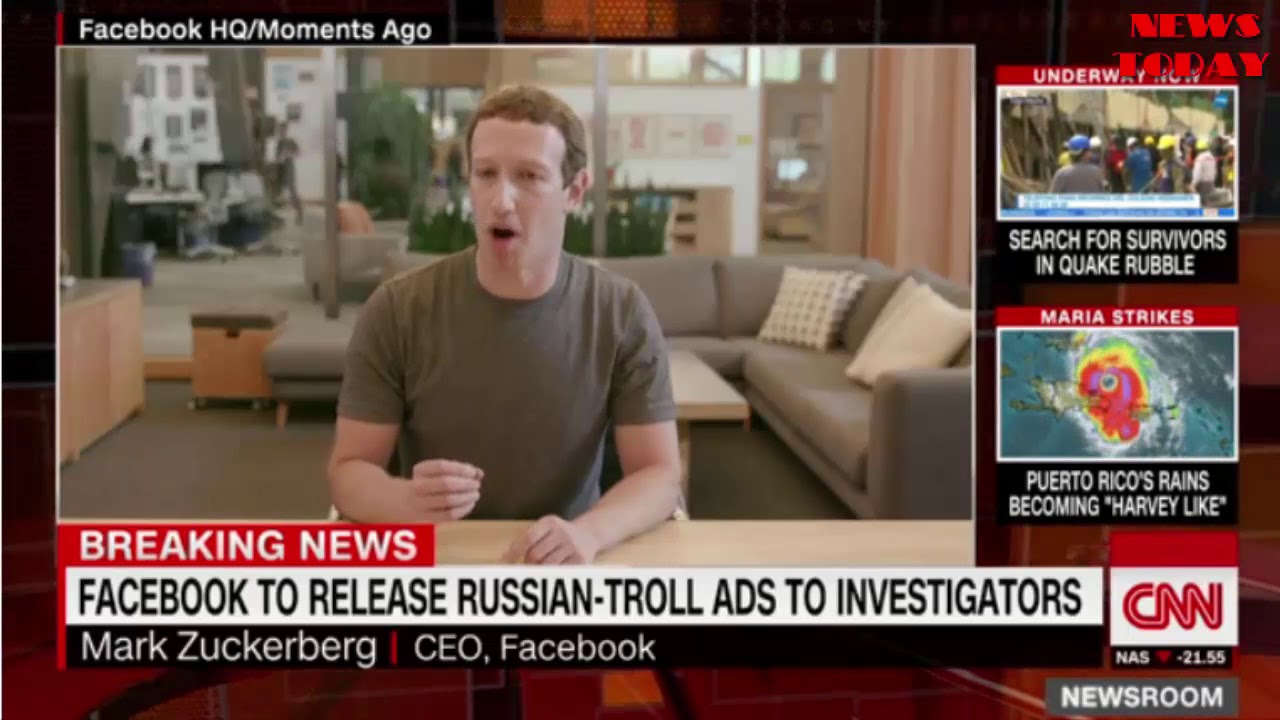
In the days following the 2016 election Mark Zuckerberg said, “The idea that fake news on Facebook, of which it’s a very small amount of the content, influenced the election in any way I think is a pretty crazy idea.” Since then Facebook has uncovered more than $100,000 of ad spending by Russian operatives designed to highlight divisive election issues. In late September Zuckerberg issued an apology saying, “Calling that crazy was dismissive and I regret it.”

It now appears that social media regret is more widespread as well. This past week Twitter admitted to a Congressional panel that it too was targeted by Russian operatives attempting to influence the election.

According to Recode,

Twitter informed congressional investigators of its findings in a series of briefings in Washington, D.C., on Thursday — and the revelations are sure to stoke further speculation on Capitol Hill that Kremlin agents sought to co-opt social media platforms to stir social and political unrest in the U.S.

In a separate report, Recode reported…

…about 20 percent of tweets sampled around the U.S. presidential election qualified as “polarizing and conspiracy content,” including links to “junk news,” WikiLeaks or Russian sources, like Sputnik and RT.

Next on the stand will be Google. Congress wants to know whether its email, advertising, and YouTube services were compromised by Russian operatives attempting to manipulate the outcome of the Presidential election.

In all of these instances it is becoming apparent that the meddling was intended to influence the outcome of the election not by promoting or attacking any one candidate, but by stoking political unrest on a variety of hot-button social issues, including: immigration, gun control, religion, LGBT, and racial issues such as Black Lives Matter.

CNN reported that a Russia-backed account called Blacktivists used Facebook and Twitter to promote racial tension and its Facebook account had more “Likes” than the Black Lives Matter Facebook account.

According to a report published in the Washington Post,

These targeted messages, along with others that have surfaced in recent days, highlight the sophistication of an influence campaign slickly crafted to mimic and infiltrate U.S. political discourse while also seeking to heighten tensions between groups already wary of one another.

Even if Congress cracks down on reporting of political ads on social media there is little evidence that much will change. After all, these are not political ads by traditional definitions.

There are, however, a couple of take-aways from these reports. First, if you’re consuming news exclusively on social media you are vulnerable to manipulation. And second, hyper-partisanship makes us even more likely to believe propaganda and lies. The first issue is fairly easy to address…the second will take significantly greater effort.

Televised Sports and Politics


I’m sure you’ve seen and heard the noise in recent weeks around the topic of politics and sports. From ESPN sportscaster Jemele Hill’s critique of President Trump to the #TakeAKnee protest this past Sunday, sports and politics appear to be on a collision course. LeBron James and Steph Curry have traded tweets with President Trump regarding the Warrior’s invite to the Whitehouse.

I don’t know about you, but my social media feed is overflowing with opinions as NFL players responded today to President Trump’s comments a few days ago calling out players who have protested racism during the playing of the National Anthem.

Thankfully this is a media blog and not a political blog…so I’ll do my best to limit my comments to the issues related to the mass media industries and free speech and expression protected by the First Amendment.

Televised sports has largely been a place where fans have gone to escape politically charged issues. With a highly integrated roster, pro sports teams have actually been able to avoid much of the racially divisive issues that have troubled other sectors of society. There have been notable exceptions of course: the Black Power protest at the 1968 Olympic games, Muhammad Ali’s protest of the Vietnam War, and others.

Even though we have been experiencing a highly polarized political climate of late, TV programmers (with the exception of Sunday morning political talk shows, cable news networks, and late night comics) typically avoid political debates. When advertising revenue is your bottom line, political issues are dangerous because they risk alienating large segments of viewers who turn on their TVs to be entertained, not excoriated.

To be clear, professional athletes, like all Americans, have a First Amendment right to express their political concerns. But the First Amendment does not apply to non-governmental entities. So while the government can do nothing to penalize these protests and protestors, team owners can legally enact policies that restrict players’ rights to express themselves while representing the team. That’s how MLB owners can restrict visible tattoos that contain brands, the NBA can fine Kobe Bryant for an anti-gay slur, and any team can discipline a player for his/her private use of social media. In an interesting twist, college athletes playing for a state-school are legally much more protected for their personal use of social media since the university is an agent of the state which is an extension of government. (see more here)

P.S. No matter what you’re political opinions, you might have strong feelings about the Unsportsmanlike Conduct penalty against Von Miller in Sunday’s game against the Bills! 🙂


The “many sides” of the Moral Equivalence Fallacy

When engaging in political debates it is quite common these days for one side to attempt to shut down an argument by arguing that the opposing view is creating a moral equivalence when one does not exist. It goes something like this: X is terrible, but Y is also terrible. So for you to support Y while criticizing X makes you a hypocrite and your critique of X invalid.

Need a practical example? The founder of PETA is well known for her statement shown below. Taken to it’s logical conclusion, a rat deserves just as much protection as a human child because they are morally equivalent.

Now consider a recent example. The widely-reported violence in Charlottesville this past weekend resulted when protestors and anti-protestors clashed in the streets. This was followed by President Trump saying,

“We condemn in the strongest possible terms this egregious display of hatred, bigotry and violence, on many sides. On many sides.”

The phrase, “on many sides” drew harsh criticism for implying that the “hatred, bigotry and violence” was not limited to those protesting the removal of the Robert E. Lee statue. While extremists on the right (e.g. white supremacists) were met by extremists on the left (e.g. antifa), few would argue that there is a moral equivalence to their motives and tactics.

Here’s another example. The recent escalation of rhetoric between President Trump and North Korea led some reporters and pundits to criticize both Trump and Kim for heightening the risk of conflict. While both leaders’ statements have tended towards the bombastic, to suggest that North Korea and the USA are contributing equally to the rising tension in the region is making a false moral equivalence.

So what does this have to do with mass media? Journalists and reporters need to be constantly vigilant for faulty logic and tortured arguments made by newsmakers. To simply accept these comparisons without pushing back, or to introduce your own moral equivalences into a story, is a rookie mistake that can be avoided once you understand the logical fallacy called moral equivalence.

Hacking, Leaking, and Weaponized Data

The press, and by that term I mean the media industries devoted to journalistic enterprise, love a good leak. Inside information not intended for public consumption that suddenly appears in a package tied with a pretty bow is a gift of great value and consequence.

Leakers come in every form imaginable, and do so for a wide variety of reasons: true whistleblowers looking out for some greater good, disgruntled employees who don’t like what they see happening behind closed doors, an injured party to a dastardly deed, or hackers looking to profit from rich corporations (e.g., the hack of HBO and threat to leak spoilers for upcoming episodes of Game of Thrones)…all find reasons to go the the press with their inside scoop.

It strikes at every level of nearly every organization or power structure. It is one of the power levelers—a way for those near the bottom to inflict damage on those near the top. Presidents, CEOs, celebrities, and clergy…all are susceptible to a well-timed leak.

Sometimes the leaker is passing along information that they came by honestly, and other times it may involve a breach of security protocol or even illegal hacking.

Recent leaks have been widely reported, including: the DNC emails hacked (or were they?) and released to Wikileaks last year, transcripts of President Trump’s phone calls to heads of state, Jared Kushner’s off-the-record meeting with congressional interns (see Wired magazine), FBI director Comey’s anonymous leak to the press,  and the leak of an internal memo at Google that ignited a firestorm of controversy over sex discrimination in the tech industry (see more here and here). The last example also raised questions about when and where it is safe to speak out when speaking out may be controversial and politically incorrect.

In all of these cases the leakers were only part of the equation. The leakers need the assistance of a willing journalist and a willing publisher to distribute the information to the public. Journalistic history is filled with stories about investigative reports that broke because of leakers; perhaps the most infamous being Deep Throat of Watergate fame. But these symbiotic relationships are risky when the motives of leakers are unclear. Leakers may be seeking revenge, or may even leak information in an attempt to promote their own agenda. Sometimes those in positions of power use leaks through intermediaries in order to advance their own version of events. Without corroborating evidence, a leak is simply a rumor…or worse.

The legality of leaking to the press is complicated. Prosecution of illegal leaks that compromise national security is rare but does happen, e.g. Chelsey Manning’s conviction and sentence, which was later pardoned by President Obama. But more often than not the leaker and the news organization escape punishment. This inclination to protect journalists, and their sources, is part of our First Amendment tradition.

For more information about leaks and the media, see this page at the Newseum and listen to this podcast at On The Media.

Did They Really Say That?!

Soundbites have a way of coming back to bite us. Whether we’re a politician, celebrity, or just an average person, we sometimes wish we could take back something that slipped out in an unguarded moment. For those in the public spotlight, these “hot mic” moments have lasting repercussions. An errant comment caught on tape can have disastrous consequences.

For a top 10 list of “hot mic” moments, see Time magazine.

But new technology may make these moments seem, well, so 2010. Adobe is developing, and may soon release to the public, software that will bring the manipulative potential of Photoshop to the world of audio editing. We’ve grown accustom to questioning “Photoshopped” images, but now we’re going to have to question every soundbite as well. This applies to news-makers as well as consumers. When confronted with accusations about an inflammatory statement, public figures will now be able to cast doubt on any recorded evidence that casts them in a negative light. “You must have misunderstood me. I never said that, and here’s an audio soundbite” (that my staff just edited) “to prove that I never said it!”

The folks at RadioLab recently recorded an episode in which they explored the ethical implications of technology that allows not only for audio files to be manipulated, but video files as well. Combining the potential of audio editing with new video morphing software allows technicians to, literally, put words in the mouth of a target of interest. Here’s a video that demonstrates this new technology.

And here’s another demonstration video.

For those concerned about the future of news and the potential for manipulation of documentary evidence, this is a very frightening development.


css.php