Help Us, Please, Somebody Help Us

What’s more fun than going out to a baseball game? Well, for a group of sorority sisters from Arizona State University the only thing more fun than the game was taking selfies. While the game continued in the background, the TV crew and commentators became mesmerized watching the gals enjoy their cell phones. The commentators offered their own perspective, calling for someone to “help us, please…somebody help us.” They went on to ask for an intervention, suggesting that someone go out and “collect all the phones.”

This raises serious questions about several issues:

  1. What is appropriate cell phone behavior at your local __________ (insert public venue of your choice)?
  2. Is living life through your smart phone screen a viable substitute for living life without the assistance of technology?
  3. Does the announcers’ commentary cross a line into public shaming? And if so, is that an appropriate response?
  4. Why is social media so obsessed with calling people out for what is perceived bad behavior (on the part of either the gals or the commentators)?

Here are two of the comments I read on posts about this topic:

Yeah, the announcers are correct. You are completely wrong and asinine. We have a pathetically Narcissistic, ego-manically infantile society. Selfies are the most disgusting revelation of the new century. People used to take pictures of other people, places, things… Now they just take pictures of themselves.

and

How mature of a bunch of middle aged me to mock girls for doing what girls do. They should stick to baseball comments and stop bullying people.

Between the Devil and the Deep Blue Sea

The title is a saying that is intended to capture the painful choice between two equally bad options. You may have also heard someone use the phrase “between a rock and a hard place.” Both are idioms used to describe a dilemma.

When I saw this AP (Associated Press) photo in my local newspaper a few days ago I knew that this was one of those photos. It grabbed my attention and forced me to acknowledge a painful reality. Refugees from Syria and other nations under siege by the Islamic State are trying to get to safety, and some are dying in the process. Three-year-old Aylan and his five-year-old brother Galip, along with their mother, were just three of the victims of this tragically failed bid for freedom. To see a lifeless body of a young child is never easy…but is it necessary? That’s a question for journalists and reporters…and media ethicists.restricted-refugee-boy

The decision to take the photo or to record audio/video of an event unfolding is fairly straight-forward. Unless you can do something to change the outcome, your journalistic responsibility is to shoot the photo and record the event. Once you get back to the office, away from the urgency of the situation and with the support and counsel of colleagues who are emotionally one step removed from the situation, you can make the decision whether to use some part or all of the material.

As expected the photo was widely distributed, not just by AP but by social media users: some who were shocked by the photo, others by the reality that it represented, and still others by the decision to publish the photo at all. It’s not an easy call. Those who published the photo argued that the shocking nature of the photo may serve a greater purpose. According to the BBC article linked below, the UK newspaper The Independent said it had decided to use the images on its website because “among the often glib words about the ‘ongoing migrant crisis’, it is all too easy to forget the reality of the desperate situation facing many refugees.”

This incident is not without precedent. There have been other photos that have forced us to face harsh realities and the dilemmas inherent in life-and-death moments captured on camera. In an earlier blog post I asked similar questions about photos of men who were seconds away from dying. Years and continents away, a South African photojournalist, Kevin Carter, took a Pulitzer Prize winning photo of a Sudanese child as a vulture waited for her to die. Carter later took his own life. You can read more here and here.

If you believe that these photos should not be published, then you see me as contributing to the problem. I thought about that…and decided to take the risk. I hope that you think deeply about what this picture means, and what it means for you. If we turn away and go back to our Twitter feeds, our video games, or our Netflix movies…or even back to work or whatever else we might be doing this Labor Day weekend…without asking soul-searching questions about our role in the world and how this tragedy might be averted for future Aylans or Galips, everyone loses.

For more information:

Planned Parenthood’s PR Problem

You may have noticed that Planned Parenthood is in hot water. Now that a third undercover video has been released…this one featuring a PP official from Colorado discussing the selling of fetal organs…the crisis is moving from social media to front page news. But that is exactly what Planned Parenthood is trying to prevent by hiring a Public Relations firm. The firm is, according to Politico‘s website, attempting to keep media outlets from covering the story by claiming that the videos are a violation of patients’ privacy. That was the same tactic used to prevent the distribution of the Frederick Wiseman’s ground-breaking documentary Titicut Follies. That documentary was effectively banned for 24 years. Produced in 1967, the film eventually aired on PBS in 1992.

Another tactic being employed is to discredit the source of the leaked videos. According to a PR website,

Ferrero blasted the video publishers, the Center for Medical Progress, as a “well-funded group established for the purpose of damaging [PP’s] mission and services.” He said the video was heavily edited and falsely portrays the group’s participation in tissue donation programs.

This incident raises ethical questions about undercover reporting and agenda-driven journalism. Gotcha sound bites and crafty editing can be used to manipulate unsuspecting, or already convinced, audience members that this is an open and shut case. Perhaps it is…and time will tell if we can just sustain our focus and attention on the legitimate concerns.

Social media thrives on polarizing stories such as this one. With a catchy hashtag calling for the defunding of Planned Parenthood, i.e. #SToPP, social media will keep the debate front and center for at least a short time.

What happened in Vegas…

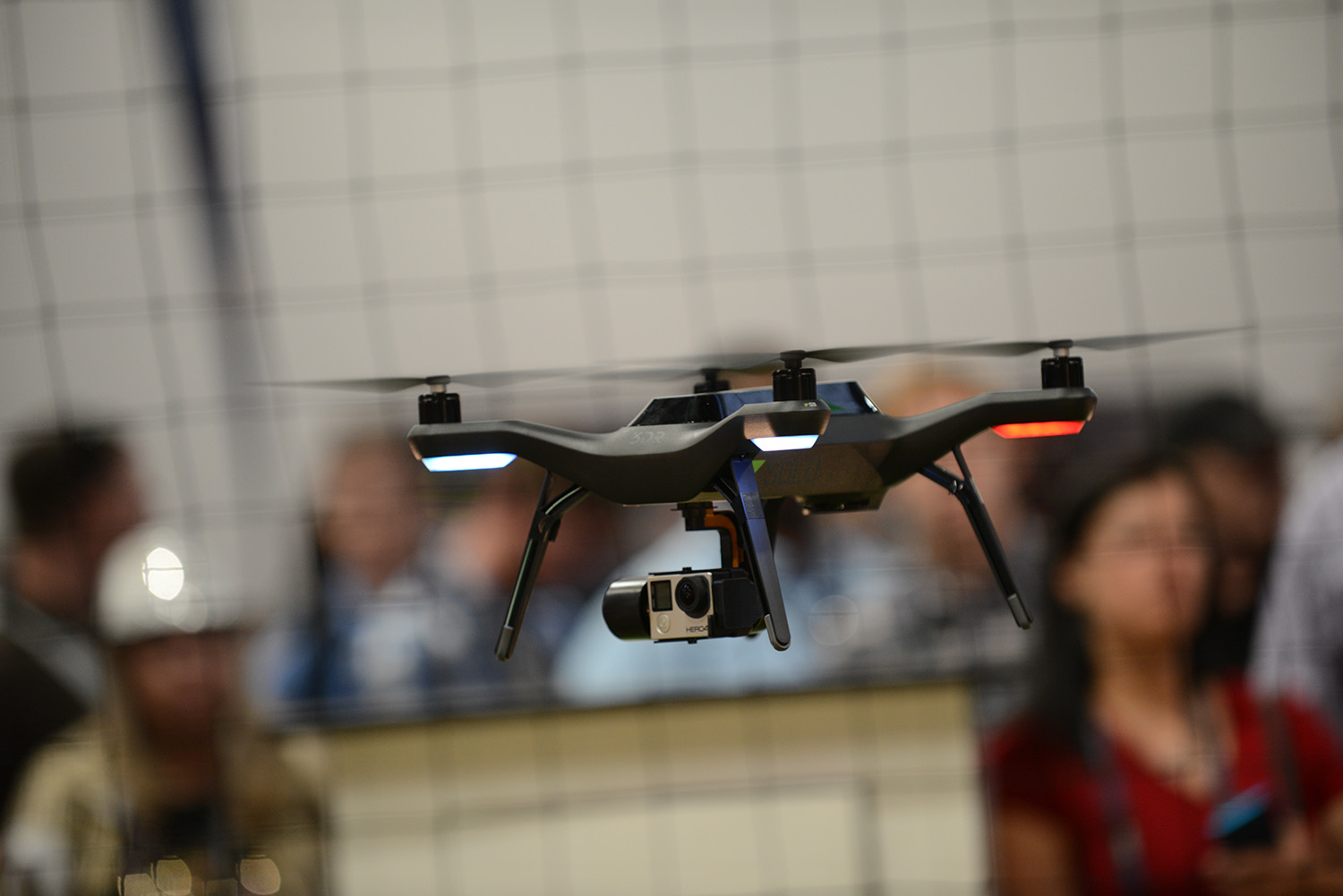
Many companies were demonstrating drone technology
Drone demo on the exhibit floor

Actually, it’s still happening. It’s the annual convention of the National Association of Broadcasters and it will be continuing through Thursday. According to their press release, “With more than 98,000 attendees from 150 countries and 1,700+ exhibitors, NAB Show is the ultimate marketplace for digital media and entertainment.” Conveniently for academics, the Broadcast Education Association annual convention runs concurrently and overlaps the NAB for a few days.

I, along with several of my colleagues from CSU-Pueblo, made presentations, attended sessions and workshops, and toured the more than 1 million square feet of exhibit space. Of course I didn’t see it all. Even if I had been there for the entire 4-day run I would have had a hard time seeing all of the booths, exhibits, and displays.

But I can tell you one thing…in just a few hours today I saw more pixels than some people see in a lifetime. There were 4K displays everywhere, and quite a few 8K displays as well. Monitor walls stretched from floor to ceiling, and there were $50,000 digital cinema cameras everywhere you looked. Companies (including: Adobe, Arri, Canon, Dolby Laboratories, GoPro,  Red Digital Cinema, Sony, and Zacuto, just to name a few) were showing off the latest and greatest hardware and, perhaps more important, software used by radio and TV broadcasters and media content producers. One of the highlights this year is the aerial robotics and done pavilion. Other buzz words for 2015 include UHD (Ultra High Definition), ATSC 3.0, Virtual Reality, and SVOD (Subscription Video On Demand, e.g. Netflix and Hulu+).

So, what was my ah-ha moment? During a State of the Industry report one of the speakers made the point that the media production/distribution industry was moving from hardware to software. More and more of the tools that we use to acquire, edit, manage, and distribute content are primarily software tools. Once media content is digital, software allows us to do any number of things to it in the process of making it available to our intended audience. The future of media production will be less about engineering breakthroughs and more about software development. And in the future most of our media and software will live in the cloud. It’s an exciting time to be in this business.

Couch Potato Dumplings

Question: What do you call someone who binge watches TV shows about binge eating? Answer: Someone who needs to get a life. Sorry if that sounds harsh, but seriously! Apparently the new hit YouTube TV genre in South Korea involves watching people eat.

Mukbang performance artists eat in front of their webcams for live audiences who apparently get a voyeuristic thrill out of the experience. “Rachel Ahn, who goes by ‘Aebong-ee’ on her broadcasts, is kind of a big deal in the mukbang world.” For three hours a night she eats for an audience, and the audience rewards her with virtual prizes that combined amount to a salary greater than her day job.

You can read/listen here on the NPR website.

Sadly, the fact that their neighbor to the north has perennial problems with mass starvation may be lost on these seekers of fame, and their followers.

Are we all ADD now?

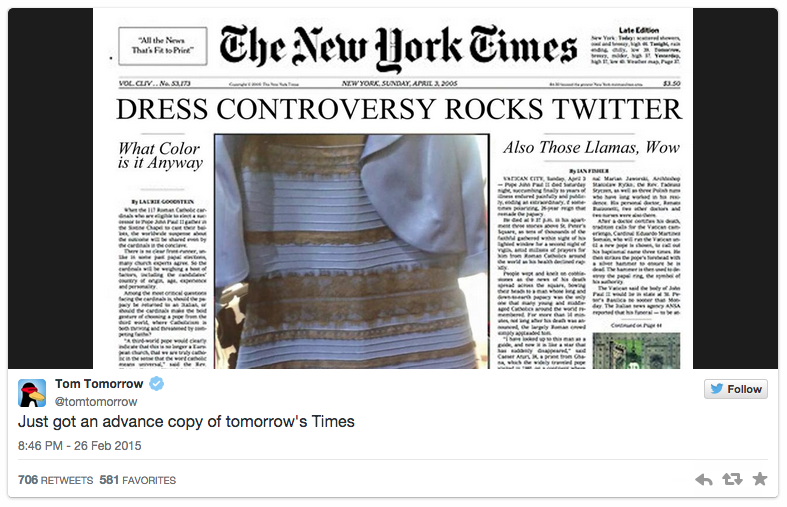
Black and Blue, or While and Gold? It’s the question that appears to have captivated the ever-so-brief attention span of the online world. The more philosophical are asking again the age-old questions; what is the nature of reality and perception?…and, can we ever know for certain what we think we know? Yes I’m talking about #TheDress. And if you haven’t been paying attention, suffice it to say that the “twitterverse” has been embroiled in a heated debate about the real color of a dress that was worn to a wedding in Ireland. Here’s just one of the many tweets having a bit of fun with the whole thing.dress

Well, that was before the llamas got loose in Arizona…which was just briefly before Leonard Nimoy passed away. We are an easily distracted lot, humanity. One might argue that we need a distraction every now and then to give us relief from the pressure and demands of real life.

But seriously, is this what we’ve come to expect from our media? Was there nothing important going on in the world at the end of last week? Oh yeah, there was. “Jihadi John” was  identified as a college grad from West London; Net neutrality was adopted by the FCC (thanks, perhaps, to John Oliver); and a Russian politician, and foe of Putin, was executed on a city street.

But perhaps there is an explanation. According to this article by Mel Robbins at CNN, “the emotions that make a story go ‘viral’ are not fear and anger — they are awe, laughter and amusement.” Well, there you go. I feel just a little better now about #TheDress and #LlamaDrama.

Net Neutrality and the Jester

Net neutrality, the idea that the internet should be an open network where internet service providers cannot restrict or prioritize content from any particular source, is one step closer to becoming the law of the land. FCC Chairman Tom Wheeler outlined his position in an editorial published by Wired magazine, and barring any last-minute hijinks it now appears that the Obama administration will prevail in a long, drawn-out, battle with those (mainly large telecom providers) who have argued that net neutrality will stifle technological innovation and reduce incentives for expanding service.

In late 2014 President Obama staked out his position in a short video calling for the FCC to act to implement net neutrality regulations. In order for the FCC to step in they would need to reclassify the internet as falling under Title II of the Telecommunications Act–essentially treating access to the internet as a public service utility not unlike your phone, water, or electric service. Many argue that the internet has become such an essential part of our daily lives that to be without it is unthinkable.

As I was reading an article in the WSJ about the ongoing debate I came across a paragraph that caught my eye…

At the same time, Mr. Ammori tried to build wider public support for net neutrality. Last May, he spoke with a researcher for “Last Week Tonight with John Oliver, ” the HBO comedy series. On June 1, Mr. Oliver unleashed a 13-minute rant in an episode of the show, comparing Mr. Wheeler to a dingo and encouraging viewers to bombard the FCC with comments.

If you’re not familiar with John Oliver, he was a former correspondent for The Daily Show.  Now that he has his own show he continues to poke fun at serious topics, just as he did when he worked for Jon Stewart. Below is the video by Oliver.

The video was produced and posted in the summer of 2014, so the framing of the debate does not take into account the developments that have transpired since. But the video does two things very well: 1) it explains in easily accessible terms the nature of the debate, and 2) it allows us a few laughs in the process. That may be the genius of Jon Stewart, Stephen Colbert, and now John Oliver. Like court jesters of old, they make their point and wield tremendous influence while we laugh along; while all too often remaining oblivious to the subtleties of their arguments.

Cord Cutters Gaining Options

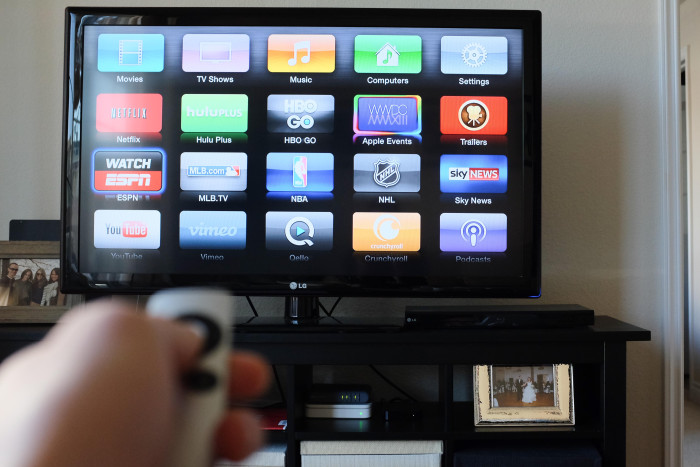
apple-tv-streamThe cable and satellite TV industry is beginning to face the inevitable. With broadband internet widely available on multiple screens, TV viewing options are morphing from the traditional fixed time and space (appointment TV in your living room) to flexible viewing (anytime, anywhere). Having resisted a la cart pricing for many years, cable and satellite TV providers are slowly coming to terms with the future…and hoping that they haven’t waiting too long to become viable players in a future where content is packaged by the buyer–not the seller.

In the past if you wanted access to broadcast and cable network programming you had, at most, only a few options. Depending on where you lived you could subscribe to cable (basic and tiered packages at prices ranging from $50-$100+ per month), satellite (pretty much the same deal but with a dish instead of a wire), or, in some markets, a variation known as wireless cable. Or, (see my earlier post), you might consider OTA (Over The Air) broadcast TV for only the cost of an antenna!

Most of these “packages” were available directly from the provider or bundled with your phone and/or internet service. Telecom and cable providers rushed to create packages of video, voice and data (i.e. television, telephone and internet) and the result was often a monthly bill between $100-$200.

But Millennials have been slow to buy in to these marketing plans. Tech savvy and often financially squeezed, they have looked for other, (read, less expensive) alternatives. These alternatives still required internet access or a data plan on their phones…but landline phones and cable/satellite TV were for older folks, e.g., their parents, and seemed redundant at best. With so many media options literally at their fingertips, younger consumers found that a mix of YouTube (seriously?, you need a link for YouTube?), Hulu, and Netflix provides a wealth of “television” programming without the sticker shock.

The problem is that, up until recently, live sports were seldom available online (unless you wanted to watch a choppy stream from some former Soviet-bloc website). But DiSH TV’s Sling TV (their slogan is Take Back TV), will soon be offering a basic package available for $20/month that will include ESPN, ESPN2, Disney Channel and CNN along with a handful of other popular networks. All you need is a smart TV or one of several streaming devices (e.g., Apple TV, Roku, Chromecast) and you’re in business. Or just sign up and watch on your computer, tablet or phone. In either case there is no long-term contract to sign. However, if you need your DVR’s time-shifting capability, or your weekly fix of Mad Men or The Walking Dead, Sling TV may not be for you. But others may find that it’s time to Take Back TV!

One other significant development is that cable networks and program providers are beginning to offer stand-alone streaming packages. In addition to deals announced last year by HBO, Showtime, and CBS, you can now subscribe to Nickelodeon, Comedy Central, and Sesame Street via Google’s Chromecast service, and the necessary hardware will only set you back a one-time fee of $35.

As you can see it will be fairly easy to cobble together some sort of TV programming package from a variety of sources to build a customized set of choices–and probably for a good bit less than you’d pay for a cable or satellite package.


Hacking, Journalism, and Moral Treason

The hack of Sony Pictures and subsequent release of salacious emails and other confidential information has been the talk of the town (read Hollywood) in recent days. Much of the information obtained by the hackers (aka Guardians of Peace) is very personal and potentially damaging to careers and reputations of employees, executives, and celebrities connected to Sony. Medical records, compensation packages and their private negotiations…even jokes about President Obama that have a racial component…are on display for all to see.

But the hackers alone cannot do serious damage to Sony without the willing participation of journalists. What the hackers have stolen, journalists are now distributing with the protection of the first amendment and the claim that these are important and relevant issues to be discussed in a public forum.

But not every one is willing to give the news media a pass when it comes to reporting this story. Appearing on Howard Stern’s radio show, Seth Rogen (co-star of The Interview) claimed that journalists are profiting from doing exactly what the criminals/hackers want.

Television writer Aaron Sorkin has been another outspoken critic saying, “Every news outlet that did the bidding of the Guardians of Peace is morally treasonous and spectacularly dishonorable.” Sorkin acknowledges, in his op-ed piece in the New York Times, the importance and role of the media when it comes to whistle-blowing and exposing wrong-doing, e.g. the Pentagon Papers. But he makes a clear distinction between that and these gossipy morsels that have little or no value for the preservation of democratic ideals.

As demented and criminal as it is, at least the hackers are doing it for a cause. The press is doing it for a nickel. ~Aaron Sorkin

I suppose one could argue that this hack reveals facts relevant to issues of importance: gender disparity for celebrity compensation, race-tinged jokes about the President by Sony execs who support him and gave to his political causes, and allegations of journalistic malpractice by New York Times columnist Maureen Dowd. But these exceptions are not what’s generating all the buzz on blogs and social media.

Not too long ago when nude celebrity pictures were hacked from the cloud “real” journalists were careful to keep their distance for fear of being seen as accomplices to the crime. But this time the “gift that keeps on giving” has fewer detractors and the benefit of readers’ fascination with celebrity culture. The hackers have promised a “Christmas gift” of new information while Sony’s lawyers are sending threatening letters to news organizations in an attempt to discourage further dissemination. But if there’s one thing on which we can be fairly certain, it’s that attacking journalists won’t go over well.

Uber’s Image Problem

UberPerhaps you’ve heard of Uber, the smartphone-enabled ride-sharing alternative to traditional taxis. Uber, along with Lyft and Sidecar, work on the premise that a person with a car can offer a service to someone who need a ride, and make a few bucks in the process for both the driver and the company. Now that most everyone has a smartphone–and with real-time location services knowing your every move–connecting drivers and riders is really pretty simple.

But Uber, like the other start-ups, has a few natural enemies. Taxi cab companies don’t like having their business syphoned off by competitors who are not licensed and have little to no overhead.

But it is Uber’s CEO and a senior VP who may become the company’s greatest liability. CEO Travis Kalanick, whose aggressive leadership has been credited with the quick rise of the company, has ruffled more than a few feathers with his aggressive business practices. Uber has been accused of violating its own privacy policy and tracking users for suspect reasons. (You can read more about that on the ACLU blog.) And recently, Uber VP Emil Michael has suggested that Uber should investigate journalists who have been investigating Uber.

Specifically Michael targeted Sarah Lacy, co-editor of the Pando Daily website. Lacy has been critical of Uber’s treatment of women and has been leading the call for Uber to clean up its act. And for that, according to The Tech Bulletin, “A top executive of Uber explained a Nixonian plan to dig up dirt on the journalists who are critical towards Uber and sully their reputations.”

One doesn’t have to be a PR pro to see that this is not a smart move by Uber. Picking a fight with journalists is seldom a good idea. As Bill Greener, press aide to Gerald Ford and Donald Rumsfeld in the 1970’s once said, “Never pick a fight with someone who buys ink by the barrel” (Lewis).

css.php