Stolen Valor Debated by the Supreme Court

A law that got its start at CSU-Pueblo has made its way all the way to the Supreme Court where, this week, justices debated when it becomes a crime to tell a lie. In this case the lie is about being a recipient of  a military medal.

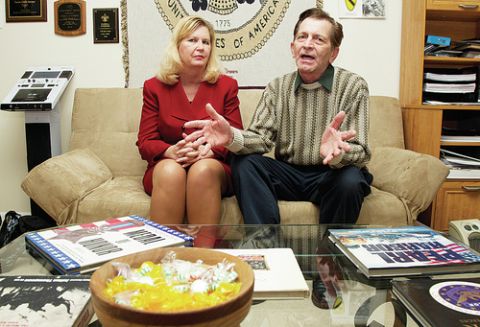
The Stolen Valor Act of 2005 got its start as a college paper written by Pam Sterner when she was a student at the University of Southern Colorado, now renamed CSU-Pueblo. Pam and her husband Doug are seen in this photo taken in their home in Virginia where they now live. According to the Daily Herald,

Pam Sterner went back to school in her early 40s at Colorado State University in Pueblo, Colo. In a political science course, she wrote a paper that grew out of her husband’s frustrations over phony award claimants whose worst punishment was public embarrassment. That paper eventually led to the Stolen Valor Act.

What is the significance of the Stolen Valor Act for students of the media? The Supreme Court will make its judgement based on whether the law is consistent with the 1st Amendment to the Constitution and its protection of free speech. Opponents of the Stolen Valor Act are concerned that defense of the law could lead to additional restrictions of free speech. The 1st Amendment is the most important legal protection for the media industries because of it protects not only personal speech, but it also protects the press which is broadly understood as media of all kinds. The 1st Amendment protects a broad array of speech, including speech that is mean-spirited, unpatriotic, and worse. [See a previous post on this blog which examined the protection of protests at military funerals.]

Lying about one’s exploits is not new nor unique to claims of military honors. As one person said in response to the debate over false claims of heroism, “there are only a six hundred Navy Seals in total. But in bars around the country, on any given Friday night, there are three times that number.”

Pink Ribbons and PR Missteps

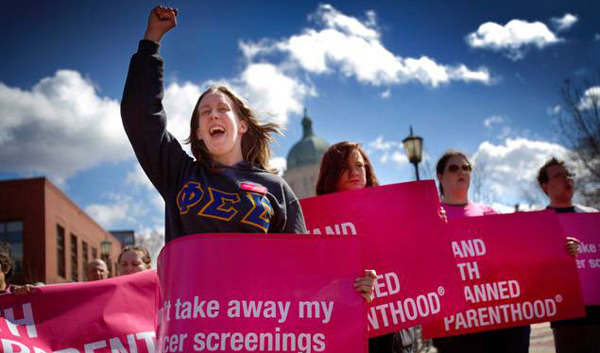
The social media buzz machine turned into a buzz saw late last week for the Susan G. Komen Foundation. If you’ve been anywhere near this social media maelstrom you know that the Komen Foundation has taken a major hit for its decision to cut funding to Planned Parenthood, and then reversing the decision, all within a 72-hour period. According to Advertising Age, the incident “showed how a brand can boomerang from one of the most loved into one of the most reviled in a head-snapping two days.’’

First a little background. Over the years the Komen Foundation, and their Race for the Cure, has raised billions of dollars for diagnosis, treatment and research of a disease that kills about 110 women every day in this country. The foundation gives away tens of millions of dollars every year and some of that money, about $700,000, had been going to Planned Parenthood. Planned Parenthood was using that money to provide screenings and mammogram referrals to women who might not otherwise be able to pay for these services. But Planned Parenthood is also the largest provider of abortions in the US, and that has resulted in close scrutiny by members of congress who want to ensure that government funds are not being used to provide abortions. Planned Parenthood is currently under investigation by congress with regard to its financial dealings and that was the initial reason cited by the Komen Foundation as to why they were withdrawing funding from Planned Parenthood. However, as negative responses mounted the story began to change. The Foundation countered that Planned Parenthood does not provide mammograms, only referrals, and that this change in funding was about being more responsible stewards of precious resources. You can see their initial response in this YouTube video.

Proponents and opponents have taken sides, sometimes determined by their view on the always-contentious topic of abortion. Critics of the Komen Foundation’s decision to halt funding to Planned Parenthood saw the decision as knuckling under to political pressure from the pro-life lobby. As you might guess, the reversal fired up the pro-life crowd who had been pleased with the earlier decision.

This blog is not a forum to debate the relative merits of either side in the culture war raging around abortion, but this case-study provides an opportunity to observe how a non-profit, known for years of service in the battle against breast cancer, could so quickly find itself under attack by many of the people that it claims to serve. The power of social media to aggregate discussions and dissent is once again center stage. Reaction to SOPA and PIPA last month, and now this…demonstrates the raw energy that can be focused by the impassioned use of  these modern-day megaphones. There’s another angle that students of media should consider. How you learned about this event may also be shaping your understanding of the issues at stake. According to an op-ed in the NYT, the media’s coverage of the story has been biased by the media’s failure to understand the perspective of those on the pro-life side of the issue.

Part of the problem facing Komen is that they appear to be giving in to political pressure…first from pro-life, then pro-choice, political operatives. Even after issuing an apology for their earlier decision plenty of anger remains. Some of their funding sources are now saying that they will stop giving to the Komen Foundation and only time will tell if the Foundation can bounce back from this misstep.  Somewhat ironically, both the Komen foundation and Planned Parenthood are reporting increased giving in the wake of the scandal. Planned Parenthood reported that it had raised $3 million in a 72-hour period, including a $250,000 pledge from NY Mayor Michael Bloomberg.

Additional Resources: Kaiser Health News has collected summaries of news organizations’ reports on the debate.

NOTE: if you respond to this post please do your best to keep your comments focused on the media issues related to the story.

Think Twice about SOPA and PIPA

If you plan to work in the media industries as a professional content creator, you need to pay close attention to the current debate over SOPA and PIPA. The two bills being debated in congress are designed, with substantial input from lobbyists representing “old media” interests, to shut down global websites that profit from the illegal distribution of copyrighted material: music, films and TV shows primarily. The issue is being framed by internet and new media companies (largely located in Silicon Valley) as a battle for internet freedom of expression and the rights of end users. Several major internet sites have gone black today or have modified their home page to express solidarity with the protest movement. But what about the rights of individuals and companies (largely located in NY & LA) that create media content?

Much of the early discussion that I’ve seen on Facebook and Twitter has bought into the new media companies’ arguments that this attempt to curtail copyright infringement will stifle creativity and growth on the internet. Others argue that the regulatory oversight will amount to censorship of creative expression. This is completely understandable from the perspective of those who are end users of content rather than creators. For the average consumer, more access to free content seems like a good thing. However, if you’re thinking that you’d like to work in the media industry as a content creator, you might want to consider what the future holds for you if creativity is not rewarded and protected.

Copyright laws exist to protect intellectual property and to reward the creative community for their investment of time and resources in the creative development process. Music, video and film content does not create itself, and those responsible for its creation and distribution deserve legal protection from those who would like to acquire, redistribute, or aggregate that content for their own personal or corporate benefit.

Now, while it may be clear that I am in favor of reasonable protection for copyright holders, I am not convinced that SOPA and PIPA are well-designed legislative tools to accomplish that goal. The video below points out some of the weaknesses of these bills and raises serious questions about their practical application.

[vimeo http://www.vimeo.com/31100268 w=398&h=224]

So, what do you think about SOPA and PIPA? Bad idea? Good idea? Good idea poorly executed?

Indecency on trial

How do you define indecency? Do you know it when you see it? Or hear it? Are fleeting expletives indecent? Or does it depend on the context? And most importantly, with hundreds of thousands of dollars of fines at stake, who gets to decide what is and what isn’t indecent? The National Association of Broadcasters recently filed an amicus brief to the Supreme Court arguing that the FCC’s enforcement of indecency rules is too vague and subjective, making it impossible for broadcasters to know what content might be subject to fines.

Some are wondering whether this brief is part of a larger effort to relax indecency regulations for broadcasters. Broadcasters, who have historically been much more restricted than cable networks when it comes to language, sex and violence, have felt that this differential treatment puts them at a disadvantage in an increasingly competitive environment. However, according to a quote published in Broadcasting & Cable, NAB spokesman Dennis Wharton said, “We do agree with the networks and the Second Circuit that the FCC’s indecency policies are unconstitutionally vague and chill broadcasters’ protected speech. However, we do not call for the overturning of Pacifica or Red Lion.” Wharton’s references to “Pacifica” and “Red Lion” refer to Supreme Court cases that are foundational to broadcast regulation.

The debate has heated up in recent years after several incidents of offensive language on live awards shows and scripted nudity on NYPD Blues attracted the attention of Parents Television Council. The recent overturning of the $550,000 fine against CBS for the now infamous wardrobe malfunction in the 2004 Superbowl halftime show suggests that the courts are less inclined to side with the FCC. What do you think? Has indecency enforcement been too aggressive, too lax, or too uneven?

What is Herman Cain’s Communications Director Smoking?

We’re quickly approaching an election year, and you know what that means…political ads 24/7. More and more we’re seeing ads launched and tested online where ROI can be extremely high if an ad goes viral. Even better is an online ad that attracts the attention of traditional media. The result is free exposure when broadcast and cable news outlets spend precious airtime talking about or even screening the online ad.

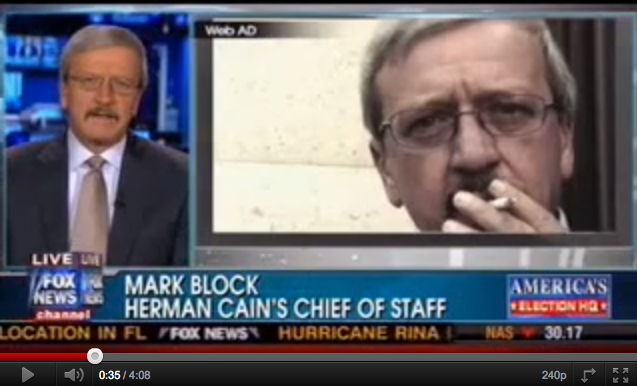
That may be the strategy behind an online ad for Herman Cain, who is running for the Republican nomination to challenge Barak Obama in the 2012 Presidential race. The ad, with more than 1.2 million views and counting, features Cain’s chief of staff Mark Block who, at the end of the spot, takes a drag on a cigarette. You can watch the ad on [Youtube]. This is an unconventional approach, to say the least. As Block says in the spot, “we’ve run a campaign like nobody’s ever seen.”And while Block says the ad is not intended to promote smoking or to send a subliminal message, that’s not stopping media critics and journalists for looking for the subtext beneath the subtext. Some are suggesting that it is defiant gesture towards the nanny-ism of Big Government that wants to tell people what they can or cannot do.

Another bazaar web ad is the long-form, He Carried Yellow Flowers. Conner Friedersdorf at the Atlantic calls it a “Dadaist Meta-Western.” I don’t know where to begin with this one, so I encourage you to watch it on [YouTube] and leave your comments below. What do you think is the message? And does it make you think of Herman Cain as a viable contender for the office of President of the United States of America?


Social Media and the OWS Movement

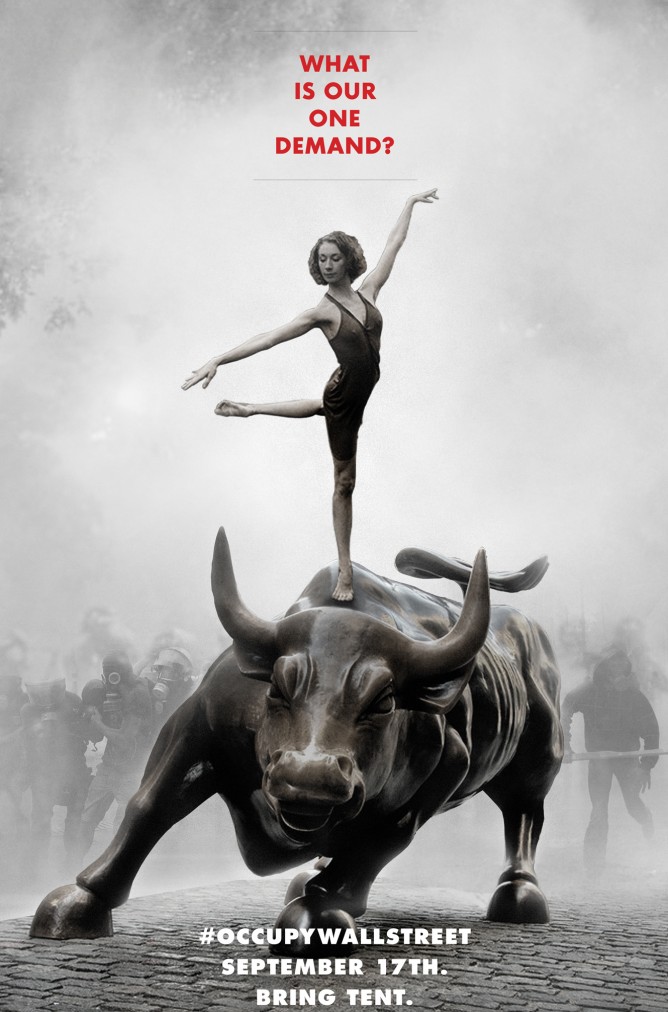
The Occupy Wall Street movement has been generating a lot of attention from the mainstream media in recent weeks. According to a report in the NYT, media coverage has been increasing as the movement gains strength and spreads to other cities. The proximity of the protestors to the nerve center of the US news industry, just blocks away in NYC, certainly helps. Organizers have also worked hard to create stories that the mainstream media are likely to cover, including orchestrated attempts to obstruct traffic and confront police.

The protestors have demonstrated some media savvy as indicated by a sign held by one protester-“Whoever controls the media, the messages, controls the culture.” They’ve got a website and they even have a print publication devoted to getting their story out. The Occupy Wall Street Journal is being supported  using funds raised by a Kickstarter campaign called Occupy Wall Street Media which has raised more than $75K to date. You can find their first issue on Google Docs here. On the Kickstarter site you can view a 3-minute video that includes sound bites from Michael Moore, a documentary filmmaker who has made a career championing the cause of the working class. Speaking of documentaries, the Academy Award winning doc from 2010, Inside Job, is an eye-opening look at the 2008 crash and subsequent attempts to deal with the financial mess that ensued. If you really want to understand the frustration being directed at Wall Street, big business, and the government this documentary would be a good place to start.

But just like the Arab spring and the Tea Party movements that came before, another factor that has helped the OWS movement gain attention and momentum is the use of social media. According to Jeff Jarvis, professor of journalism and author of the blog BuzzMachine, “#OccupyWallStreet is a hashtag revolt.” Jarvis goes on to explain that, “a hashtag has no owner, no hierarchy, no canon or credo. It is a blank slate onto which anyone may impose his or her frustrations, complaints, demands, wishes, or principles.” Using Facebook and twitter is neither new nor innovative in late 2011, but it is and will be an essential part of any current and future populist movement. The raw power of unfiltered, instantaneous mobile communication cannot be denied. The fact that mainstream media are taking their cues from social media certainly helps. While social media is a powerful tool for coordinating and inspiring participants in a populist movement, the mainstream media brings the movement to the attention of a much larger segment of the population.

In an interesting twist with conspiratorial overtones, some have accused twitter of censoring the OccupyWallStreet hashtag and downplaying the size of the twitter stream that is being generated. This alleged censorship may be the result of a cosy relationship that twitter has with investment banks on Wall Street, according to one report.

It is also worth noting that the OWS movement was instigated by the Adbusters organization out of Vancouver, Canada. Adbusters may be best known for their anti-consumerism and anti-capitalistic positions on advertising and consumption. The Adbusters media foundation is, according to their website, “a global network of artists,  activists, writers, pranksters, students, educators and entrepreneurs who want to advance the new social activist movement of the information age. Our aim is to topple existing power structures and forge a major shift in the way we will live in the 21st century.” The Adbusters organization is also known as sponsor of annual social marketing campaigns like Buy Nothing Day and Digital Detox Week.

Whether the OWS movement has legs and can reach critical mass may become evident on November 5th when, according to the Christian Science Monitor, “consumers are being urged to transfer their bank accounts from large, national financial institutions to community banks and credit unions.” If this movement grows, and hundreds of thousands close out their bank accounts, we’ll know that this is not just a fringe movement of leftists and anarchists.
Thank You & Goodbye

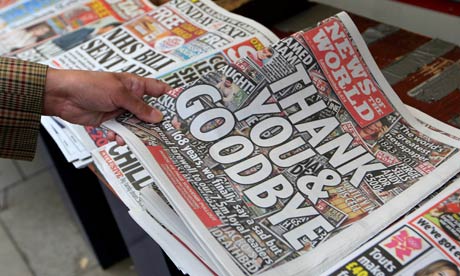
Last Sunday Rupert Murdoch’s tabloid News of the World was laid to rest after 168 years of operation. A scandal in which private individuals’ cell phones were hacked led to the public outrage that forced the closure. While politicians and celebrities, including Hugh Grant, have long complained of phone hacking by tabloid reporters, it was the hacking of the phones of  private citizens that brought strong criticism and investigations by law enforcement. Among those hacked: 13-year-old missing person Milly Dowler, relatives of victims of the London terrorist attacks and the families of fallen military.

Throughout history journalists have been rewarded for “scooping” the competition. The paper or news organization that got the story first was rewarded with the largest audience and the accolades of their peers. The challenge, of course, is knowing when to stop before aggressive journalism crosses the fine line that separates ethical from unethical practices. While this case appears to have focused attention on an unusually egregious lapse of ethics, the truth is that journalists push the envelope daily and often escape scrutiny. Sometimes the risk pays off in a big way. Other times it leads to someone getting fired–or an entire news operation being shuttered and hundreds of people loosing their jobs.

Climate Change Getting the Cold Shoulder

Early last year I wrote about the PR problem facing the global warming community. As I noted then, public interest in efforts to address global warming has fallen dramatically from earlier times when Al Gore’s documentary An Inconvenient Truth was perceived as, well, truth.

Much has changed since then, including a global recession that has taken the edge off of long-term efforts to avert possible or probable ecological disaster. Ask an out-of-work environmentalists about climate change and you may find that he is much more focused on finding a short-term solution to his economic hardship.

Another setback for the movement was the “climategate” scandal in which stolen emails suggested that climate scientists were hiding contrary data in an attempt to prop up their theories. This fall from grace was too much for some climate-change supporters who jumped ship and joined the ranks of skeptics.

Thirdly, the fact that Europe and the US have experienced a colder-than-normal winter with record snowfalls in the mid-west and east coast hasn’t exactly helped the climate change cause.

In light of the set-backs, those who want to keep climate change front and center are struggling to promote their cause.  A recent article in Der Spiegel highlights the failure of climate change advocates to find a compelling visual or spokesperson to make their case. And without a compelling hook, the climate change story has moved off the front page. (That’s a newspaper metaphor for those of you under the age of 45 who don’t read newspapers.) To try to get the story back in the limelight, climate change evangelists are resorting to marketing tricks like those mentioned in the Der Spiegel piece.

Things may change…actually, they always do. Perhaps they’ll find a compelling narrative that renews interest and concern on the part of the public. But for now, the climate change story is a hard sell to a jaded public that is significantly more interested in short term comfort and the latest tabloid gossip than a far-off environmental nightmare that may, or may not, be headed our way.

Questioning Motives

It’s still much too early to figure out what motivated Jared Lee Loughner to shoot 19 people, killing six, on Saturday…but that hasn’t stopped many from speculating. News pundits, reporters and commentators have lined up to offer their opinion of what was behind the tragic and atrocious act. On the ride home today I listened as a radio reporter speculated that political rhetoric, amplified by the media, was to blame for the shooting.

Perhaps what has been most disconcerting has been the eagerness of some to score political points by ascribing motives to Loughner that fit their personal political views. Yes Representative Gabrielle Giffords is a Democrat from a Republican district, and yes she had previously been the recipient of heated rhetoric from those who opposed her policies. But too many in the media (both mainstream and online) are trying to link the actions of a madman to social movements and political activism which may or may not be responsible.

Even the local sheriff, Clarence W. Dupnik, weighed in just hours after the shooting with his opinion linking the tragedy to “vitriolic political rhetoric.” Others suggested that talk of “second amendment remedies” and maps with cross-hairs used to target political races across the country, including Giffords’ district, were to blame. There MAY BE a connection between heated political rhetoric and the actions of Loughner, but it is too soon to try to connect the dots when one of the dots is clearly not dealing with a full deck.

Please don’t mistake my objection to those placing blame for anything less than complete repudiation of Loughner and his heinous act. Blame should–and will–come to rest on Loughner, and anyone or anything that contributed to his decision to use deadly violence. I’m simply saying that to make pronouncements about causal relationships so soon after such a shocking event says more about the motives of the speaker than it does about the motives of those under the microscope.

UPDATE: According to Broadcasting & Cable magazine, Rep. Bob Brady (D-Pa.) is working on a bill to make it a federal crime to use “language or symbols” that could be interpreted as inciting violence against a member of Congress.

UPDATE 2: I just came across a thoughtful commentary from Jon Stewart’s show last evening that addresses this very issue. Stewart said, “you know we live in a complex ecosystem of influences and motivations, and I wouldn’t blame our political rhetoric any more than I would blame heavy metal music for Columbine, and by the way that is coming from someone who truly hates our political environment.” Read and/or watch more here.

The End of Secrecy?

Julian Assange, the Australian founder (and some might say diabolical mastermind) of WikiLeaks, would like to put an end to secrets. And now, modern internet technology is bringing us closer to that reality. For as long as there have been secrets, people have been revealing them. A few months ago a college student outed his gay roommate by using a strategically placed webcam connected to the internet. The same global internet technology is now being used to anonymously distribute state secrets and classified military documents to a global audience.

I’ll briefly summarize recent events in the news. A 22-year-old Army PFC by the name of Bradley Manning is alleged to have downloaded hundreds of thousands of classified military and diplomatic documents while on assignment in Bagdad. Manning then allegedly gave the documents to Julian Assange and WikiLeaks – an organization of volunteer hackers devoted to, depending on whom you believe, “opening governments” or destabilizing the US and other world powers.* Because of the structure of WikiLeaks, the identity of leakers is protected by destroying any link between documents and their source. The reason Manning is a suspect is because he bragged online that he downloaded the docs and copied them onto his home-made Lady Gaga CD to make it easier to get them past security.  WikiLeaks has made several “dumps” of these documents over recent months, the most recent being this weekend’s release of approximately 250,000 documents related to world diplomatic efforts. One world leader called it the “9/11 of diplomacy.”

It should be noted that WikiLeaks is not acting alone. First, WikiLeaks’ technical infrastructure is supported by servers rented from Pirate Bay and Amazon (Update: according to the NYT, Amazon has booted WikiLeaks from its servers). Additional server resources have been necessary as WikiLeak servers have suffered DOS attacks at the hands of a self-described “hacktivist for good” who goes by the name of the Jester. Second, WikiLeaks depends on disgruntled insiders to feed it with information. And third, and perhaps most importantly,  it needs the cooperation of the world press to make its actions visible to society. In this most recent case WikiLeaks has the cooperation of the New York Times in the US, and the Guardian in the UK. Once leading mainstream media report on document releases the story is out and the effect is fully realized.

This the not the first time the NYT has been involved in a leak of US government secrets. Perhaps the most famous example is Daniel Ellsberg and the Pentagon Papers. In late 1969, Ellsberg used an earlier technology (photocopying) to leak classified military papers to the NYT and other newspapers. Convinced that the US government was misleading congress and the American public, Ellsberg acted hoping that the revelations revealed by the documents would force the government to change course. Many believe that the release of the Pentagon Papers was a significant turning point in our commitment to the war in Vietnam. Time will tell if Pfc. Bradley Manning’s actions will have a similar effect on the wars in Iraq and Afghanistan. In the mean time, those who believe that his actions are those of a patriot, and not a traitor, can join the Bradley Manning Support Network here.

The recent actions of WikiLeaks remind us of the challenge of balancing first amendment freedom and national security in a modern world where technology allows us to set in motion significant actions with a few clicks of a mouse. And while the ends sometimes justify the means, it is also true that actions taken for what may appear to be a noble cause may have far-reaching implications that demand and deserve careful consideration.

P.S. It’s not easy being a rogue leaker. US Senators are calling for Julian Assange to be tried under the Espionage Act of 1917. Assange, who is already on-the-run, is now listed on INTERPOLs Most Wanted List for an alleged crime of rape and molestation that took place in Sweden. Not surprisingly, the timing of these allegations is questioned by WikiLeak supporters.

*There is an interesting interview on TED Talks that will give you some additional background on Assange.

css.php