Copying is Not Theft…Or is it?

[youtube=http://www.youtube.com/watch?v=IeTybKL1pM4&feature=player_embedded]

This video is a rather “cute” argument in favor of digital copying, but the logic has some serious flaws. As YouTube commentator “spare2288” noted (with a little ad hominem thrown in for effect), “Copying is not theft. okaaaay. Also, theft is wrong. uhh yeahhh. Therefore copying is not wrong. hmm…sorry are you a moron?”

On another blog, “Anonymous” said, “I’m sure the manufacturer of the bicycle in the cartoon will be glad that making a copy of the bicycle is so easy. This will free him from the burden of actually manufacturing and selling bicycles which used to be a high-paid technical position. User-generated copying saved him just like it saved the music industry.”

If you’re a bicycle maker, or musicians, having people copy your work for free may not put you in the mood to sing along with this catchy little tune.

What Have We Become?

Sociologists, psychologists and others who study popular culture have been lamenting the decline of civil discourse for decades. Recent events have brought to light disturbing behavior that will, once again, become fodder for those of us who wonder about the role that media plays in the coarsening of communication.

First up, a text message exchange that led to the brutal beating of a 15-year-old female middle school student in Florida. According to the Washington Post, a 15-year-old male is being charged with premeditated attempted murder of his 15-year-old victim after repeatedly punching and stomping her with steel-toed boots. The boy’s 13-year-old girlfriend is being charged as an accomplice for pointing out the victim. This was necessary because the accused had never met his victim before the assault. But they HAD exchanged text messages in which the victim voiced disapproval of the relationship between the two accused teens. According to reports, the text exchange may have also included a reference to the fact that the boy’s older brother had recently committed suicide.

This past week has also seen passage of historic domestic legislation that will have enormous consequence for future generations. As Vice President Joe Biden exclaimed on live TV,  it’s a “big f***ing deal.” The Health Care Reform Bill passed by congress and signed into law by President Obama has been hotly debated and continues to generate strong passions on the part of supporters and those who oppose the bill. Some of those who oppose the bill have been accused of yelling racial epitaphs at members of congress and spitting on one member. ABC News has reported that the name calling on twitter has degenerated into calls for Obama’s assassination. According to ABC,

Another Twitter user who called himself THHEE_JAY and was identified as Jay Martin, tweeted “You Should be Assassinated!! @Barack Obama.”

Martin, who is black, followed his tweet, writing “If I lived in DC. I’d shoot him myself. Dead f***ing serious.”

Both of these instances offer sad commentary on the current state of human nature. But they also highlight the somewhat frightening tendency for online communication to quickly degenerate into exchanges that cross the line of what is acceptable in other contexts. If and when online conversations spill over into real-life actions we reap the tragic consequences.


One more about Accuracy…for now

apOkay, I don’t want to beat a dead horse or overstay my time on this particular soapbox, but here’s one more article (this one from the AP) that raises serious concerns about recent misfires in major media coverage. The following quote, from the end of the linked article, captures the essence of the change that is sweeping the news business…pushed largely by the 24-hour news cycle of cable TV and the minute-by-minute updating possible on the web.

Nowhere was the new landscape more vividly illustrated than this month when Nick Denton, chief of the irreverent Web site Gawker.com, issued a memo scolding his staff for a few cases “where we’ve thought WAY too much before publishing” a story.

Get something out fast with what we know, Denton wrote. We can always update.

“At some media organizations, you might get rapped for running a premature story,” he wrote. “At Gawker Media, you’ll lose way more points for being scooped on a story you had in your hands.”

Balloon Boy Makes My Point

hoaxWhen I posted my blog entry about accuracy in the media last week, it was the day before the Balloon Boy story broke. Since then we’ve been served a non-stop drama that started with a young child at risk, progressed to a possible media hoax, and reached a crescendo with apparent criminal charges filed against parents Richard and  Mayumi Heene. The media circus that gave birth to the spectacle is now feeding off of the dead carcass and will continue to do so until all that remains are bleached bones. Would-be actors who craved instant fame got infamy, which they will now try to peddle to unscrupulous reality show producers and tabloid publishers. There’s even an online video game based on the whole sordid affair. The one bright spot in all of this, if there is one, is that Colorado law prevents criminals from profiting from their criminal actions. Forgive me if I come across as harsh and skeptical…but perhaps a healthy dose of skepticism was what was needed last Friday.

Modern Day Pirates Run Into Trouble

Pirates, pirates and more pirates

Pirates have been  making a lot of headlines lately. Jack Sparrow has become a bankable asset in Hollywood. Somalian pirates have been on the prowl off the eastern coast of Africa stirring up trouble. If you’ve been watching the news you know that several Somalian pirates were dispatched last week by Navy Seal snipers. But it is the third photo of modern day pirates that is most applicable to discussions of media and society because of the issue of intellectual property (IP) rights. The pirates in the third picture are the founders of The Pirate Bay, a BitTorrent tracking website that connects file sharing parties. Recently they were convicted by a Swedish court of assisting in copyright infringement and sentenced to one year in prison and fined $3.6 million.

Media piracy is an ongoing problem for media companies. Music was the first media format to experience widespread piracy but movies, videogames and other media are also “shared” by both friends and strangers. People who wouldn’t think of shoplifting don’t bat an eye at the thought of downloading media without paying. Somehow the idea that media companies and content producers make plenty of money becomes justification for behavior that, despite its illegality, does not seem to be slowing.

Whether or not you view IP infringement as theft may depend on your place in the content food chain. If you’re a content producer (or hope to be one in the future) you may be more inclined to view piracy as theft. Here’s what Sir Paul McCartney had to say about the Pirate Bay verdict. Link to Sir Paul McCartney

$6 Billion for Broadband in Obama’s Stimulus Package

BroadbandOne of the first tasks for the new administration is to propose and pass a stimulus package to kick-start the ailing economy. One small part of the package currently being proposed is about $6,000,000,000 for broadband internet service, particularly for the 7-8% of Americans living in rural and underserved areas where broadband is unavailable and dial-up connections provide only 56 kbps. The US has already fallen behind the developed world and stands at 15th in terms of number of broadband subscribers per 100 residents. According to a recent report, this is critically important because broadband creates jobs. According to the Brookings Institution, for every percentage point increase in broadband adoption, approximately 293,000 jobs are added.
Not only are we lagging behind in the global race for connectivity, our broadband connections are often much slower than what is available in other countries. According to one report, the median download speed in the U.S. is 2.35 Mbps. Compare that to Japan whose median speed is an amazing 63.60 Mbps. And while fiber optic to the home (FTTH) is one approach to increasing bandwidth, new technologies in the works for cable modems offer great promise at much lower cost. Using a technology called Docsis 3, several cable TV channels can be combined to offer Internet service approaching 1 gigabit per second. At that speed you could download a two hour Hollywood movie in well under a minute. But while entertainment media is the driving force behind broadband adoption, the stakes are high for less exciting, but more important tasks. Telemedicine,  better access to online education and telecommuting are clear benefits that stimulate the economy when high-speed connectivity is universally available.

One last related issue is the battle over network neutrality. This is the idea that digital data delivered over public and private networks should not be restricted, regulated or controlled except those controls that address legal issues such as copyright infringement and other illegal actions. It is very possible that this $6 billion infusion will come with requirements that the major telecommunications businesses that own the fiber optic networks, and ISPs, practice net neutrality.

Suicide on the Small Screen

In recent days two events have focused our attention on the sometimes volatile combination of teen angst and social media websites. The first was the “broadcast” suicide of a 19-year-old man who took an overdose of prescription medications while a chat room of onlookers watched his live web cam stream. Some of the viewers urged Abraham Biggs on–either indifferent to his threats to take his life or willing to take the chance that he was bluffing. Perhaps it is not much different from sidewalk gawkers calling out to a would-be suicide victim to “jump” and “get it over with,” but it still suggests a calloused indifference and sense of alienation that comes from a failed sense of community.

The second event was the jury trial of the woman accused of cyber-bullying in the Megan Meier case. The internet hoax resulted in 13-year-old Megan taking her life after being dumped by a fictitious male character created by the 49-year-old defendant Lori Drew. While found not-guilty of violating the more severe Computer Fraud and Abuse Act, Drew was found guilty of three minor offenses including the violation of MySpace’s terms-of-service agreement which prohibits the use of phony names and the harassment of other users. Still, Drew could face up to three years in prison for the conviction. The trial highlighted the fact that we currently have few law-enforcement tools designed to address these new forms of computer crimes, and we’re likely to see new cyber-bulling legislation enacted in response.

These sad episodes of teen suicide raise serious questions about the porous nature of the LCD screen that separates our online and off-line lives. Megan’s response to a make-believe “boyfriend” and forum members’ collective failure to respond to Abraham’s calls for help have this in common–both speak volumes about how we relate to others in virtual space and how those virtual relationships have life-changing, real-world consequences.

Free Speech or Hate Crime?

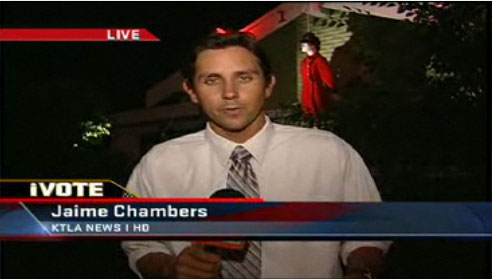
Trick or Treaters in West Hollywood, CA may be shocked to find an effigy of Sarah Palin part of the seasonal decorations at the home of Chad Michael Morrisette. A likeness of John McCain is displayed in the chimney surrounded by flames. While some say that it is simply a visual prank, others are calling it a hate crime that should be removed. National media and the blogosphere have begun to take note and according to the LA Times, MSNBC television host Keith Olbermann on Monday gave his “worst person in the world” award to Morrisette.  “This is not the spirit of Halloween, sir,” Olbermann said. “It is the spirit of violence.”

The LA Times story goes on to report on local law enforcement’s reaction. “The sheriff made this clear: This is a country that has freedom of speech, and we protect that right even when we think it’s idiotic and stupid and in bad taste,” said Steve Whitmore, spokesman for the Sheriff’s Department. “If it is nonviolent and doesn’t cause any problems, then they have the right to do it.”

Some have questioned whether a double standard is at work for those who argue that this is simply a free speech issue. To emphasize their point, they question the national response had the effigy been of Obama instead of Palin.

The website includes an online poll asking readers to weigh in on whether the display should be removed. As of Oct 29, respondents to the poll voted 82% in favor of removal of the display. What do you think?

I’m Sam Ebersole, and I approve this message.

Vote for Sam!
Vote for Sam!

Have you ever wondered why nearly every radio and television political ad contains the line, “I’m so-and-so and I approve this message”? Well, wonder no longer. It is required by law. According to the “Stand By Your Ad” provision of the Bipartisan Campaign Reform Act (BCRA) aka the McCain-Feingold Act, candidates must indicate responsibility for a spot by using this disclaimer. This is intended to cut down on attack ads in general, and outrageous claims in particular. Also, in order for a candidate to receive the lowest-unit-charge when purchasing TV/Cable airtime, an image of the candidate must appear in the commercial spot and a statement of approval must appear on screen and remain for a minimum of four seconds.

The unintended consequence of this legislation has been the raising and spending of soft money by so-called “527 organizations” or PACs (Political Action Committees) who are free to create and distribute political ads that do the candidates’ dirty work while giving the appearance of being independent. These spots are often funded by partisan organizations with such innocuous sounding names as, Colorado First Project, or Democracy for America. Because we live in a “swing state” in the 2008 elections, we’re seeing and hearing more than our fair share of political ads and will continue to do so for about 5 more weeks. But look on the bright side–the political TV spots are crowding out the normal lineup of ads for Frank “the strong arm” Azar and erectile dysfunction medications!

Sources: The Campaign Finance Guide, Political 101, and Open Secrets

css.php