American Idol Tryouts or Presidential Campaign?

Colorado is a swing state which means we’re going to be seeing a lot of political ads between now and November. Two that just hit the web, and the airwaves, feature our presidential hopefuls breaking out into song. Both are attack ads, which means the ad for Obama features Romney’s singing and the ad for Romney features the crooning of the President.

Here’s the Obama ad for your viewing, and listening, enjoyment…

[youtube=http://www.youtube.com/watch?v=Ud3mMj0AZZk]

I wanted to include the Romney ad, featuring Obama singing Al Green’s Let’s Stay Together, but a copyright claim by BMG Music resulted in the clip being pulled from YouTube. According to the Washington Post,

Romney’s campaign plans to fight the decision. “Our use was 100 percent proper, under fair use, and we plan to defend ourselves,” a spokesperson said. Other videos featuring the same clip of Obama remain on YouTube. (It’s not clear why the company has not challenged those videos.)

Now no one would seriously claim that vocal ability is a prerequisite for the highest office in the land, but the like-ability of the candidate is an important component and these ads may strike a chord with the electorate.

July 29 Update: According to Variety magazine, the Romney campaign came back with a new version of their ad featuring the singing of President Obama. You can see it on the Romney website.

Broadcast v Cable Indecency

What is indecent when it comes to television programming, and does it matter whether it is delivered over-the-air or via cable or satellite or computer? Those are just some of the questions facing TV network executives today. In an 8-0 decision, the Supreme Court last week said that ABC and FOX will not have to pay fines imposed by the FCC after episodes of fleeting indecency. The ABC TV network had been fined for airing an episode of NYPD Blue that contained seven seconds of a woman’s backside while FOX had been fined for airing awards shows in which speakers used expletives in their unscripted remarks. According to the Court, the FCC policies were too vague and therefore violated the broadcasters’ rights to due process according to the Fifth Amendment.

However, despite the unanimous ruling (Justice Sonia Sotomayor recused herself), the Court left in place the FCC’s right to regulate the airwaves. This right was established by the 1978 decision FCC vs. Pacifica. The now famous case was in response to a radio station airing George Carlin’s monologue about dirty words. According to the ruling the government has a right to regulate indecent speech–which would otherwise be protected by the First Amendment–at times when children are likely to be present in the audience. This has resulted in a policy that makes the hours between 10pm and 6am a “safe harbor” for indecent (but not obscene) speech since children are not expected to be viewing TV or listening to the radio during these hours.

The real confusion for many people is that broadcast TV is indiscernible from cable TV, and neither look much different from TV programming streaming on their computer or tablet. However the FCC, and its regulatory process, only applies to over-the-air broadcast TV. When NBC TV network is only two clicks away on the remote control from ESPN, History Channel, or MTV, the fact that NBC is prohibited from showing indecent content from 6am till 10pm while the others are free to do so seems, well, odd. Historically the distinction between public airwaves and private cable networks made sense, but today is appears to be unfair or inconsistent.

According to Edward Wyatt, writing in the NY Times,

All of which leaves broadcasters with little real grasp of what is allowed and what is not. Similarly, the public has no idea what to expect; the next time Cher appears on a live awards show, should adult viewers cover the ears of their 8-year-olds, or can they depend on the broadcasters to censor indecent content?

 The National Association of Broadcasters, the trade group that represents the broadcasting industry, has asked for relaxed governmental regulation and a move towards self-regulation…a model that is used, for example, by the motion picture industry.
Caution: 3-D Action Movies May be Harmful to Your Health

I saw The Avengers in 3D this afternoon and it made me wonder if I wasn’t doing incremental harm to my finely tuned survival instincts. You and I were born with some amazing skills at recognizing, and avoiding, danger. Think about it…in a split second we can see, and react, to something that is headed our way. We duck or swerve to avoid a flying object that might otherwise take us out. So, here’s what I’m thinking. Every time we have a virtual 3D experience with a flying object that DOESN’T do us harm, that part of our brain that is well trained to react in a split second registers a direct hit with no consequences. In other words, it has been fooled by the visual artistry that makes 3D action films so much fun. You may have heard the old saying, “fool me once, shame on you…fool me twice, shame on me.” Every technology comes with hidden consequences. Consider the loss of penmanship since keyboarding took its place. Others have argued that ready access to the internet and Google is reducing our capacity to remember. I can imagine a future where we are a nanosecond or two slower to react because of the de-evolution of our highly-refined reaction instinct. Something to think about the next time you are standing in line to see the latest 3D blockbuster.

Disturbing Photos Create a Moral Dilemma

A few days ago the LA Times created a stir by publishing photos of U.S. soldiers posing with Afghan corpses. The two photos, published in the paper and online versions of the news publication, were taken in 2010 by a soldier in the 82nd Airborne Division and given to a Times reporter. According to the Poynter website, military officials asked the Times to not publish the photos, but the newspaper went ahead and offered this rational in defense:

After careful consideration, we decided that publishing a small but representative selection of the photos would fulfill our obligation to readers to report vigorously and impartially on all aspects of the American mission in Afghanistan, including the allegation that the images reflect a breakdown in unit discipline that was endangering U.S. troops.

This incident touches on several issues related to the textbook chapters currently being discussed in class. There are concerns over the legality of images that compromise personal privacy. There are also ethical issues related to images of a graphic nature. And there are concerns over journalistic ethics when national security is at stake. Another factor at play is the embarrassment of military and government leaders who would like to have miss-deeds go unnoticed. While military and government leaders have called the behavior captured in the photos “reprehensible” and “morally repugnant,” journalists have an obligation to shine a light on misbehavior whenever and wherever they find it. The question here is how to do so without compromising other important and cherished values. As the LA Times website noted, “the taboo against desecration of the dead is strong in this religiously conservative country.”

There are, unfortunately, plenty of other examples in recent history of visual imagery that posed ethical dilemmas. The Abu Ghraib photos in 2004 of U.S. military personnel posing with inmates in compromising positions comes quickly to mind. Graphic photos of slain Libyan leader Moammar Gadhafi were carried by some news outlets while others decided to opt for photos of rebels celebrating his death. The White House refused to release photos of a dead Osama bin Laden thus relieving journalists of the pressure of having to make that decision. And just a few months ago a video surfaced of U.S. troops urinating on dead Taliban fighters.

Images are powerful. Perhaps cameras should come with a warning label: CAUTION, do not use without first considering consequences.

Plato’s Allegory of the Cave

The ancient Greek philosopher Plato lived about 400 years BC and is well known for his many contributions to modern thought. But did you know that he wrote about modern mass media thousands of years before they existed? Watch this short video on YouTube and see if you can identify the modern mass medium that is depicted by this allegory.

[youtube=http://www.youtube.com/watch?v=69F7GhASOdM]

For more about the making of the short film, visit this website.

Rushing to Judgement

This blog post is in no way intended to add to the current public debate about the guilt or innocence of either Trayvon Martin or George Zimmerman. The tragic shooting has become the center of a national dialogue about race (Martin is African-American and Zimmerman is Hispanic), violence, and media coverage of the same. While there has been little verifiable evidence about the tragic incident, there is no shortage of opinion about what happened on that night of February 26th.

What we do know is that the national media were slow to report the initial shooting. Only after African-American commentators, bloggers and radio talk show hosts took up the cause–and after social media amplified the discussion–did the mainstream media finally pay attention.

Photos of Martin and Zimmerman widely disseminated by the mainstream media have also led some to jump to conclusions. Newer photos of both are now being released. One can’t help but think that the images being presented are part of the process of making a case for either innocence or guilt of those portrayed. Either way it is easy to see how important first impressions can be when forming an opinion in the absence of hard facts.

Additional facts about Martin’s record of suspensions from school are also changing the nature of the debate. Some are claiming that these are irrelevant facts that are being intentionally leaked to the media with intent to destroy the reputation of the victim.

Even coverage of the media coverage has been controversial. The Daily Texan, a student newspaper from University of Texas at Austin, pulled a controversial editorial cartoon that was critical of the media’s coverage of the story.

One of the most important responsibilities of the media in a democratic society is to draw attention to misbehavior and to do so in an even-handed and unbiased way. Crime reporting is just one example. But so is investigative reporting of how police and other civil servants carry out their duty to administer justice. When public outcry about a possible miscarriage of justice by the local police reached a tipping point, the US Department of Justice was called in to investigate the Sanford police department.

Questions remain: Is justice being served by the attention being given to this story? Would justice have been served if a few African-American journalists had not gained the attention of the social media megaphone…which then led to the mainstream media paying attention? Can truth and justice prevail in what some are now calling a “media circus”?


UPDATE 3/30/12

PEW Research has released an interesting study comparing the way that Twitter, blogs, and cable TV and talk radio have covered the story.

Would Narcissus have a Facebook page?

Narcissism, named after the Greek god Narcissus, is defined as, “inordinate fascination with oneself; excessive self-love; vanity.” Narcissus, according to legend, saw his image in a reflecting pool and was so captivated by himself that he was unable to leave  the pool and eventually died.

While the story of Narcissus may be fiction, we all know people who suffer from the affliction of self-love and vanity. According to an article in The Guardian newspaper, a study recently published in the  journal Personality and Individual Differences suggests that there may be a link “between the number of friends you have on Facebook and the degree to which you are a ‘socially disruptive’ narcissist.”

People who score highly on the Narcissistic Personality Inventory questionnaire had more friends on Facebook, tagged themselves more often and updated their newsfeeds more regularly.

Two constructs measured by the researchers–exhibitionism and entitlement–appear to be connected to the number of Facebook friends and may be related to educational trends that have emphasized self-esteem at the expense of other values.

Because social media is still in its infancy many more studies will likely be undertaken in an attempt to better understand what appears to be the dark side to this quickly expanding phenomenon.

The Beginning of the End for Joseph Kony

If you’ve ever wanted to see an internet meme take off…here’s your chance. If you’ve ever wanted to get on the ground floor of a global movement that has great potential to do good…here’s your chance. If you’ve ever wanted to see what it takes to harness social media to motivate millions of people to get up off the couch and take action…here’s your chance.

[vimeo http://www.vimeo.com/37119711 w=398&h=224]

A friend of mine posted a link to this video in facebook yesterday (March 6th) around noon MST. When I started to watch the video I had no idea that it was 30-minutes long…but I was quickly caught up in the story of a madman doing terrible things to children in the interior of Africa. Thirty minutes later I knew several things: 1) this filmmaker knew how to use video effectively to tell a story, and 2) the story was one that would compel anyone who watched to care about this terrible situation. If you read just a few of the many comments on the Vimeo page you’ll see people who have been genuinely moved to action.

I shared the link on fb and twitter and began to see others doing the same. When I watched the video yesterday, it had been viewed by several hundred thousand people. As I write this on the morning of March 7th it has been viewed 5.3 million times! I’ve never seen something take off this quickly. This is big folks, and is only going to get bigger. A couple of days ago the number of people who knew about Kony was a fraction of those who recognize the names Kobe or Kim Kardashian…but that will change. And that is a good thing.

March 8 Update: As promised, here are links to a critique of Koni2012 and Invisible Children’s rebuttal. Remember, as traditional mass media editors and gatekeepers become less important, individual media consumers must become adept at evaluating media messages using a full-range of critical thinking skills. The challenge is to become a critical thinker without becoming overly cynical.

Rush v Fluke and Broadcast [In]Decency

In case you missed it, Rush Limbaugh said some pretty terrible things last week about Sandra Fluke, a student at Georgetown Law School. Fluke testified before a congressional committee in favor of legislation that would require that birth control be covered as part of all heath insurance programs. This is somewhat controversial amongst Catholic institutions who believe that they should be exempt from providing a service that runs counter to their official doctrine. Religious leaders from other faiths have joined the debate fearing that government intrusion into this arena could open the doors for further erosion of First Amendment rights to practice their beliefs without government interference.

Rush Limbaugh, an outspoken voice for the conservative movement has never been shy about speaking his mind. In fact, his media career is founded on a bombastic approach that often includes personal attacks. Last week he called Fluke a “slut” and a “prostitute” and suggested that she post videos of her sexual encounters online for taxpayers in exchange for their funding her activities. Nearly everyone agrees that Limbaugh crossed the line with his remarks. After AOL and a half-dozen or so other advertisers withdrew their ad dollars, he issued this apology.

For over 20 years, I have illustrated the absurd with absurdity, three hours a day, five days a week. In this instance, I chose the wrong words in my analogy of the situation. I did not mean a personal attack on Ms. Fluke.

I think it is absolutely absurd that during these very serious political times, we are discussing personal sexual recreational activities before members of Congress … Where do we draw the line? If this is accepted as the norm, what will follow? Will we be debating if taxpayers should pay for new sneakers for all students that are interested in running to keep fit? In my monologue, I posited that it is not our business whatsoever to know what is going on in anyone’s bedroom nor do I think it is a topic that should reach a Presidential level.

My choice of words was not the best, and in the attempt to be humorous, I created a national stir. I sincerely apologize to Ms. Fluke for the insulting word choices.

This is not without precedent and is not limited to conservative talk radio hosts. According to Kirsten Powers, liberal radio and TV commentators have similar track records of misogynistic missteps. This event also is a reminder of the Don Imus incident in 2007 when he referred to the Rutgers woman’s basketball team as “nappy-headed hos.” However, as Paul Farhi pointed out in the Washington Post, Imus is not in the same league as Limbaugh. Limbaugh is the most popular talk show host in the country. His 8-year, $400 million contract virtually guarantees that Premiere Radio Networks will continue to give Limbaugh a microphone. In fact, some believe that this might even help to fire up his base. According to the New York Times, Premiere issued this statement:

The contraception debate is one that sparks strong emotion and opinions on both sides of the issue,” the company said. “We respect the right of Mr. Limbaugh, as well as the rights of those who disagree with him, to express those opinions.

What do you think? When strong emotion meets opinion, where should broadcasters draw the line?

Stolen Valor Debated by the Supreme Court

A law that got its start at CSU-Pueblo has made its way all the way to the Supreme Court where, this week, justices debated when it becomes a crime to tell a lie. In this case the lie is about being a recipient of  a military medal.

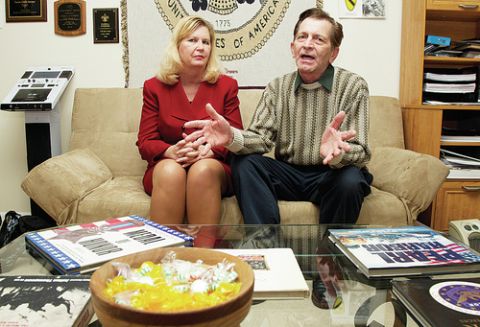
The Stolen Valor Act of 2005 got its start as a college paper written by Pam Sterner when she was a student at the University of Southern Colorado, now renamed CSU-Pueblo. Pam and her husband Doug are seen in this photo taken in their home in Virginia where they now live. According to the Daily Herald,

Pam Sterner went back to school in her early 40s at Colorado State University in Pueblo, Colo. In a political science course, she wrote a paper that grew out of her husband’s frustrations over phony award claimants whose worst punishment was public embarrassment. That paper eventually led to the Stolen Valor Act.

What is the significance of the Stolen Valor Act for students of the media? The Supreme Court will make its judgement based on whether the law is consistent with the 1st Amendment to the Constitution and its protection of free speech. Opponents of the Stolen Valor Act are concerned that defense of the law could lead to additional restrictions of free speech. The 1st Amendment is the most important legal protection for the media industries because of it protects not only personal speech, but it also protects the press which is broadly understood as media of all kinds. The 1st Amendment protects a broad array of speech, including speech that is mean-spirited, unpatriotic, and worse. [See a previous post on this blog which examined the protection of protests at military funerals.]

Lying about one’s exploits is not new nor unique to claims of military honors. As one person said in response to the debate over false claims of heroism, “there are only a six hundred Navy Seals in total. But in bars around the country, on any given Friday night, there are three times that number.”

css.php