Political Ads Just Keep On Coming!

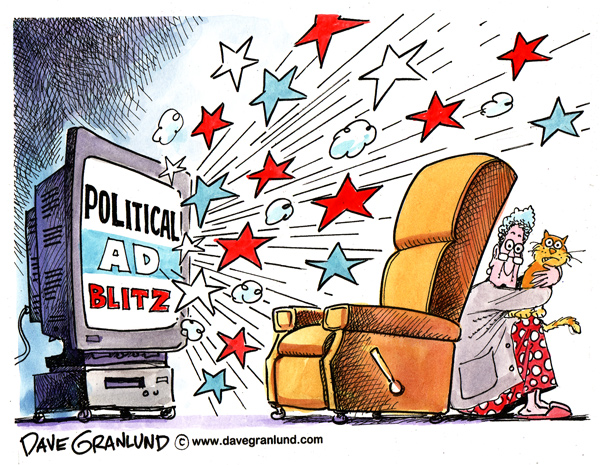
We’re approaching the end of another election season and the race couldn’t be tighter. Living in a “battleground state” I’ve seen my share of political ads, even while wielding my DVR remote control as a light saber to vanquish as many as I possibly can. With nearly a billion dollars spent on the presidential race alone, this has been a year for the record books. According to Wesleyan Media Project, this year’s presidential race has seen more than 915,000 ads air on broadcast and cable television.

TV is the medium of choice for politicians hoping to reach the masses. No other medium offers as much persuasion power as video, and a well-crafted TV spot can be a powerful tool for energizing the base and persuading the undecided voter.

Another notable characteristic of the 2012 campaign is the prevalence of negative or attack ads. Obama’s campaign was more negative (73.3%) than Romney’s (36%), while both Democratic and Republican ads by outside groups and super PACs were almost entirely negative.

Given the deluge of TV ads, what is your strategy for coping?

Ruffling Feathers at PBS

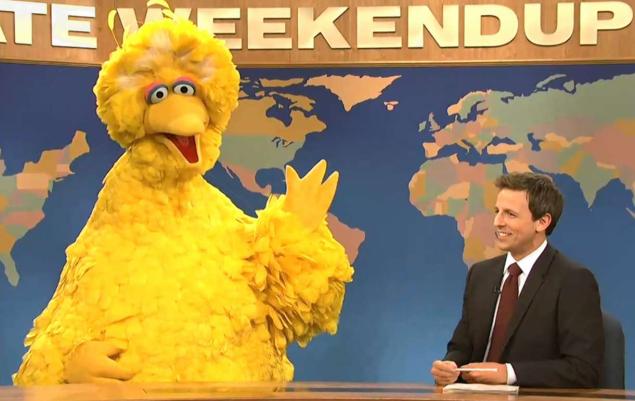
SNL invited Big Bird to the set of Weekend Update.

For a generation raised on Sesame Street, Big Bird is the poster child for all that is right and good about children’s television. A creation of puppeteer Kermit Love, Big Bird was originally designed to be played by Jim Henson. While that never quite worked out, according to Wikipedia Big Bird has been “officially performed by Caroll Spinney since 1969.” It is worth noting that Spinney is paid more than $300,000 annually for the role, according to the Sesame Workshops forms filed for 2010 tax year (the Atlantic).

So why are we talking about Big Bird? Because in the first 2012 Presidential Debate, which aired Oct 3, Mitt Romney said that in order to reduce the federal budget deficit he would makes cuts to certain domestic programs. Here’s the quote:

“I’m sorry, Jim [Lehrer, moderator of the debate]. I’m going to stop the subsidy to PBS. I’m going to stop other things. I like PBS. I love Big Bird. I actually like you too. But I’m not going to — I’m not going to keep on spending money on things to borrow money from China to pay for it.”

In response, the Obama campaign released this ad accusing Romney of going after Sesame Street while giving Wall Street a pass…

[youtube=http://youtu.be/bZxs09eV-Vc]

According to an article in the WSJ, Sesame Workshop would prefer to avoid being politicized by either candidate and has requested that the Obama campaign pull the ad.

“We have approved no campaign ads and, as is our general practice, have requested that both campaigns remove Sesame Street characters and trademarks from their campaign materials,” said Sesame Workshop, a nonprofit educational organization that produces and owns the show, in a statement.

What do you think about Big Bird, funding for PBS, and politicizing of both for the sake of political gain?

Movies are Made to be Seen

Have you ever tried to describe a movie to your friends…but they just didn’t get it? You may relate to this humorous spot from French TV.

[youtube=http://www.youtube.com/watch?v=9M5ej-mCtzI]

An Out’rage’ous Newsweek Cover?

Newsweek magazine was once a leader in the news weekly genre. But that was a long time ago and Newsweek is now struggling to attract readers. One technique they’ve employed is the sensational cover photo and headline. According to an article in the Huffington Post, “The conservative Daily Telegraph called it a ” sickening piece of shock journalism that cheapens a once great magazine” and compared it to the anti-Muslim film that sparked the protests.”

This YouTube video captures some of the outrage directed at Newsweek and other journalists.

[youtube=http://www.youtube.com/watch?v=6PaOfycgyCg]


In response to criticism about their cover, Newsweek invited the public to chime in with their own take on the events recently unfolding in Islamic nations around the globe. They invited people to post to Twitter using the hashtag #muslimrage which was quickly hijacked by Muslims and non-Muslims alike. You can find a collections of some of the tweets, and images of Muslim Rage at Gawker.

This mocking response to a serious issue demonstrates the challenges facing media companies who give up control to their readers/viewers/users. Listen to this NPR story about the Twitter backlash.

Yesterday’s LA Times points to a recent article in Foreign Policy magazine in which the author suggested,

that the increased democratization brought by the 2011 Arab uprisings and social media platforms like Facebook and Twitter helped break down the barriers between cultures and tamp down the cycles of outrage compared to the previous protests over Danish cartoons in 2006 that left hundreds dead.

It may be too soon to tell if democracy and social media will have a lasting positive effect on relationships that have taken centuries to grow apart.

Arab Spring Gives Way to the Arab Fall

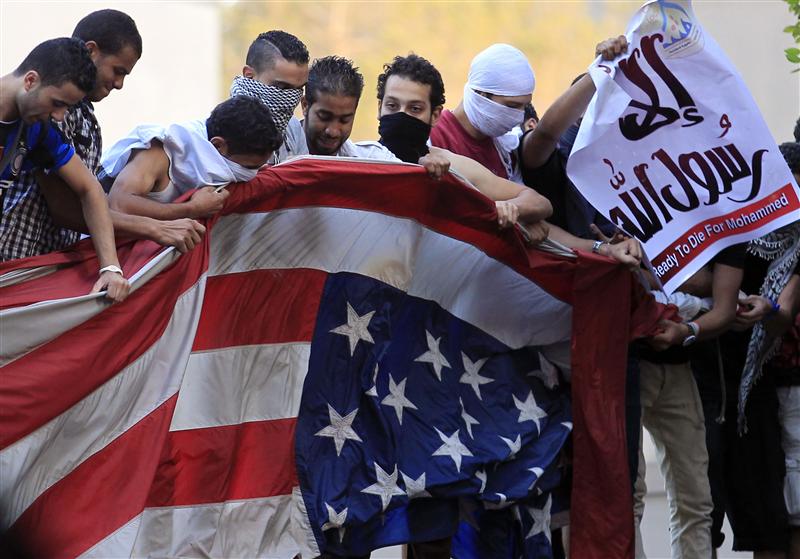
On the anniversary of 9/11, rioting in Cairo and the murder of Libyan ambassador John Christopher Stevens, and several others, at the US consulate in Benghazi is a stark reminder that we still don’t understand the complex nature of middle-eastern politics and Islamic extremism. In the words of Secretary of State Hillary Clinton, “how could this happen in a country we helped liberate and in a city we helped to save from destruction.” It is becoming increasingly clear that the overthrow of former Libyan dictator Muammar Gaddafi brought new freedom, but also instability, to the region.

There are several connections to mass media in this story. First, much has been made of the role of social media in bringing democracy to Northern Africa and the Middle East. Second, news reports say that a YouTube video criticizing Mohammed was the initial spark that ignited the riots. The two-hour YouTube video, produced and written by Sam Bacile, a California real estate developer, was made for $5 million. A 13-minute trailer/excerpt can be seen here. According to reports, the film portrays the prophet Mohammed as, “a fraud, a pedophile and a womanizer.” Muslims do not allow the portrayal of Mohammed in any form, but are particularly intolerant of depictions that are perceived as an insult. Afghanistan blocked YouTube today in an attempt to prevent access to the controversial video.

While freedom of speech and freedom of expression are highly valued in American culture, much of the world does not share our appreciation for speech that sometimes offends segments of the audience. In this country individuals can safely criticize government entities and religious institutions without fear of reprisal. But that is not the case in many countries and cultures dominated by totalitarian rulers or oppressive religious factions.

While Americans hold their noses and “tolerate” protests by Fred Phelps and his Westboro Baptist “Church”, the response has not been so generous in other contexts. Take, for example, the case of Theo van Gogh. Van Gogh was a Dutch filmmaker who made Submission, a movie that many Muslims found offensive. After the movie was shown on Dutch public television, Van Gogh was killed by a “Muslim extremist.” The killer shot Van Gogh eight time, stabbed him, and attempted to decapitate him. When a Danish newspaper published caricatures of the prophet in 2005, it sparked riots in many Muslim countries.

Because we are in an election season, the news also took a political twist. According to a report by the BBC,

Mitt Romney, Mr Obama’s Republican challenger in the forthcoming presidential election, criticized the US administration’s response to the attacks in Benghazi and Cairo, saying it had appeared to “sympathize with those who waged the attacks”.

Religious freedom, freedom of speech, and tolerance for opposing views are values not to be taken lightly. And when they appear to be in conflict with each other, the stakes are even higher.

Bleeping and Blurring on Network TV

Regulating indecency on broadcast TV is a tricky business. First of all, the American public does not agree on what is or isn’t indecent. Differences of geography, background, religiosity, and age account for much of the variance…but even then it is difficult to find commonality on what is or isn’t appropriate for prime time TV when children may be in the audience. Another complicating factor is that the networks are competing with basic and premium cable/satellite TV programming which is not subject to the same regulatory scrutiny as over-the-air TV networks. To further confuse the issue, the increase in IPTV and smart TVs that stream video content over the internet makes the distinction of broadcast TV’s more restrictive content policies appear less and less relevant.

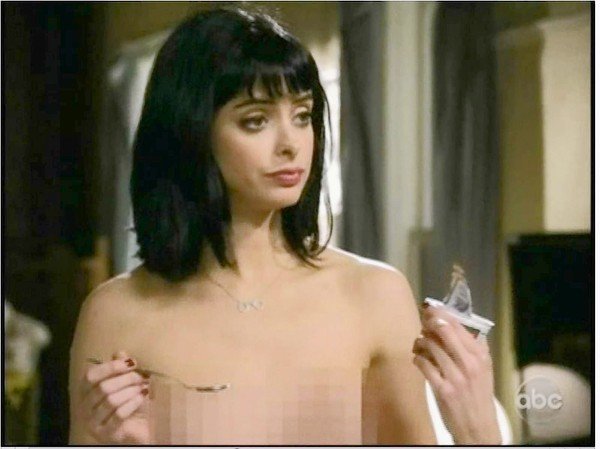
Despite–or perhaps because of–the confusion, the controversy is not going away. A study by the media watchdog group Parents Television Council revealed a significant increase in the number of instances of pixelated “full-frontal nudity” on network TV. According the PTC, there was one instance in the 2010-2011 season and 64 in the most recent season. Use of pixelation allows the networks to avoid prosecution by the FCC while implying nudity for comedic or dramatic effect.

According to a quote in the LA Times, PTC President Tim Winter said,

pixilated flesh is “unfortunate, unnecessary and offensive to the family audience” and that it happened more often in 7 to 9 p.m. shows, when kids could be watching, than in those airing after 10 p.m. Nor did the shows’ ratings always warn parents of sensitive content.

Because of the sensitive nature of these issues and the difficulty of making the right decision during the initial filming or taping, occasionally special effects are used in post production to modify the frames that might cross the line. According the same article in the LA Times,

John Gross, a veteran visual effects supervisor at L.A.-based Eden FX, said he and other effects executives are often asked to add pixels or shadow parts of actors’ bodies so network shows will pass muster with censors. They also draw clothes back on so that programs can be sold to international markets more modest than the U.S.

The FCC’s polities on indecent language are also under scrutiny. Currently the courts are wrestling with the proper interpretation of regulatory policies that prohibit “language or material that, in context, depicts or describes, in terms patently offensive as measured by contemporary community standards for the broadcast medium, sexual or excretory organs or activities.” Radio stations carrying the Howard Stern Show racked up about $2.5 million in FCC fines before Stern moved from broadcast radio to Sirius XM satellite radio, which is exempt from FCC indecency policies. After several awards show incidents, it is now common policy on live radio and TV to have a short delay which allows a censor to hit a switch to mute the sound or picture in the event of an unscripted moment of vulgarity or profanity.

This practice has become so commonplace that Jimmy Kimmel has a reoccurring segment called “This Week in Unnecessary Censorship” in which he “bleeps and blurs” video clips to give the appearance of vulgarity and indecency when in fact nothing of the sort had taken place. But viewers are easily persuaded to fill in the gaps by imagining the worst. The same phenomenon is happening with the pixelation of full-frontal nudity. Even though the actors are wearing flesh-colored undergarments, the pixelated image encourages the viewer to assume or imagine that the actor is indeed nude in the scene.

So here’s the question: where does offense over indecency happen? Is it in the word or image presented,  in the mind of the audience member, or, somewhere in between?
Jailhouse Rock: Pussy Riot Found Guilty

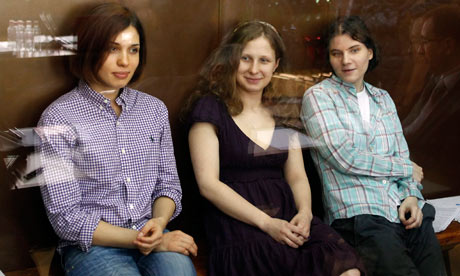
In case you haven’t heard, members of the punk rock band Pussy Riot have been sentenced to two years in prison for, “hooliganism driven by religious hatred.” The trial and sentencing of the three Russian women has attracted attention and outrage from around the world. Amnesty International and other supporters of free speech and human rights have declared them “prisoners of conscience.” According to USA Today,

The three were arrested in March after a guerrilla performance in Moscow’s main cathedral, high-kicking and dancing while singing a “punk prayer” pleading the Virgin Mary to save Russia from Vladimir Putin.

Several celebrities have spoken out in support of Pussy Riot. Garry Kasparov, former world chess champion, as well as Paul McCartney and Madonna have expressed support for the rights of the performers. Russia does not have the same level of protection for speech that we appreciate.  Thanks to the 1st Amendment to the US Constitution, US citizens have much more freedom to speak our minds than do most other citizens of the world.

But we also want to be careful that free speech rights do not infringe on the rights of others. Hate speech is one of those sensitive areas where, even in America, free speech sometimes has to take a back seat. But who gets to decide that a specific act of speech crosses the line into hate speech and, in so doing, forfeits the rights of the speaker to protection under the law? That’s a question that many are asking in light of this sentence.

Update Aug 20: In an unusual twist, Madonna is being sued for over $10M by concert goers who “were offended by her support for gay rights during a recent concert in St. Petersburg.” See more here.

An Olympic-sized Effort by NBC

The Summer Olympic games have come to a close and the 10,000+ athletes and their fans have returned to their 200+ home countries. NBC Sports production personnel will be dismantling their enormous production facilities and shipping tons of equipment back to the US. I was fortunate to be part of the NBC Sports production team in 1988 at the Seoul Summer Olympics. It was a massive undertaking then, but every four years the US Olympics broadcasting team outdoes the previous effort.

NBCUniversal paid dearly for the rights to broadcast the XXX Games to a US audience…somewhere in the neighborhood of $1.18B. They spent hundreds of millions more bringing hours and hours of programming to your TV screen, laptop, tablet and cell phone.

Over a period of 17 days, NBC Universal provided 5,535 hours of coverage spread across NBC, NBC Sports Network, MSNBC, CNBC, Bravo, Telemundo, NBCOlympics.com, two specialty channels, and the first-ever 3D platform. While athletes were setting records in the pool and on the track, NBCUniversal set records of its own. Working with Panasonic, the games in London marked the first time that Olympic sports were broadcast in 3D in the US. To appreciate the size and scope of the Summer Olympic games, this is what their media guide said about the size of the audience:

To deliver the same number of gross household impressions NBC delivered during the 17 days of its primetime Beijing Olympics coverage, one network would have to own the rights and broadcast the Super Bowl, the Academy Awards, the Grammy Awards, the Golden Globes, the AFC Division playoffs, the NFC Championship Game and six games of the World Series all within a 17-day span.

Also from their media guide…

Dark Knight Falls Short

The latest in the Dark Knight series is struggling to bounce back from the tragic shooting in Aurora that appears to be having a greater impact on attendance than initially projected. It may appear callous to be talking about box office receipts and financial success when so many lives were lost and others were changed forever. But that is the nature of the business of big media. The studio, Warner Brothers, took steps to try to appear sensitive to the tragic shooting. They delayed reports of box office receipts that first weekend and cancelled premiere events in Paris, Mexico City and Tokyo. According to the WSJ, a spokesperson for the studio said, “We just felt it would be disrespectful and not the right thing to do to go forward.” Warner Bros also pulled trailers for Gangster Squad from theaters because of a scene that includes shooting up a movie theater. Meanwhile, security has been beefed-up and theater chains are implementing new rules about patrons showing up in outfits and masks.

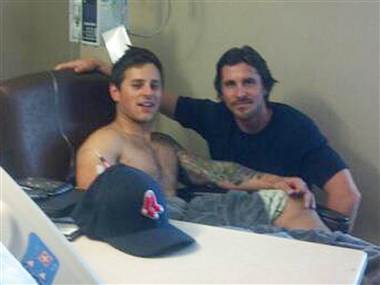
Christian Bales’ surprise visit to patients in Aurora hospitals was certainly well-received by both the patients and the media. The visit may have been inspired by a Facebook viral campaign calling for the star to make a visit to the victims. And while I sincerely hope that the visit was made for all the right reasons, we’re sure to hear criticism from skeptics and cynics who question motives whenever fame and fortune is at stake.

Public Relations experts have been weighting in on the difficult position facing Warner Bros. Some had advised that all screenings of Dark Knight Rises be pulled for a short time. Others have argued for business as usual. According to a report by Fox News, Daniel Keeney, President of DPK Public Relations and PR crisis expert, believes that the best response is to acknowledge and move forward.

“There realistically is no way in the foreseeable future to extricate the Batman brand from this horrific tragedy,” he said. “So instead of hoping to get beyond this, the studio needs to accept that this event is a part of this movie from this point forward. A simple way to acknowledge this and recognize as well as honor the victims is to add a slide to the beginning of the movie along with a moment of silence prior to the start of the film.”

According to a report filed by LA radio station WKZO,

Ronn Torossian, chief executive of New York-based 5W Public Relations, agreed that the public “has a very short-term memory” of news events and said the Aurora shooting would not leave a long-term impact on film promotion. “Reality shows have had tragic suicides and other incidents, yet reality shows continue,” he said.

Of course it is entirely possible that Word-Of-Mouth and film critic reviews are responsible for the lackluster performance. But it is also possible that potential movie-goers are not in the mood for a film that will remind them of senseless killing by a deranged “Joker” from Aurora.

Another Mass Shooting in Colorado: A Dark Night Indeed

Yesterday I posted a short entry and link to the Media & Society facebook page about the heated debate on Rotten Tomatoes about The Dark Knight Rises. The essence of the story, as reported by the Wall Street Journal, is that the comment section of the latest Batman film was out of control with trash talk and threat of physical violence because of a couple of unflattering reviews of the newest movie in the Batman franchise. Apparently fans of the series were not taking kindly to the negative reviews and, as often is the case with online discussions, the anonymity and deindividuation (I know it’s a big word…look it up) led to brutish behavior on the part of some.

This morning I woke up to horrible news that a gunman had opened fire in an Aurora (suburb of Denver, CO) theater where movie goers had gone to see the newest Batman movie, The Dark Knight Rises. Dressed in a bullet-proof vest and gas mask, and with his hair colored red, the shooter opened canisters of gas and then opened fire with multiple weapons in the crowded theater. Some 71 persons were shot and 12 are reported killed. Taken into custody, the gunman–recently a PhD student at CU’s medical school–claimed to be the Joker, the villain portrayed by the late Heath Ledger in  the previous Batman film.

All of this will no doubt raise questions, and even political posturing, about the shooter’s motives and the state of our society. Some of these questions may be genuine attempts to deal with the loss by looking for explanations. Others may be asking questions in an effort to direct public dialog to topics in which they have political axes to grind. Some of the questions will look to the media. Was the shooter in any way influenced by the Batman movies? Are villainous portrayals on the big screen capable of triggering desperate acts by deranged individuals?

I began this blog with reference to the uncivil behavior in an online forum. Some might argue that this online incident is indicative of a greater social illness that found its final outlet in a horrific act of carnage. While causal links are incapable of providing explanations for the behavior of psychotic and deranged individuals, it won’t stop people from trying to connect the dots. There may well be connections to be made, but those will have to wait for now.

css.php