Concern over Movie is no Joker

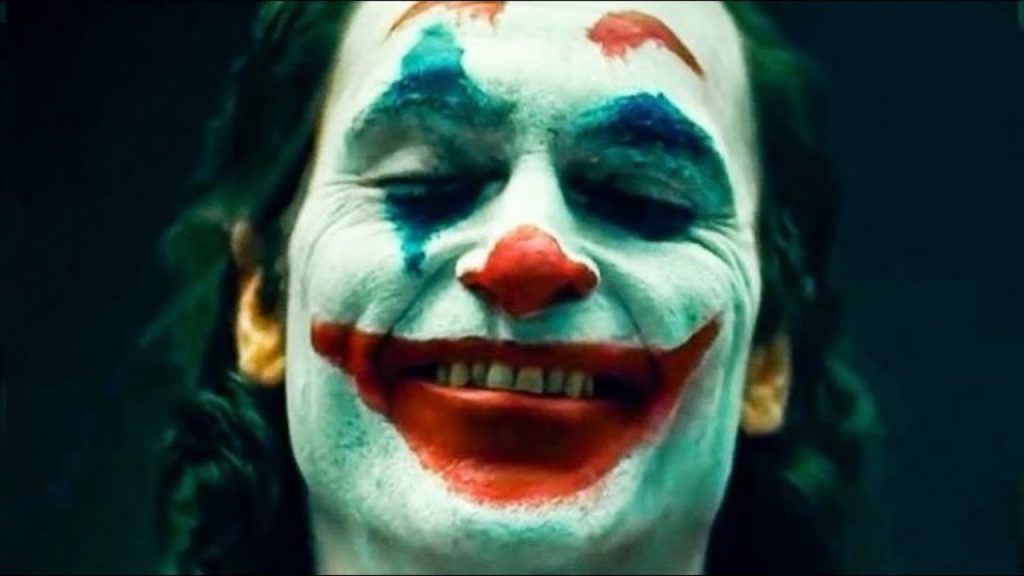
According to the MPAA movie-ratings site, Joker is “rated R for strong bloody violence, disturbing behavior, language and brief sexual images.” Scheduled to open in theaters this Friday (Oct 4th), Joker is not an appropriate film for youngsters who may be fans of the Batman franchise.

“Starring Joaquin Phoenix and directed by Todd Phillips, the movie has already been deemed dangerous by its vocal critics, akin to an incel training manual. To some of the movie’s fans, those critical reviews and negative reactions are just another example of social justice warrior overreach. “

Vox

Concerns over dangerous media content have a long history going all the way back to the ancient Greek philosopher Plato who warned about the dangers of writing. Plato was concerned that writing would be a substitute for memory and over time result in forgetfulness. Centuries later, photography was seen as facilitating the sin of idolatry. Motion pictures (film) introduced young audiences to all sorts of vices including lust and violence. Comic books, radio, TV, internet and video games have all suffered the same accusations of endangering young hearts and minds.

But just because we’ve come to dismiss the dangers and fears associated with each new technology does not mean that we should dismiss real threats when they arise. Bullying on social media, addiction to video game play or pornography, and racism and misogyny promoted in anonymous chat rooms and forums: each of these are real threats to physical and mental health and, one can argue, a threat to community.

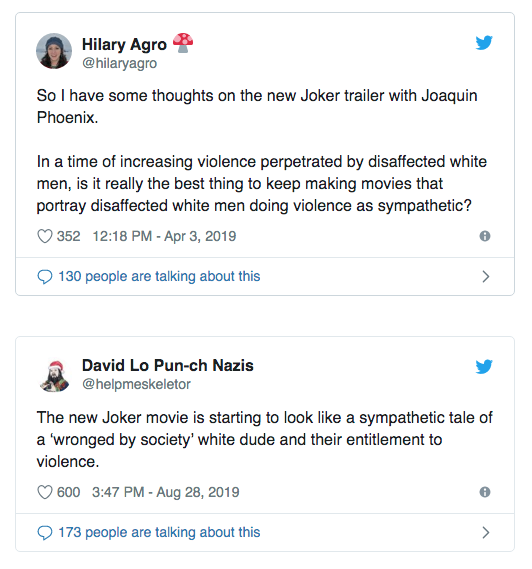
Based on the trailers for Joker some are questioning whether the film gives too much attention (and cover) to “disaffected white men” whose alienation leads them to act out to get attention. The following tweets capture this sentiment.
In response to criticism the Warner Bros. studio offered this statement.
“Warner Bros. believes that one of the functions of storytelling is to provoke difficult conversations around complex issues. Make no mistake: neither the fictional character Joker, nor the film, is an endorsement of real-world violence of any kind. It is not the intention of the film, the filmmakers or the studio to hold this character up as a hero.”

Not being a big fan of superhero movies–and not one to enjoy gore and extreme violence–I’ll likely sit this one out. But if you see it I’ll be interested to hear what you think. Is it a dangerous film, or are the critics who are passing judgement a greater danger to our collective well-being?

Why Local Investigative Journalism Matters

Last month in Colorado Springs, 19-year old De’Von Bailey was shot and killed as he ran from police. Bailey and his cousin were stopped by police after a 911 caller reported an armed robbery in the area. After being stopped (but before being patted down) Bailey fled. According to police, the shooting occurred after Bailey reached for what was later identified as a gun.

Still frame from bodycam footage just before the shooting of De’Von Bailey. Link to video is to the right.

The Gazette newspaper in Colorado Springs published edited and condensed body camera footage of the incident. You can see it here, but be warned that the footage is graphic and disturbing.

Bailey’s death is a tragic outcome of a very unfortunate event and it is critically important to understand how and why the shooting occurred if we are to understand how to prevent similar incidents in the future. According to the Gazette, 5 of 7 police-involved shootings in Colorado Springs in 2019 have resulted in fatalities. Community activists in Colorado Springs point to a number of similar events around the country in recent years where police use of deadly force resulted in the death of minority suspects. Other names you might recognize include Michael Brown of Ferguson and Eric Garner of New York City.

The highly-respected journal Nature recently published an article calling attention to the shortage of scientific data on the topic of police use of lethal force. According to the article, “In the United States, police officers fatally shoot about three people per day on average.” And while it is essential that objective research be gathered, analyzed and published it is also critically important that journalistic investigations continue to shine a spotlight on any sign of injustice and abuse of power. This is why local journalism exists and why it matters.

To carry out their duty journalists must be dogged and relentless in their pursuit of truth. And once they find truth, they must present it to their readers/listeners/viewers in a way that is informative, compelling, and unbiased. Anything less is an abdication of their purpose and mission.

I’m being honest when I say that I don’t know enough about this tragic event to have formed a strong opinion on whether this shooting was justified. I hope that investigative journalism, and an independent investigation, will step up to provide the necessary context to help us process this tragedy. Without that we will be left to our own biases and interpretations of what happened on that evening of August 3rd in the 2400 block of East Fountain Blvd. in Colorado Springs.

Additional links to media coverage of the shooting

If You Build it They Will Come

If you build the most powerful propaganda platform in the history of communication and make it available for free to a global audience, don’t be surprise when anyone and everyone shows up to use (and abuse) your platform. That’s what social media giants Facebook, Twitter and Google are discovering as yet another attempt to manipulate users has been revealed.

According to recent reports, Twitter said it will no longer accept advertising from from “state-controlled news media entities” after it was discovered that China was attempting to use Twitter and Facebook to engage in orchestrated misinformation around the ongoing protests in Hong Kong. This comes on the heels of repeated reports of Russian use of social media to influence political campaigns and elections in the USA and elsewhere. 

The question now is whether these huge tech companies can put the genie back in the bottle. Or will regulation, new AI technology, or some other solution have to appear before we can feel confident that freedom and democracy are safe from the actions of nefarious state actors?

Reporting on Racism

Journalists are struggling to figure out how to cover President Trump, and more specifically his recent tweets about four democratic representatives who also happen to be persons-of-color. The President’s Twitter stream, and his public comments made at campaign events and press conferences, have crossed a line for some reporters and editors who are now grappling with how to talk about the President who is accused of saying things that they interpret as racist.

The New York Times has taken heat recently from politicians and other media outlets for not calling out the President as a racist. According to critics, the NYT’s failure to call Trump a racist is enabling and promoting the rise of racism. But according to CNN, Executive Editor Dean Baquet, “has opted to explain what Trump has said, allowing readers to decide for themselves whether they consider his comments racist.” This approach has been the standard approach to non-partisan and objective journalism over the years, but one that leaves more progressive advocates calling for a change.

In a related issue, the NYT was criticized for a headline published, and then changed, in the aftermath of the El Paso and Dayton shootings. According to The Independent, “The first headline read, “TRUMP URGES UNITY VS RACISM”, but was changed to, “ASSAILING HATE BUT NOT GUNS” following outrage as the portrayal of the US president as a unifier.” In response, Democrat congresswoman Alexandria Ocasio-Cortez tweeted that the NYT’s initial take was a reminder that “white supremacy is aided by – and often relies upon – the cowardice of mainstream institutions”.

What do you think? Should journalists call out racism by naming it, or should they report on what was said or done and let the readers decide for themselves? And, if you’re a working journalists, take a survey to let them know what you think about the debate.

Content Moderation and Shadow Banning

If you’ve spent any time on social media you’ve no doubt seen and heard things that were offensive and, quite possibly, even dangerous. Assuming you live in the USA, you also know that the “constitutional” right to Free Speech is a well-established right that goes to the heart of who we are and what we value. The challenge then is to know the fine line between constitutionally protected speech, and speech that is so harmful or dangerous as to pose a credible threat to actual life or property.

Social media platforms know that they do not have an obligation to grant users their “constitutional” rights. While their very size and oligopolistic nature give us cause for concern, they are not the government* and users are free to pick and choose which platforms and services they want to use. Those platforms are, likewise, allowed to make policies that allow certain types of speech and disallow others. Users who fail to abide by those policies can be warned, suspended, or banned.

So what to do about reports that platforms like Facebook, Youtube, Twitter, and even Pinterest are banning or demonetizing users who have come to reply on these platforms for their livelihood? In extreme cases such as death threats, doxing, and online bullying/harassment, the actions taken by these social media platforms appear to be justified. But what about provocative posts that deploy humor or satire to make a political statement? And what about users who fail to adhere to a standard that is difficult (some say impossible) to understand because it is so subjective?

According to a recent essay by Will Oremus,

The underlying problem of our platforms is not that they’re too conservative or too liberal, too dogmatic or too malleable. It’s that giant, for-profit tech companies, as currently constructed, are simply not suited to the task of deciding unilaterally what speech is acceptable and what isn’t.

On top of this is the fact that these are global platforms struggling to satisfy laws and regulations in an extremely wide range of contexts. Political, cultural, religious, ethnic and racial differences make it nearly impossible to avoid offending some segment of a potential audience that could reach into the billions. And too often it is the loudest voices, regardless of the strength of their argument, that get the most attention.

Again, according to Oremus…

In a good legal system, decisions may be controversial, but at least the rationale is clearly laid out, and there’s a body of case law to serve as context. But when Facebook decides to de-amplify a doctored video of House Speaker Nancy Pelosi, or YouTube opts to demonetize Steven Crowder’s channel, there’s no way to check whether those decisions are consistent with the way they’ve interpreted their rules in the past, and there’s no clear, codified way to appeal those decisions.

So, if you’re easily offended by either gritty content or over-aggressive thought policing…or if you’re counting on a social media platform to help you build an audience and then treat you fairly when you want to push the envelope, remember…you get what you pay for.

*For more about the distinction between government and private industry and the legality of regulating speech, see this article by Reuters.

Billionaire Sex Scandal: “Enquiring” Minds Want to Know

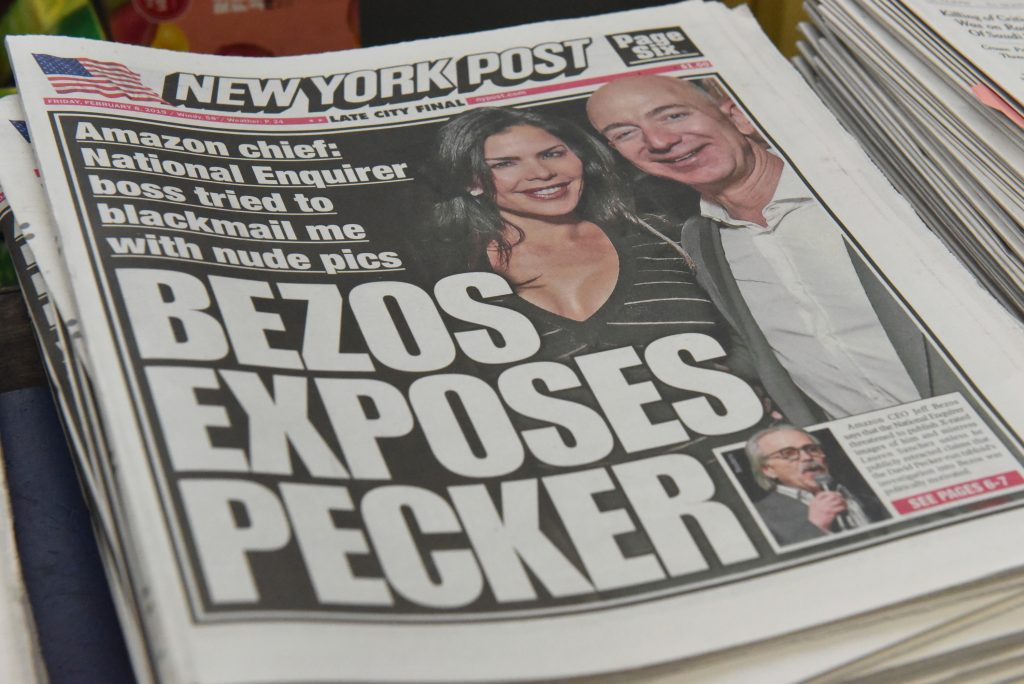
Jeff Bezos owns Amazon and the Washington Post newspaper (aka the WaPo). The amazing success of the first company allowed Bezos to buy the second one. But all is not rainbows and unicorns for the richest man in the world. Bezos is divorcing his wife of 25 years after engaging in an illicit affair with Lauren Sanchez, a TV news reporter. But wait, there’s more…

NEW YORK, NY – FEBRUARY 08: The New York Post with a headline referring to Jeff Bezos is photographed at a convenience store on February 8, 2019 in New York City. Jeff Bezos, CEO of Amazon is accusing David J. Pecker, publisher of National Enquirer, the nations leading supermarket tabloid, of extortion and blackmail. (Photo by Stephanie Keith/Getty Images)

Pictures and text messages from the affair were leaked to the National Enquirer, whose CEO, David Pecker, is a long-time friend of President Trump. In case you didn’t know, there is no love lost between the President and Bezos, largely because of the critical coverage of the Trump Presidency by the WaPo.

Now AMI, parent company of the National Enquirer, is being accused by Bezos of blackmail and extortion for threatening to release more lurid photos unless Bezos backed off from going after AMI. If this isn’t all strange enough, there’s even speculation that Sanchez’s brother may have been the one who leaked the photos.

Tabloid newspapers found in supermarket checkout aisles have always trafficked in sensational and unseemly “news” especially those stories involving celebrities, money, and sex…and this story has it all. Add a little political intrigue with the Trump connection and you have a perfect fire-storm of scandalous gossip masquerading as journalism.

This may not be the kind of journalism that the Founding Fathers wanted to protect when they wrote the First Amendment, but it still benefits from its protections. Media history buffs may recall James Thomson Callender, a scandalmonger whose attacks on our earliest Presidents led to the Sedition Act. According to the Digital History website, “Attacked by his critics as a ‘traitorous and truculent scoundrel,’ Callender defended himself on strikingly modern grounds: that the public had a right to know the moral character of people it elected to public office. Although he has often been dismissed as a ‘pen for hire,’ willing to defame anyone, Callender was much more important than that. His life underscored one of the most radical consequences of the American Revolution. The Revolution ensured that ordinary Americans would be the ultimate arbiters of American politics.”

Fyre Festival Torch Job

I once knew an old fire chief and he used to describe arson as, “a New York torch job”…no matter where it happened. Arson, as you well know, is a crime committed to defraud an insurance company and make off with the cash. Of course insurance companies and law enforcement are pretty good at sniffing out circumstances when arson is likely to have occurred, and when they do the guy playing with fire is the one who gets burned.

According to Wikipedia, the Fyre Festival was “a failed ‘luxury music festival’ founded by Billy McFarland, CEO of Fyre Media Inc, and rapper Ja Rule. It was created with the intent of promoting the company’s Fyre app for booking music talent.”

Here’s the promo video…

Slick promotional video

Two documentaries (one from Hulu and the other from Netflix) were released a couple of weeks ago. According to The New Republic website, “Both documentaries purport to tell the ‘real’ story behind the Fyre Festival debacle of 2017, in which the charlatan Billy McFarland ripped off customers who had bought into an Instagram-fueled dream of partying with supermodels in the Bahamas. The dream never materialized—instead of champagne and concerts and luxury villas, ticket-holders encountered FEMA tents, empty beaches, and a transportation crisis. McFarland left behind a trail of unpaid debts, notably to the residents of Great Exuma itself, and ended up in jail for wire fraud.”

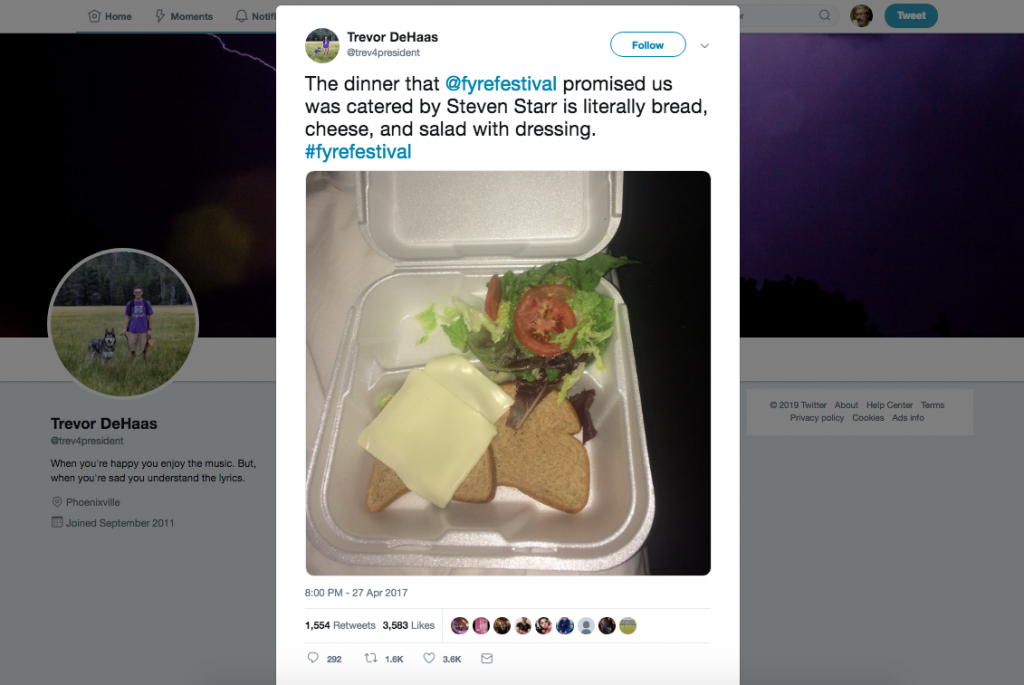
But this is where things really get interesting. According to The New Republic, the Netflix version of the story may be an attempt to rehabilitate the reputation of the festival’s much maligned promoter. The full article is worth the read and contains fascinating information about how this scam materialized. For example, Kendall Jenner was paid $250,000 for one Instagram tweet promoting the festival. As MCCNM student Monique Cousin observed, “it was Instagram that created the buzz for the festival, and one tweet of a cheese sandwich that brought it down.”

The infamous cheese sandwich pic

The article concludes with this caution…”Fyre Festival is a story about insidious digital marketing, corporate irresponsibility, and the misdeeds of a handful of men who control the images that appear on your social media and shape your opinions.”

The event billed as “the cultural experience of the decade” turns out to be just another warning of eminent danger ahead for those who can’t read the signs of the times.

A Teachable Moment at the Lincoln Memorial

Last week in class we spent some time laying the groundwork for our study of mass media and the societal effects of modern communications technologies. To understand media you have to understand communication and that begins with the ancient art of rhetoric and the modern study of semiotics and how we share and process symbols.

We discussed how we, as human beings, are born communicators. We like to connect with others and share our experiences. We are constantly communicating even when we’re not aware of it. We cannot NOT communicate. We discussed how everything that we SAY (or don’t say) and DO communicates…including our choice of clothing, our body language, and our use of space.

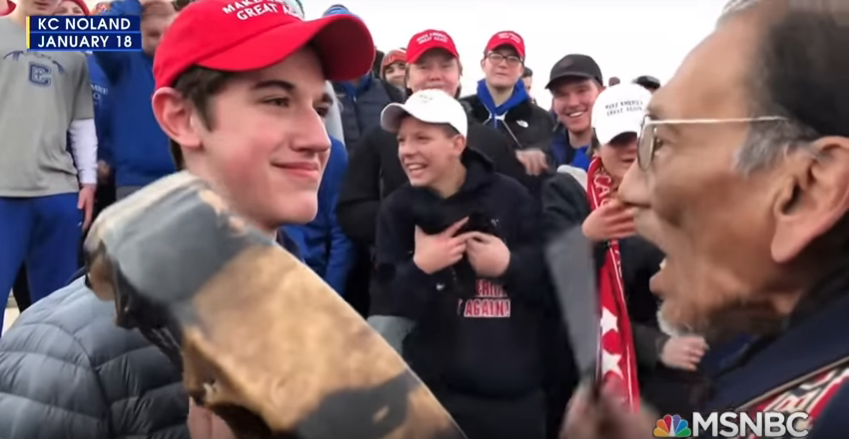
Covington Catholic High School student Nick Sandmann and Native American Nathan Phillips on the steps of the Lincoln Memorial

These points were illustrated and driven home in a video that circulated over the weekend. You might recognize this frame from a video clip that went viral on social media. The students had participated in the March for Life demonstration earlier in the day and were waiting for their buses to arrive to take them home. As you can see, some of the students (including Sandmann) are wearing MAGA hats. Phillips, an activist and Omaha tribal elder, had participated in The Indigenous Peoples March earlier in the day. A third group, members of the Black Hebrew Israelites sect, were also present and a factor in what transpired.

A real problem here is that many made up their minds about what happened on the steps of the Lincoln Memorial on Friday based on very little evidence…and evidence that may have been carefully selected to present a particular narrative. If you are willing to invest a bit of time to dig a little deeper, and are willing to keep an open mind, you may find out that your initial gut reaction is not entirely supported. In fact major news organizations are updating their initial posts and writing new commentaries to include evidence that became available in a number of long, unedited, videos posted to YouTube. You can find links to these videos in a commentary posted at the Reason.com website.

This week we’ll explore issues related to social media including: viral videos, manufactured outrage, public shaming, and doxing. This weekend’s events contains all of these and more. Later in the semester we’ll explore “fake news” and how confirmation bias and uncritical thinking are key factors in how so many are so easily misled by propaganda and biased reporting.

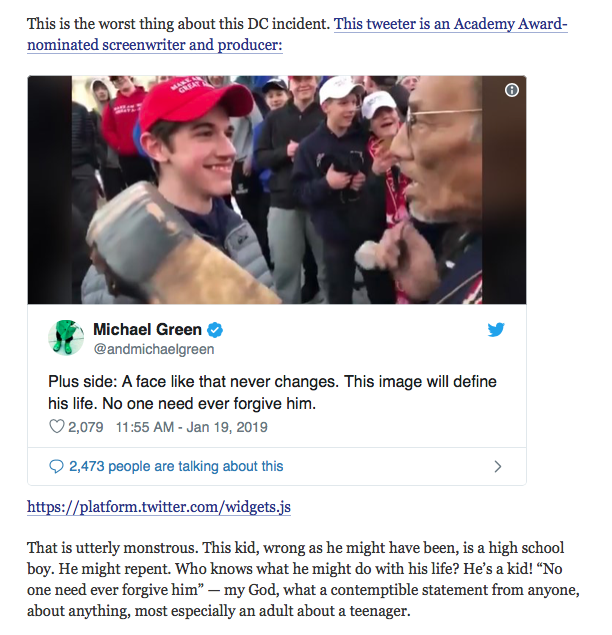
The screen shot on the left includes a tweet from Michael Green, a film and television screen writer. The commentary before and after the tweet is by Rod Dreher, an author and writer. You might consider the fact that Green and Dreher are modern-day storytellers and mass media heavyweights. They are shaping our culture and telling us how to think about the issues of the day. But they clearly see things from very different perspectives.

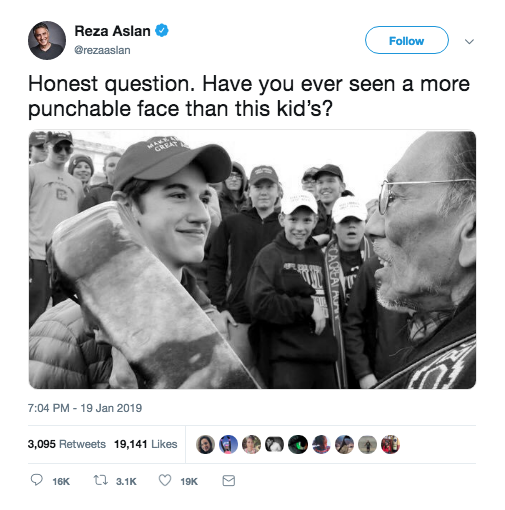
Former CNN host Reza Aslan appears to be endorsing violence as an appropriate response

On this day set aside to honor the legacy of Reverend Martin Luther King, Jr., it is important to remember that racial bigotry remains and must be confronted at every opportunity. But as Reverend King reminded us repeatedly, only love drives out hate. Hatred is easy, fast, and decisive. Love is hard, slow, and often unsure. The choice is ours.

Are you a soldier or a scout?

Unconscious bias infects our every thought and decision. It is a given, and most of the time we learn to live with our own (and with others’) biases. However, as media content producers we should learn a few best practices to minimize the effect of our personal biases if we want to rise above petty partisanship and minimize the reproach of our readers/listeners/viewers. As the Society of Professional Journalists Code of Ethics says, “Seek the Truth and Report it.”

The YouTube video below by Julia Galef explains how we approach new information from different perspectives when we’re acting as a soldier or a scout. The “soldier” is seeking to win the battle, while the “scout” is simply trying to understand the context and the facts on the ground.

This concept also applies to the role of media consumer. When you’re consuming new information try to step outside of your team/group identity before you rush to judgement. Try to adopt a scout mindset, especially when confronted with information that counters your existing values and opinions. If we can all take a small step in that direction we’ll find that truth is much more likely to begin to chip away at our unconscious biases.

How NOT to Promote Voter Registration

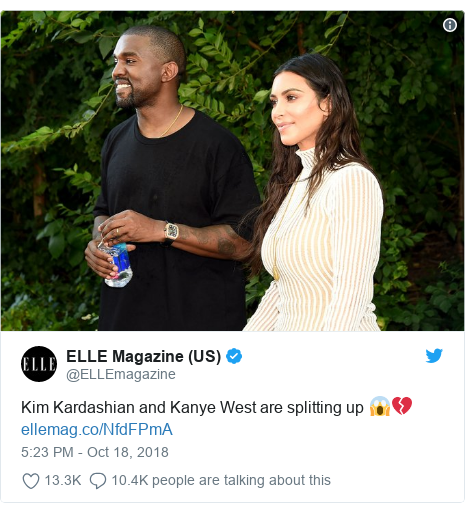
Elle magazine may have had good intentions, but their strategy to encourage readers to register to vote was terribly misdirected. Here’s the tweet that Elle sent out to its followers:

The catch is that Kim and Kanye are NOT breaking up, and the link provided takes users not to a news story but to a Voter Registration website. What some have called “trolling for good” is anything but good for media credibility which is already suffering from years of decline.

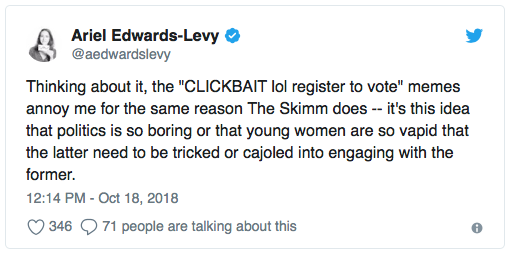
Some saw the stunt as a slap in the face of young women who are frequently depicted as politically unengaged and only interested in celebrity news.

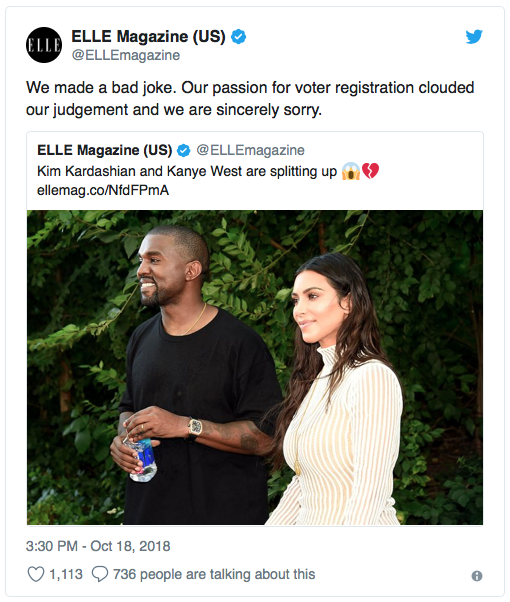
Which led Elle to tweet an apology for the original tweet; a reminder once again that social media gone wrong is a constant threat to brand credibility.

css.php