Cops Pulled from Lineup

After more than 1,000 episodes, the longest-running reality TV show is coming to an end. Paramount Network, in response to public outcry over the death of George Floyd, has pulled Cops from production, making the 33rd season its last.
Cops started in 1988 during the WGA strike that crippled the production of scripted TV programs. The show quickly developed a following as viewers tuned in to ride-along and observe the “real-life drama” that happens in the parts of town that they wouldn’t dare drive through on their own.

Using a cinéma vérité approach to bring policing to the small screen, Cops and various spin-offs that followed became low-cost programing hits. But the dramatized portrayal of crime and punishment as spectator sport left critics disturbed about the way that it portrayed the “stars” of the show. With recent scrutiny focused on police brutality, especially towards suspects and victims who are minorities, the fate of the long-running program was sealed.

But reality TV shows are only part of the equation. With scripted dramas like Law & Order, CSI, and Blue Bloods also under the magnifying glass, we may be witnessing the start of a new approach to how we tell stories about law enforcement and the people who serve as first responders. For decades crime dramas have made up a significant portion of prime-time TV schedules, and for decades we have known that the portrayals of victims and perpetrators have not reflected reality. As I’ve said before, art is a mirror…but it is a funhouse mirror that distorts reality and alters perceptions.

According to IMDb’s entry about the Cops TV program, “The theme song, ‘Bad Boys,’ is one of the most well known television theme songs in the last 30 years. The lyric, “what cha gonna do when they come for you?” takes on new meaning when the bad behavior of law enforcement officers is in the spotlight.
Reporting on the Pandemic When Experts are Wrong

It is still early to be performing a critical analysis of the handling and reporting on the Covid-19 pandemic of 2020. But that won’t stop others from doing so…so let’s take a minute to reflect on how journalists are doing, and whether there are lessons to be learned.

Lesson #1: most journalists are woefully unprepared to report on complex medical issues under crisis-induced deadlines. Economic realities on the ground mean fewer reporters overall, and fewer with the kind of specialized training needed when reporting on the most complicated topics, e.g. science/medicine, international policy, and economics, all of which are part of this complex story. That’s why we need more specialized journalism outlets like Stat to turn to for expert reporting.

Lesson #2: experts consulted by journalists were either intentionally or unintentionally misreporting the data, and the level of skepticism by journalists was insufficient. Taking the word of China’s authoritarian leadership, the World Health Organization, and our own medical experts and policy leaders has turned out to be, on some level, a mistake.

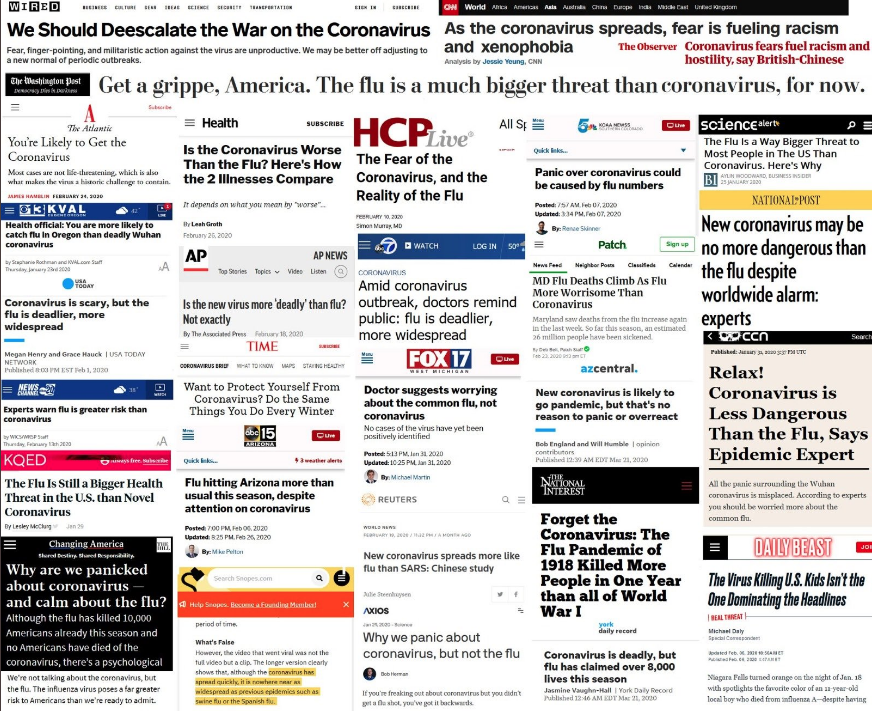
Lesson #3: political partisanship has clouded the reporting. The hyper-partisan climate in our country, and the partisan divide that separates news consumers into left/right echo-chambers, has made it extremely difficult to separate fact from opinion. The collage below was put together for partisan reasons by someone who was trying to deflect the current blame game about “who knew what and when did they know it.” It is easy to see how bias creeps into reporting when so much is at stake in an election year.

Collection of dubious news headlines

There are plenty of additional lessons to be learned, and there will be plenty of time to learn them once the crisis has been averted. But for now it would do us all well to have a bit more humility when confronting what we don’t know, and a bit more skepticism when “experts” declare their “truth” about this deadly pandemic.

UPDATE: This quote from Recode captures another dilemma facing journalists.

This core challenge for journalists won’t go away after the pandemic: There are always going to be threats that could eventually lead to disaster, but most of them don’t. If we holler every time we see one, we’ll be wrong and no one will listen to us. If we don’t holler when there’s a real one, we will have let down our audience.

Bloomberg Buys Instagram Influencers

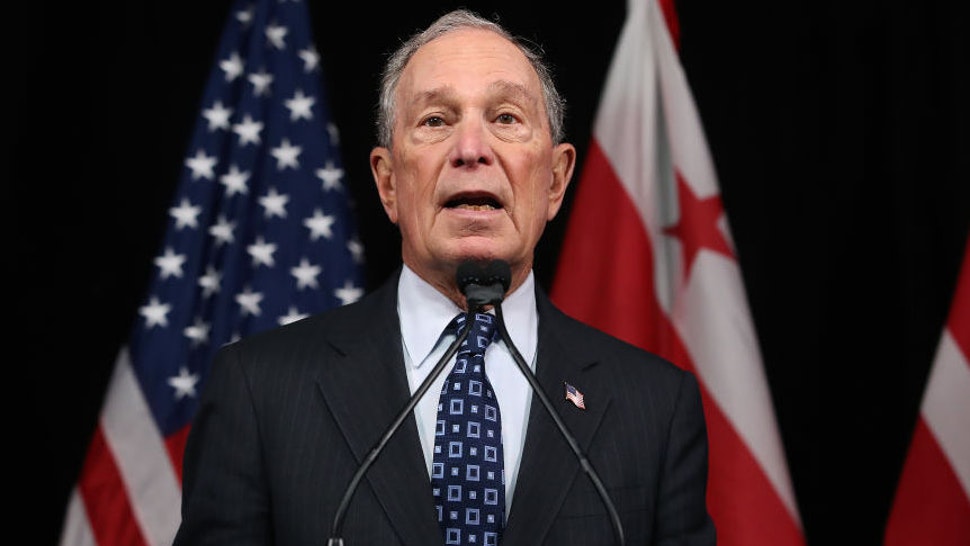
Former NYC Mayor Michael Bloomberg

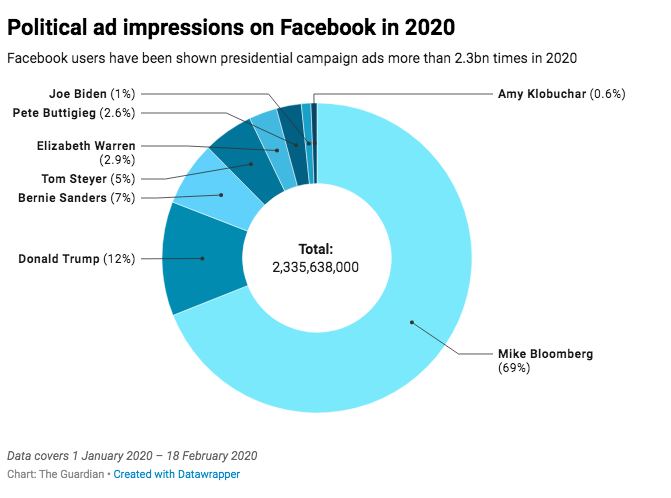
Former NYC mayor Mike Bloomberg is a candidate in the Democratic primary for the 2020 Presidential race. Having built a fortune of more than $60 Billion with his financial news business, Bloomberg is financing his own campaign and has already spent more than $400 Million of his own money. To give you some perspective, the chart below, from the Guardian newspaper, shows you how many advertising impressions each of the candidates have purchased on Facebook in the first six weeks of 2020.

Drawing fire from all sides, Bloomberg is accused of trying to buy the election and that fear was amplified last week when news organizations reported that his campaign is paying Instagram influencers $150 a pop to post memes that will make him look “cool.” Using influencer marketing on social media is nothing new, and is certainly a powerful way to reach younger demographics, but is has never been used at this level for presidential political campaigns.

The huge media buy leading up to Super Tuesday gives every impression that money is no object for this billionaire businessman. So if you have a lot of followers on IG, and want to cash in some of that “juice,” this presidential candidate with deep pockets may want to make you an offer.

VR: A Time to Grieve

Sometimes, when reality punches you in the gut, it is tempting to turn to “unreality” to escape. It may be as simple as turning to a sitcom or videogame after a difficult exchange with a roommate or family member. We’ve all done it, because it works…it distracts our mind long enough to let the negative emotions ebb and gives us time to return to a more comfortable emotional place.

At other times we turn to fantasy to intentionally trigger an emotional response because we enjoy the “feelings” that serve to remind us of our humanity. We read a romantic book, watch a funny TV show, or go to an action-adventure movie for the experience that each emotional experience brings.

But what about a recreation of something from our past for the purpose of giving us an opportunity to re-live an emotional moment? And what if that recreation could be a fully-immersive experience made possible by VR technology?

According to the PC Gamer website:

A South Korean TV documentary that aired on February 6 depicts Jang Ji-sung, mother of four, donning a headset, haptic gloves, and meeting a virtual recreation of her daughter Nayeon…Nayeon died in 2016 from an incurable disease at only seven years old…the documentary production team spent eight months building Nayeon, including her actual voice. An elaborate park scene was the backdrop, where the two played and celebrated Nayeon’s birthday. 

I’m interested in know what you think…is this a healthy use of technology that will facilitate emotional healing?

The Cost of Personal Privacy and Security

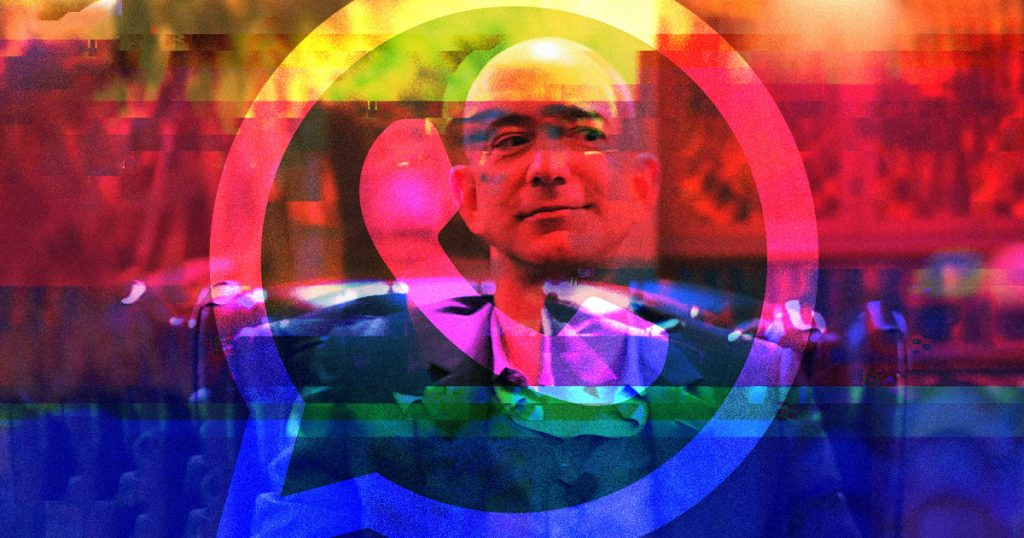
If you’re the richest man in the world you would think that you could afford the highest level of security for your personal data and information. And if you’re Jeff Bezos, you would hope that your phone would be safe from hacking by enemies wanting to expose your secret affairs.

According to allegations by United Nations investigators, Saudi Arabia’s Crown Prince Mohammed bin Salman may be behind the hack of Bezos’ iPhone gaining access through the WhatsApp messaging service. Possible motivation for the hack is the fact that Bezos owns the Washington Post newspaper, who employed writer and columnist Jamal Khashoggi, a staunch critic of the Crown Prince. Despite denials by the Saudi Prince, the alleged murder of Khashoggi in October of 2018 is believed to have been carried out by hit men employed by bin Salman.

There are multiple stories and plot lines of interest to Hollywood producers, but also for those of us interested in the intersection of media, politics, and technology. As our phones become more and more intertwined with our moment-by-moment activities and our most private and intimate actions, they leave us vulnerable to commercial manipulations and privacy violations. No one is safe. WhatsApp, one of the most popular encrypted messaging apps in the world, prides itself in a high level of security. According to their website, “Privacy and security is in our DNA.” 

According to Vox, “The alleged hack shows that security online is never guaranteed, even on this very popular Facebook-owned encrypted messaging app. And that’s something to keep in mind even if you aren’t a billionaire.”

YouTube Takes Action to Protect Children

If you have children of your own, a younger sibling, or nephews and nieces, there’s a good chance that they spend a good amount of time online, and often that time is spent on YouTube. For preteens, YouTube is the top destination for streaming media content. And why not? It’s free, constantly updated with fresh content, and a lot of it is pretty entertaining.

But in recent years YouTube has attracted criticism for not sufficiently protecting children from potentially harmful content. They’ve also been criticized for profiting off of children’s personal data. In 2019 that led to a $170M fine from the FTC for a violation of COPPA (the Children’s Online Privacy Protection Act).

In response, YouTube has just rolled out new policies to limit the downside for children and (let’s be honest) to minimize YouTube’s exposure to future fines and litigation.

Starting today YouTube will require content creators to identify content designed for a younger audience. That content will no longer allow commenting, live chats, push notifications, and the ability to save videos to a playlist. All of these changes are designed to reduce the amount of data that YouTube collects on its younger audience members. YouTube is also eliminating targeted ads around this content.

While this is a great first step, critics say that more needs to be done to ensure that YouTube is a safe environment for children. One options for parents is to use the separate app, YouTube Kids. This app provides more parental control features and its content is more carefully curated by YouTube.

Makeup Tips, With a Side of Political Activism

New Jersey teenager and Afghan immigrant Feroza Aziz offers beauty tips online…or does she? In the following clip you can watch a portion of the video that led to her account being suspended by TikTok.

After its initial action censoring Feroza, TikTok backtracked and claimed that her account was suspended for a different video. But few are believing that explanation. TikTok has already drawn scrutiny because of concerns over its political ties to China and this incident is being offered as an example of what happens when free speech and religious freedoms are compromised for political ends.

In this short interview the 17-year-old says that “anyone can do it” (raise awareness) and that she’s not scared of TikTok.

Zuckerberg v Dorsey, round 1

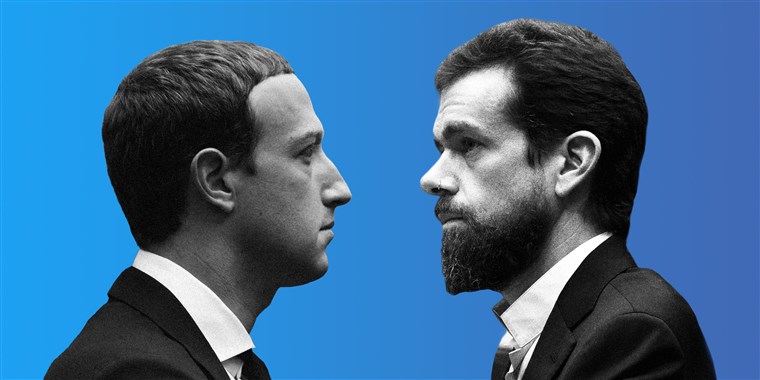
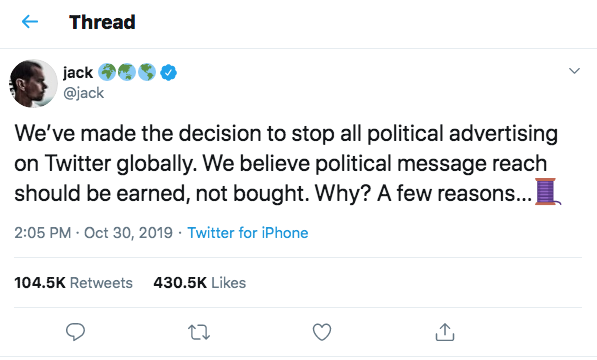
Jack Dorsey, head of Twitter, just announced that political advertising will not be allowed on his platform. Meanwhile, Mark Zuckerberg, head of Facebook, will allow political ads and has taken a hands-off approach to policing political ads for false or deceptive content. The stakes are high and the debate is contentious.

Regardless of your political views, you can easily see how these different policies are complicated by very real and important foundational issues. First up is freedom of speech. In the US Constitution, freedom of speech as enshrined in the First Amendment is at the center of this debate. First and foremost the First Amendment protects political speech…which includes political advertisements. Those who are First Amendment absolutists argue that the solution to wrong speech is not banning speech. Rather, the solution is to allow MORE speech. In the end, they argue, truth will win out as long as everyone is free to speak and present their views. Score one for Zuckerberg

If you have a lower view of human nature you might argue, yeah, but advertising is paid speech, and those with the most money can afford the most advertising and most sophisticated advertising strategies and campaigns. Free speech is great, but allowing people with money to distribute political messages to the masses without any responsibility to speak truthfully will result in many people being deceived and manipulated for political ends. Score one for Dorsey

I could go on but am more interested in your thoughts. Which of the arguments articulated by Zuckerberg and Dorsey resonate with you?

With $B at Stake, NBA Not Sure Freedom is Worth It

How much is freedom and free speech worth to you? You may never know until it costs you something. That’s what the National Basketball Association and star players are discovering in the wake of a tweet-storm that began with a statement by Houston Rockets general manager Daryl Morey in support of the Hong Kong protestors. Because of the nearly 300 million NBA fans, political statements about China come with a price-tag.

First a little background. Hong Kong was a British colony for 99 years and was returned to Mainland China in 1997. China, known for its record of authoritarian rule and suppression of human rights, has been criticized by much of the Western World for imprisonment of dissidents and persecution of religious and cultural minorities. The current protests in Hong Kong have been widely embraced by those around the world who want China to end its battle against human rights.

In response to the tweet from Morey, the NBA issued its own statement calling it “regrettable.” A few days later LeBron James said that Morey spoke too soon, that he “wasn’t educated on the situation.” What situation exactly James was referring to is unclear.

LaBron has a history of speaking out about social issues here in the USA. If he believes that human rights deserve world-wide respect, he owes it to his fans, and to the people of China, to stand for the protestors in Hong Kong. Yes, standing up for human rights and free speech does come at a cost…in this case the cost is more than lucrative contracts and endorsement deals.

According to an editorial in Slate,

The league has certainly not covered itself in glory in its handling of the blowback over the Morey tweet and, in the process, reminded fans across the U.S. that the NBA is, at its core, still a profit-seeking international organization serving multiple constituencies of which the most important one is money.

Elliot Hannon

LeBron was right about one thing…before you wade into politics on social media you need to consider the cost.

Facebook Takes Down Political Ads…

..but not for reasons that you might suspect. According to an article in BuzzFeed, Facebook has taken down a slew of political ads from most of the leading Democratic candidates, and President Trump, for reasons that have some political observers shaking their collective heads.

The leading reason for taking down ads? Fake buttons. That’s right, building the appearance of an interactive button into your ad is grounds to have your ad “banned” by Facebook. And I have to say, as someone who has a personal vendetta against fake media player buttons (see below), this is a well deserved take-down.

Go ahead and click the “play” button…

Clicking on the Play button above doesn’t do anything (sorry to disappoint you) and if I were really sneaky I would have created a link to another website where I would have tried to sell you something.

But back to political ads…fake buttons is just the leading reason for being disqualified by Facebook. Other reasons include profanity, broken links (aka bad landing pages), and violating local disclosure rules.

The one thing that will not get your political ad banned from Facebook? Lying. That’s right, if your campaign makes a statement that doesn’t check out with reality…well, that’s left up to FB users to decide. So it’s on you to figure out who’s telling the truth. As they used to say in Ancient Rome, caveat emptor.

css.php