Can Anyone be a Journalist?

By now you may have heard the term “citizen journalist.” The idea is that as newspapers and news magazine fold, professional journalists will go the way of the dinosaur. In their place will rise up a league of citizen journalists who will report, write and publish the new news. Because the barrier to entry is so low, anyone with a computer and some rudimentary computer skills can own and operate the “press.” Thanks to the internet they can also reach a global audience.

We already have citizens doing the jobs of professionals. Typically they do the job for less, often for free, and the final product often reflects that. We have citizen barbers. You can recognize their kids by their trendy, non-symmetrical haircuts. We have citizen graphic artists…who feature their work on the sides of railroad cars and vacant buildings. And we have citizen pharmacists…sometimes we refer to them as drug dealers. Okay, I’m being just a bit facetious and completely unfair, but you get my point. If everyone could do it, and do a good job, there would be no need for professionals. So my question is: can anyone be a news reporter…and if so, why have we had professional journalists all these years?

Personal note to Dr. Ross…just playing devil’s advocate for a moment. 😀
Citizen Investigative Reporter in Hot Water

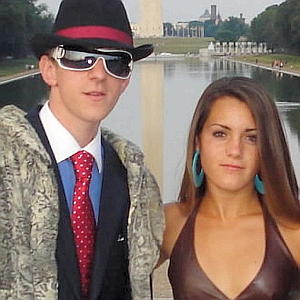
Free-agent investigative reporter James O’Keefe has switched professions from pimp to telephone repairman. O’Keefe gained fame (or notoriety) last year when he posed as a pimp to record ACORN employees advocating illegal and unethical practices. His undercover sting won him praise from conservatives who have long suspected ACORN and led to congress cutting off funding for the community organization with links to Obama.

However, O’Keefe’s  use of undercover cameras and deception raised red flags for journalism’s leading ethicists. Journalists have a long-standing tradition of investigative reporting practices, but they also have strict guidelines that must be followed to avoid the pitfalls associated with this ethically gray area.

Now, it appears, O’Keefe’s questionable practices have landed him in hot water. Yesterday O’Keefe and several of his partners were arrested on charges of tampering with phones at Democratic Sen. Mary Landrieu’s office. While we do not yet know their motives, there may be a tie to the healthcare reform deal that Landrieu struck with her Democratic partners. The deal reportedly gained her state millions in additional Medicare funds in exchange for her vote of support.

What’s the lesson for students of journalism? As exciting as investigative reporting may appear on TV, the practice of investigative journalism is a lot more difficult, tedious, and boring than it seems. To do it right, you’ve got to spend a lot of time ensuring that your methods do not cross the line that separates good journalism from shoddy and unethical vigilantism. One more thing…if you want to be a citizen journalist, best to focus on straight news reporting for awhile and leave the investigative reporting to seasoned journalists who understand the ethical issues involved.

P.S.  The name of O’Keefe’s video company is Veritas Visuals. We’ll have to wait and see if veritas (Latin for truth) comes to his defense!

Social Networking Contest Contains Lessons for News Media

Last week the Defense Advanced Research Projects Agency (DARPA), the folks responsible for bringing us the Internet, sponsored a contest that may result in some interesting data about how we use social media to gather and disseminate information. The goal of the contest was to provide the location (longitude and latitude) of 10 red, eight-foot-wide weather balloons that had been placed at various locations within the continental US. It took the team from MIT just 9 hours to win the contest, and the $40K prize, using a diverse strategy combining social media collaboration with reward programs. But some of the teams also took a walk on the dark side when they employed deception intended to sidetrack competing teams.

So, what does this have to do with media and journalism? Think of every breaking news story as a contest. The first journalistic team to crack the story and file the report is rewarded with ratings/readership/reputation, etc., all of which translates into monetary rewards for the winning team. How does NBC,  CNN, the BBC, or People Magazine “scoop” the competition when they’re working a breaking story? They may try to buy an “exclusive” interview with a key player. When President Kennedy was assassinated in Dallas, TX, Dan Rather, a reporter for CBS, became aware of Zapruder’s 8mm film of the assassination. He asked for permission from the top CBS brass to buy the film for $10,ooo, but that turned out to be too little, too late. Zapruder had already sold the film and rights to Life magazine for $150,000! And if you think that’s a lot of money, the 6-foot long strip of celluloid with 494 frames, lasting 26 seconds, was later purchased by the US government for $16 million!

Today, news organizations may use social media networking to mobilize reporters and stringers who work for the news organization and perhaps even try to recruit “citizen journalists” who may have inside information. Twitter and other social media tools can be used to disseminate information and to recruit collaborators.

The DARPA contest may actually provide some insight into the process of collaboration and even intentional deception using social media. Hopefully the news media are above floating fake balloons to try to fool the competition. But sadly, whenever money is at stake there are people willing to bend the rules.

Read more, or listen to the story, at the NPR website.

Tiger’s Public Transgressions

Many of us wish this story would just go away, but it won’t…so here are a few lessons for students of the media.

#1: ALL celebrity endorsement deals come with some risk. If you had asked executives at Nike, Gatorade, etc. whether there was risk associated with hiring Tiger Woods as a celebrity spokesperson, they likely would have replied that the risk was minimal. But if they thought it was zero, they were wrong. Will it do long-term damage to their brands and to the Tiger Woods brand? It is too soon to tell, but there will be fall out for Tiger and every other celebrity that has a “squeaky clean” image.

#2: Crisis Management PR has changed dramatically in the age of cable news, the blogosphere, and the twitterverse. PR agents have got to get ahead of the story and be much more transparent than in the past. Remember, the media (both traditional and new media) exist to uncover and distribute “dirt” and attempts to stonewall will only compound the problem.

#3: As we’ve been reminded recently by the parents of balloon boy and the White House party crashing Salahi’s, reality TV culture makes people do crazy things for their 15 minutes of fame/notoriety. Anyone remotely “connected” to the Tiger Woods drama will see opportunity to cash in by playing the tabloid media. Releasing cell phone messages and scheduling press conferences strings along the media and extends their window of opportunity.

#4: <editorial warning>There is no such thing as a private “transgression.”</editorial warning>

One more about Accuracy…for now

apOkay, I don’t want to beat a dead horse or overstay my time on this particular soapbox, but here’s one more article (this one from the AP) that raises serious concerns about recent misfires in major media coverage. The following quote, from the end of the linked article, captures the essence of the change that is sweeping the news business…pushed largely by the 24-hour news cycle of cable TV and the minute-by-minute updating possible on the web.

Nowhere was the new landscape more vividly illustrated than this month when Nick Denton, chief of the irreverent Web site Gawker.com, issued a memo scolding his staff for a few cases “where we’ve thought WAY too much before publishing” a story.

Get something out fast with what we know, Denton wrote. We can always update.

“At some media organizations, you might get rapped for running a premature story,” he wrote. “At Gawker Media, you’ll lose way more points for being scooped on a story you had in your hands.”

Balloon Boy Makes My Point

hoaxWhen I posted my blog entry about accuracy in the media last week, it was the day before the Balloon Boy story broke. Since then we’ve been served a non-stop drama that started with a young child at risk, progressed to a possible media hoax, and reached a crescendo with apparent criminal charges filed against parents Richard and  Mayumi Heene. The media circus that gave birth to the spectacle is now feeding off of the dead carcass and will continue to do so until all that remains are bleached bones. Would-be actors who craved instant fame got infamy, which they will now try to peddle to unscrupulous reality show producers and tabloid publishers. There’s even an online video game based on the whole sordid affair. The one bright spot in all of this, if there is one, is that Colorado law prevents criminals from profiting from their criminal actions. Forgive me if I come across as harsh and skeptical…but perhaps a healthy dose of skepticism was what was needed last Friday.

Accuracy of News Media

One of the most sacred tenets of journalism is under fire. Recent surveys point to disturbing trends with regard to perceived accuracy and demand for accuracy from our news media.

According to recent findings by the Pew Research Center for the People and the Press, the public’s assessment of the accuracy of news is at its lowest level in more than two decades. Less than 30% of Americans surveyed believe that news organizations generally get the facts straight, while 63% say that news stories are often inaccurate. That is a dramatic reversal from 1985 when 55% said news stories were accurate while 34% said they were inaccurate.

What may be more disturbing is the view, held by some, that consumers of web news prefer speed over accuracy.  According to consultants to The Columbus Dispatch, readers prefer getting the information sooner rather than later, even if it means that there is a greater chance that the information is inaccurate. These ideas–that readers want to be “part of the reporting process” and “over time, the truth will come out”–are at odd with one of the sacred cows of journalism.  The mantra has been repeated over and over…you’ve got to get it fast, but you’ve got to get it right. Does that mean that you wait to publish until you’re 99.9% sure of the accuracy of your story? That may depend on whether you want to be known for scoops or for consistently reliable information. If you’re an old-school journalist it may be that your commitment to accuracy is what sets you apart from the bloggers, citizen journalists, and advocates who are willing to take more risks.

The State of the News Media

state_of_news1According to The State of the News Media, a report by the Pew Project for Excellence in Journalism, audiences for news are shrinking and advertising revenue is falling. News magazines and newspapers have lost the most readers, followed by local and network news. On a positive note, internet and cable TV news are attracting new viewers. The down side is that internet news users are still difficult to sell to advertisers.

The other problem with internet news is that many online news outlets don’t do much if any news reporting…they simply aggregate news from various sources, e.g. Associated Press and Reuters, and bundle them for visitors to their websites. This model is unsustainable if the ones actually doing the reporting are not sharing in the revenue generated by the online advertising. As newspapers fold and reporters are laid off, there will be fewer stories available to the online portals such as Yahoo! and Google news. In some ways it mimics the change that our country has seen over recent decades. We have moved from manufacturing to a service economy. No one wants to make things anymore, and it seems that no one wants to “produce” news content. Without reporters in the field making calls, conducting interviews, showing up at events, and keeping their ears to the ground, the future of journalism looks bleak…and news organizations are scared.

So if your business model is broken and your source of income is in jeapordy, what do you do? Just last week the Associated Press (AP) announced that they would take legal action against aggregators (such as Yahoo! and Google) who use their headlines and news excerpts without paying copyright premission. While Google pays AP for full articles that it carries on the Google website, the problem pertains to Google’s, and other aggregators’, use of headlines and excerpts. News aggregators have argued Fair Use and say that they drive traffic to the AP website in return for using a short bit of the news copy. In this difficult economic climate, the battle is about power, prestige, and, ultimately, survival.

Late Night with Prez Obama

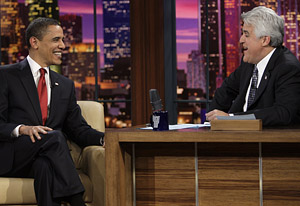
NUP_134498_0162Last night President Obama made history when he became the first sitting president to appear on the Tonight Show. While Washington D.C. was embroiled in the AIG bonus scandal, our Chief Executive was discussing policy, and his bowling score, with Jay Leno in Hollywood, CA.  Something about it all seemed slightly unseemly and a little bit strange… as though the leader of the free world was seeking the kind of exposure that late-night TV hosts typically provide to comedians and film stars. Usually “the press” travels to DC and the White House to interview the president. There’s a certain seriousness demanded by the office and the oval office that bestows a sense of gravity to the whole affair…a gravity that is sorely lacking on late-night TV.

Some have argued that this is just the sort of relief that the American public needs when the economic hardship and the resulting rancorous debate in Washington has us all feeling slightly under the weather.  According to this line of thinking,  a little levity from the chief executive might provide some relief from our misery. But I suspect that Neil Postman might see it differently. Postman was a media theorist, and author of Amusing Ourselves to Death: Public Discourse in the Age of Show Business. According to Postman, television is wholly unsuited for serious discourse and trivializes the most important of issues. Postman would not have been surprised that an American president would appear on a late-night comedy show. In fact, he would probably conclude that this was the inevitable outcome of a society preoccupied with entertainment and enraptured with celebrity. In his book Postman provides a short history of politicians intentionally presenting themselves as sources of amusement. JFK allowing the camera crew of Ed Murrow into his home, former President Richard Nixon appearing on Laugh In, former President Gerald Ford and former Secretary of State Henry Kissinger taking brief roles on Dynasty, Tip O’Neill showing up on the sitcom Cheers, and Mayor Ed Koch hosting Saturday Night Live…these and other examples demonstrate that political celebrity is nothing new. President Obama’s actions simply take it to a new level.

And what is the result?  Postman concluded that, “Americans are the best entertained and quite likely the least well-informed people in the Western world.” I wish he were wrong.

css.php