Are we all ADD now?

Black and Blue, or While and Gold? It’s the question that appears to have captivated the ever-so-brief attention span of the online world. The more philosophical are asking again the age-old questions; what is the nature of reality and perception?…and, can we ever know for certain what we think we know? Yes I’m talking about #TheDress. And if you haven’t been paying attention, suffice it to say that the “twitterverse” has been embroiled in a heated debate about the real color of a dress that was worn to a wedding in Ireland. Here’s just one of the many tweets having a bit of fun with the whole thing.dress
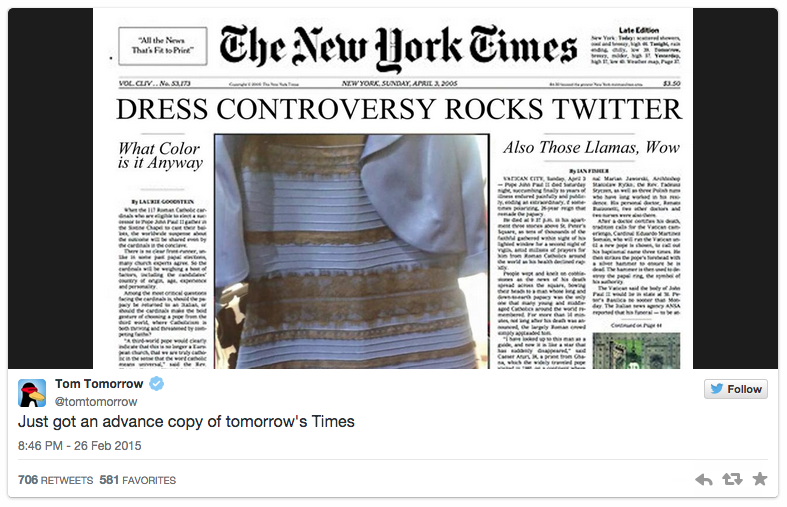
Well, that was before the llamas got loose in Arizona…which was just briefly before Leonard Nimoy passed away. We are an easily distracted lot, humanity. One might argue that we need a distraction every now and then to give us relief from the pressure and demands of real life.

But seriously, is this what we’ve come to expect from our media? Was there nothing important going on in the world at the end of last week? Oh yeah, there was. “Jihadi John” was  identified as a college grad from West London; Net neutrality was adopted by the FCC (thanks, perhaps, to John Oliver); and a Russian politician, and foe of Putin, was executed on a city street.

But perhaps there is an explanation. According to this article by Mel Robbins at CNN, “the emotions that make a story go ‘viral’ are not fear and anger — they are awe, laughter and amusement.” Well, there you go. I feel just a little better now about #TheDress and #LlamaDrama.

David Carr, Gone at 58

At the risk of this blog becoming a collection of obituaries, it is important to recognize the passing of a man who The New York Times executive editor called, “the finest media reporter of his generation.” Arthur Ochs Sulzberger Jr., the Time’s publisher and chairman, said, “David Carr was one of the most gifted journalists who has ever worked at The New York Times.”

David Carr, media reporter for The New York Times newspaper, was an enigma. No one who knew him in his earlier life as a crack addict and single parent on welfare could have seen his rise to celebrity reporter for, arguably, the greatest journalistic enterprise of the modern age.

In his regular Monday column, The Media Equation, Carr dissected the media industry and many of its key players. His writing was often acerbic but always insightful. If all that you knew about the media industries was what you read in David Carr’s columns, you’d be pretty well-informed. If he hadn’t died last week I’m sure that he would have had something pithy to say about the 3.5 hour-long 40th anniversary of SNL that aired this past weekend. And you can be sure that he’d have written something both relevant and revealing about the upcoming Academy Awards telecast this Sunday. Carr did live long enough to weigh in on the very public implosion of NBC News anchor Brian Williams and his article will give you insight into both Williams and Carr, (and the delicate balance between fame and trust), if you take the time to read it.

You can read more about David Carr at the NYT website. Or, for the visually-inspired crowd, watch Page One, a documentary about The Times, in which Carr has a starring role.

When the News Reporter Becomes the News Maker

Brian Williams, anchor of NBC Nightly News for more than 10 years, is stepping down from his nightly responsibilities. While it is unclear for how long he will be gone, it is a sign that Williams and NBC are beginning to take seriously the damage that has been done to his professional career by his failure to accurately remember (or his intentional misrepresentation of) events that took place in the recent past.

At question is an incident while reporting on the war in Iraq. According to various recollections by Williams he was in a helicopter that was either under fire, took a hit from an R.P.G., and/or was forced down. Military personnel who were there recall it differently and have been upset that Williams has been twisting the facts to make it appear that he was in greater danger than was the case. In a separate case, Williams’s reporting after Hurricane Katrina is also being questioned.

Social media has not been kind. The hashtag #BrianWilliamsMisremembers has dogged Williams since the story broke and fellow journalists are not coming to his rescue. Some are piling on, according to the New York Times. “Brian Williams will be fine,” Andy Levy, a Fox News commentator, wrote on Twitter. “If he can survive being hit by an R.P.G., he can survive this.”

Journalism is a business that trades in credibility and the fair exchange of accurate information in a timely manner. If any part of that equation is missing, the value of the information plummets. For a network anchor who is reported by the New York Times to be worth about $2M a year, the loss of value is significant. According to the Times, at his recent contract negotiations “Deborah Turness, the president of NBC News, called him one of ‘the most trusted journalists of our time.’” Also according to the Times,

Before the episode, Mr. Williams long had been considered one of the most trusted people in not only in the news business but in the country as a whole. He was trusted by about three-quarters of consumers, making him the 23rd-most-trusted person in the country, according to the celebrity index of The Marketing Arm, a research firm owned by Omnicom. That places him alongside the likes of Denzel Washington, Warren E. Buffett and Robin Roberts.

That was then, this is now. Brian Williams’s credibility is on the line and only time will tell if American consumers of news will forgive him the lapse in judgement.

Don’t Shoot the Messenger

Newspaper headlines this morning provide another grim reminder that terrorism by Islamic extremists is often directed at media outlets and media professionals who dare to poke them in the eye. What constitutes a “poke in the eye” is partly the issue. In this particular case, employees of a satirical magazine that caricatured the Prophet Muhammad were executed in a military-style attack by gunmen with possible links to al-Qaida.

It may be difficult for Westerners to understand how a religious insult escalates to this level of hatred and violence, but we certainly have no shortage of examples. You may remember the Benghazi attack that resulted in the death of our ambassador to Libya and two of his security detail. That attack, and widespread rioting in the Middle East, was blamed on the YouTube release of a controversial movie produced in the US. In 2005 a Danish newspaper published cartoons of the prophet leading to widespread riots and  violence in Muslim countries. And the year before, Dutch filmmaker Theo van Gogh was murdered for his film Submission, which took a critical look at the treatment of women in Muslim culture.

Adding insult to injury, a guest oped in today’s edition of USA Today, by radical Islamic cleric Anjem Choudary, suggests that the French newspaper had it coming and blamed the victims for their own fate.

The Social Responsibility model of the press, and the 1st Amendment of the US Constitution, call for a very different response to speech that may offend.

According to an editorial published in today’s Pueblo Chieftain,

It is both a fundamental right and a sacred duty of newspapers to consider and publish all opinions and angles of a news story, including those that are unpopular with certain readers. Any attack on this right is an attack on the very foundation of a free press.

Unfortunately this story, like life itself, it’s a bit more complicated than first appears. Journalism, the kind the 1st Amendment was designed to protect, is morphing into something that might be unrecognizable to our founding fathers. Charlie Hebdo, the satirical French magazine that was attacked today, should not be compared to Time magazine, The Guardian, or Le Monde. Don’t get me wrong, the actions of the radical terrorists is inexcusable…it was brutal, repugnant, and evil, and I am in no way offering a defense of their actions. But I’m also not ignoring the fact that news organizations (and pseudo-news organizations) are increasingly engaging in activities that are not entirely defensible under the old rules of engagement.

Hacking, Journalism, and Moral Treason

The hack of Sony Pictures and subsequent release of salacious emails and other confidential information has been the talk of the town (read Hollywood) in recent days. Much of the information obtained by the hackers (aka Guardians of Peace) is very personal and potentially damaging to careers and reputations of employees, executives, and celebrities connected to Sony. Medical records, compensation packages and their private negotiations…even jokes about President Obama that have a racial component…are on display for all to see.

But the hackers alone cannot do serious damage to Sony without the willing participation of journalists. What the hackers have stolen, journalists are now distributing with the protection of the first amendment and the claim that these are important and relevant issues to be discussed in a public forum.

But not every one is willing to give the news media a pass when it comes to reporting this story. Appearing on Howard Stern’s radio show, Seth Rogen (co-star of The Interview) claimed that journalists are profiting from doing exactly what the criminals/hackers want.

Television writer Aaron Sorkin has been another outspoken critic saying, “Every news outlet that did the bidding of the Guardians of Peace is morally treasonous and spectacularly dishonorable.” Sorkin acknowledges, in his op-ed piece in the New York Times, the importance and role of the media when it comes to whistle-blowing and exposing wrong-doing, e.g. the Pentagon Papers. But he makes a clear distinction between that and these gossipy morsels that have little or no value for the preservation of democratic ideals.

As demented and criminal as it is, at least the hackers are doing it for a cause. The press is doing it for a nickel. ~Aaron Sorkin

I suppose one could argue that this hack reveals facts relevant to issues of importance: gender disparity for celebrity compensation, race-tinged jokes about the President by Sony execs who support him and gave to his political causes, and allegations of journalistic malpractice by New York Times columnist Maureen Dowd. But these exceptions are not what’s generating all the buzz on blogs and social media.

Not too long ago when nude celebrity pictures were hacked from the cloud “real” journalists were careful to keep their distance for fear of being seen as accomplices to the crime. But this time the “gift that keeps on giving” has fewer detractors and the benefit of readers’ fascination with celebrity culture. The hackers have promised a “Christmas gift” of new information while Sony’s lawyers are sending threatening letters to news organizations in an attempt to discourage further dissemination. But if there’s one thing on which we can be fairly certain, it’s that attacking journalists won’t go over well.

Uber’s Image Problem

UberPerhaps you’ve heard of Uber, the smartphone-enabled ride-sharing alternative to traditional taxis. Uber, along with Lyft and Sidecar, work on the premise that a person with a car can offer a service to someone who need a ride, and make a few bucks in the process for both the driver and the company. Now that most everyone has a smartphone–and with real-time location services knowing your every move–connecting drivers and riders is really pretty simple.

But Uber, like the other start-ups, has a few natural enemies. Taxi cab companies don’t like having their business syphoned off by competitors who are not licensed and have little to no overhead.

But it is Uber’s CEO and a senior VP who may become the company’s greatest liability. CEO Travis Kalanick, whose aggressive leadership has been credited with the quick rise of the company, has ruffled more than a few feathers with his aggressive business practices. Uber has been accused of violating its own privacy policy and tracking users for suspect reasons. (You can read more about that on the ACLU blog.) And recently, Uber VP Emil Michael has suggested that Uber should investigate journalists who have been investigating Uber.

Specifically Michael targeted Sarah Lacy, co-editor of the Pando Daily website. Lacy has been critical of Uber’s treatment of women and has been leading the call for Uber to clean up its act. And for that, according to The Tech Bulletin, “A top executive of Uber explained a Nixonian plan to dig up dirt on the journalists who are critical towards Uber and sully their reputations.”

One doesn’t have to be a PR pro to see that this is not a smart move by Uber. Picking a fight with journalists is seldom a good idea. As Bill Greener, press aide to Gerald Ford and Donald Rumsfeld in the 1970’s once said, “Never pick a fight with someone who buys ink by the barrel” (Lewis).

#GamerGate

Over at Vox, Ezra Klein has written an interesting, 25-paragraph essay Gamergate and the Politicization of Absolutely Everything. For those who have not been introduced to the raging debate swirling around the video game industry, gamergate is a controversy that touches on many of the media topics and themes that we’ve been addressing this semester: media effects and concerns related to sexual and violent content, politically incorrect stereotypes, censorship, and journalistic ethics just to name a few. Here’s Gawker‘s attempt to explain what all the fuss is about. Want more?  Here’s a great article by Erik Kain at Forbes.

Klein’s thesis is premised on the idea that everything has been politicized in the extreme. The gamergate battle lines have been drawn between waring factions. On one side the “young, white, male” demo (that has historically been at the core of the gamer community) and on the other side, feminists (more here). It’s hard to ignore the fact that real differences exist between gamers who like to blow things up and those who like to build things together. And finally, differences exist between those who feel marginalized by the present systems and,…well…those who feel marginalized by the present system. In fact the entire controversy has something to offend nearly everyone. It’s as though the controversy is a kind of ink blot test on which we are invited to project our own worldview and moral objections. As Klein notes, “Video games are the excuse for this fight, not the cause of it.” For those with political biases on the left, it’s about “sexism and online harassment,” but for those on the right it’s about “political correctness and speech policing.”

Klein’s essay ends on a cautionary note that predicts other battles, like gamergate, but with even greater consequences. As the culture wars escalate and battles lines are drawn, the battlefield itself will be the online space where digital avatars battle to the death over controversies large and small. Thankfully, digital wars are not nearly as painful as analog wars. After all, when your digital self is mortally wounded or killed a quick reboot is all that’s needed to get back in the fight.

An Epidemic of Fear

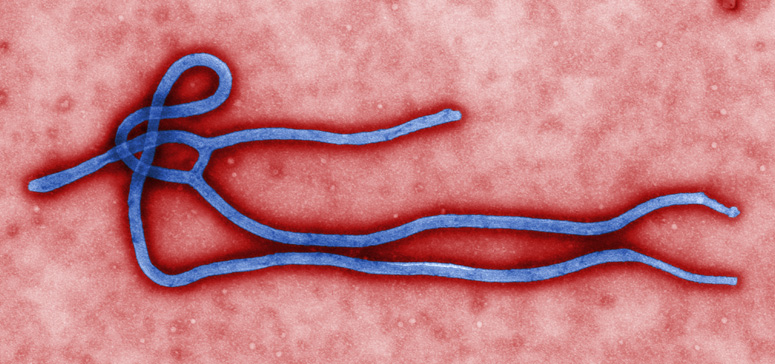
about-ebolaI watched a few Sunday news shows today and, thanks to the DVR, was able to fast-forward through their Ebola coverage. It’s not that I don’t want to know what’s going on in the world. Rather it is precisely because the coverage that I have seen this past week has been long on sensationalism and short on useful information.

Journalists have a difficult job and I don’t want to Monday-morning quarterback their attempt to cover this fast-moving and emotional story. But I also don’t want to defend the fear-mongering and ratings-whoring that is being pawned off as journalism.

There’s always a delicate balance between keeping people informed and keeping things in proper perspective. For example, Ebola is a deadly disease that does not have a vaccine or a cure. It is spread by contact with bodily fluids of an infected carrier. And because of modern air transportation, any viral disease can travel around the world in a matter of hours. On the other hand, as of October 19th only two individuals have contracted Ebola in the US and both were healthcare workers who were treating a patient who had carried the disease from Liberia to the US. Most medical experts are confident that modern treatment and aggressive containment can prevent the virus from becoming an epidemic.

If you saw the movie Contagion (2011), you may recall that this fictional account of a global pandemic shares some similarities with the Ebola crisis. Hollywood loves a narrative because we, the viewing public, love narratives. A story allows us to make sense of the onslaught of information that is frequently confusing and contradictory. In this case the storyline is simple: a deadly disease appears (usually in some dark corner of the globe) because of mankind’s lack of respect for nature. It quickly spreads and threatens population centers in the western world. Science comes to the rescue and the hero is usually someone who defies conventional wisdom to save the day.

Sadly, life doesn’t follow the script. While we obsess over the fate of folks on a plane or cruise ship who MAY have come in contact with someone who MAY have been exposed to Ebola, fear keeps people from living life.  And meanwhile, in Western Africa, the true crisis continues out of the glare of the media spotlight.

Hello! It’s a Joke!

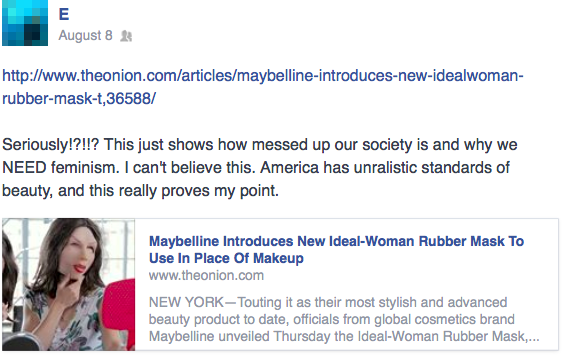
According to a report from Mashable, Facebook is considering adding a “satire” tag to links to stories from fake news sites, e.g. The Onion and The Daily Currant. Apparently the move is a response to requests from Facebook users who want help identifying fake news and distinguishing it from real news. Somewhat ironically, the staff of the Washington Post newspaper could also use a little help. Politico reported that a WP reporter was duped by a fake news report about Sarah Palin joining Al Jazeera.

I have witnessed, on several occasions, Facebook friends re-posting outrageous stories from fake news sites, and on one occasion (that I know of), I’ve done it myself. So I’m not suggesting that the idea of a “satire” tag is unnecessary or silly. However, let’s not assume that the satire tag will somehow eliminate the need for critical thinking on the part of media consumers. Any time that you off-load responsibility for critical thinking on someone (or some algorithm), you risk becoming a victim of that person’s (or algorithm’s) biases.

And there’s another potential downside. If the satire tag works we may have fewer opportunities to have a laugh at the expense of those who believe fake news is real, e.g. the website Literally Unbelievable. Here’s an example from their website:

TheOnionSatire

Cannibalism, Cable News Style

newsI can’t take credit for the catchy title…it is a line by Joe Concha of the website Mediaite. Concha is referring to the over-the-top coverage of Malaysia Airlines flight 370 by one cable news network in particular, and how other networks have taken to bashing CNN for their overboard speculation and sensational reporting for the past three weeks. The thing that is most disconcerting about the coverage is that there has been very little new information to report. Imagine being asked to fill the airwaves for 24/7 for three weeks with little to no new information. This kind of over-coverage has made CNN and easy target for competitors MSNBC and Fox News.

CNN has taken this “all-in” approach before with the Boston Marathon bombing and the Trayvon Martin story/trial. Critics of MSNBC and Fox News have pointed to MSNBC’s obsessive coverage of Governor Chris Christy’s Bridgegate and Fox News’ relentless coverage of ObamaCare.

For now it appears that CNN has found success with their approach. Wall-to-wall coverage of “Breaking News” (regardless of whether there is anything currently “breaking”) seems to be attracting ratings and advertising dollars…and that will no-doubt ensure that the practice continues.

Concha was interviewed by Howard Kurtz on his show Media Buzz. You can watch the clip at the link below.

http://video.foxnews.com/v/3410330300001/pundits-sniping-over-missing-plane/

css.php