Would Narcissus have a Facebook page?

Narcissism, named after the Greek god Narcissus, is defined as, “inordinate fascination with oneself; excessive self-love; vanity.” Narcissus, according to legend, saw his image in a reflecting pool and was so captivated by himself that he was unable to leave  the pool and eventually died.

While the story of Narcissus may be fiction, we all know people who suffer from the affliction of self-love and vanity. According to an article in The Guardian newspaper, a study recently published in the  journal Personality and Individual Differences suggests that there may be a link “between the number of friends you have on Facebook and the degree to which you are a ‘socially disruptive’ narcissist.”

People who score highly on the Narcissistic Personality Inventory questionnaire had more friends on Facebook, tagged themselves more often and updated their newsfeeds more regularly.

Two constructs measured by the researchers–exhibitionism and entitlement–appear to be connected to the number of Facebook friends and may be related to educational trends that have emphasized self-esteem at the expense of other values.

Because social media is still in its infancy many more studies will likely be undertaken in an attempt to better understand what appears to be the dark side to this quickly expanding phenomenon.

The Beginning of the End for Joseph Kony

If you’ve ever wanted to see an internet meme take off…here’s your chance. If you’ve ever wanted to get on the ground floor of a global movement that has great potential to do good…here’s your chance. If you’ve ever wanted to see what it takes to harness social media to motivate millions of people to get up off the couch and take action…here’s your chance.

[vimeo http://www.vimeo.com/37119711 w=398&h=224]

A friend of mine posted a link to this video in facebook yesterday (March 6th) around noon MST. When I started to watch the video I had no idea that it was 30-minutes long…but I was quickly caught up in the story of a madman doing terrible things to children in the interior of Africa. Thirty minutes later I knew several things: 1) this filmmaker knew how to use video effectively to tell a story, and 2) the story was one that would compel anyone who watched to care about this terrible situation. If you read just a few of the many comments on the Vimeo page you’ll see people who have been genuinely moved to action.

I shared the link on fb and twitter and began to see others doing the same. When I watched the video yesterday, it had been viewed by several hundred thousand people. As I write this on the morning of March 7th it has been viewed 5.3 million times! I’ve never seen something take off this quickly. This is big folks, and is only going to get bigger. A couple of days ago the number of people who knew about Kony was a fraction of those who recognize the names Kobe or Kim Kardashian…but that will change. And that is a good thing.

March 8 Update: As promised, here are links to a critique of Koni2012 and Invisible Children’s rebuttal. Remember, as traditional mass media editors and gatekeepers become less important, individual media consumers must become adept at evaluating media messages using a full-range of critical thinking skills. The challenge is to become a critical thinker without becoming overly cynical.

Pink Ribbons and PR Missteps

The social media buzz machine turned into a buzz saw late last week for the Susan G. Komen Foundation. If you’ve been anywhere near this social media maelstrom you know that the Komen Foundation has taken a major hit for its decision to cut funding to Planned Parenthood, and then reversing the decision, all within a 72-hour period. According to Advertising Age, the incident “showed how a brand can boomerang from one of the most loved into one of the most reviled in a head-snapping two days.’’

First a little background. Over the years the Komen Foundation, and their Race for the Cure, has raised billions of dollars for diagnosis, treatment and research of a disease that kills about 110 women every day in this country. The foundation gives away tens of millions of dollars every year and some of that money, about $700,000, had been going to Planned Parenthood. Planned Parenthood was using that money to provide screenings and mammogram referrals to women who might not otherwise be able to pay for these services. But Planned Parenthood is also the largest provider of abortions in the US, and that has resulted in close scrutiny by members of congress who want to ensure that government funds are not being used to provide abortions. Planned Parenthood is currently under investigation by congress with regard to its financial dealings and that was the initial reason cited by the Komen Foundation as to why they were withdrawing funding from Planned Parenthood. However, as negative responses mounted the story began to change. The Foundation countered that Planned Parenthood does not provide mammograms, only referrals, and that this change in funding was about being more responsible stewards of precious resources. You can see their initial response in this YouTube video.

Proponents and opponents have taken sides, sometimes determined by their view on the always-contentious topic of abortion. Critics of the Komen Foundation’s decision to halt funding to Planned Parenthood saw the decision as knuckling under to political pressure from the pro-life lobby. As you might guess, the reversal fired up the pro-life crowd who had been pleased with the earlier decision.

This blog is not a forum to debate the relative merits of either side in the culture war raging around abortion, but this case-study provides an opportunity to observe how a non-profit, known for years of service in the battle against breast cancer, could so quickly find itself under attack by many of the people that it claims to serve. The power of social media to aggregate discussions and dissent is once again center stage. Reaction to SOPA and PIPA last month, and now this…demonstrates the raw energy that can be focused by the impassioned use of  these modern-day megaphones. There’s another angle that students of media should consider. How you learned about this event may also be shaping your understanding of the issues at stake. According to an op-ed in the NYT, the media’s coverage of the story has been biased by the media’s failure to understand the perspective of those on the pro-life side of the issue.

Part of the problem facing Komen is that they appear to be giving in to political pressure…first from pro-life, then pro-choice, political operatives. Even after issuing an apology for their earlier decision plenty of anger remains. Some of their funding sources are now saying that they will stop giving to the Komen Foundation and only time will tell if the Foundation can bounce back from this misstep.  Somewhat ironically, both the Komen foundation and Planned Parenthood are reporting increased giving in the wake of the scandal. Planned Parenthood reported that it had raised $3 million in a 72-hour period, including a $250,000 pledge from NY Mayor Michael Bloomberg.

Additional Resources: Kaiser Health News has collected summaries of news organizations’ reports on the debate.

NOTE: if you respond to this post please do your best to keep your comments focused on the media issues related to the story.

Breaking Through the Clutter of Superbowl Spots

It’s nearly Superbowl time again, and of course America is all excited about….the TV spots. The TV event that year-in and year-out pulls the largest audience is not just about football. Superbowl spots are sometimes the only reason people tune in to watch two teams–often hated teams, e.g. the Patriots–fight it out on the field. Watching advertisers fight it out for our attention in between the gridiron action can be quite the spectacle.

Every year, it seems, some advertiser pushes the limits of broadcast decency (as determined by the FCC) and the host TV network has to decide whether to reject that ad from airing. Of course rejection has, in itself, become a strategy for some advertisers. For example GoDaddy.com has made a TV advertising career from ads rejected by the network. GoDaddy is happy to direct curious viewers to the “banned” ad on the internet where decency regulations do not apply. Other advertisers have also pushed the limits of sexual images or innuendo to generate “buzz” and attention. PETA submitted an ad in 2009 that was rejected for sexual situations involving vegetables and ManCrunch, a website for gay dating, was rejected in 2010.

But the controversies are not always about sex. Last year CBS finally approved and aired a spot by conservative religious organization Focus on the Family (located just up the road in Colorado Springs). The spot featured Bronco quarterback Tim Tebow and his mother who decided, against her doctor’s advice, to continue her risky pregnancy. The pro-life spot was opposed by a national coalition of women’s groups. In response to the controversy, Tim Tebow was quoted by the Huffington Post as saying,

“I know some people won’t agree with it, but I think they can at least respect that I stand up for what I believe,” Tebow said. “I’ve always been very convicted of it (his views on abortion) because that’s the reason I’m here, because my mom was a very courageous woman. So any way that I could help, I would do it.”

The question for CBS was whether “issue ads” were appropriate for a TV event that has the broadest possible audience, in terms of demographics, of any TV broadcast. CBS had been criticized before for not airing an ad that they deemed to be a “contentious advocacy ad.”

This debate over what is and is not appropriate for a national TV audience is not going away. But one thing is for certain. Regardless of the network and their policies, advertisers will position themselves to benefit from the buzz that their edgy spots generate…either by being aired or by being banned.

Think Twice about SOPA and PIPA

If you plan to work in the media industries as a professional content creator, you need to pay close attention to the current debate over SOPA and PIPA. The two bills being debated in congress are designed, with substantial input from lobbyists representing “old media” interests, to shut down global websites that profit from the illegal distribution of copyrighted material: music, films and TV shows primarily. The issue is being framed by internet and new media companies (largely located in Silicon Valley) as a battle for internet freedom of expression and the rights of end users. Several major internet sites have gone black today or have modified their home page to express solidarity with the protest movement. But what about the rights of individuals and companies (largely located in NY & LA) that create media content?

Much of the early discussion that I’ve seen on Facebook and Twitter has bought into the new media companies’ arguments that this attempt to curtail copyright infringement will stifle creativity and growth on the internet. Others argue that the regulatory oversight will amount to censorship of creative expression. This is completely understandable from the perspective of those who are end users of content rather than creators. For the average consumer, more access to free content seems like a good thing. However, if you’re thinking that you’d like to work in the media industry as a content creator, you might want to consider what the future holds for you if creativity is not rewarded and protected.

Copyright laws exist to protect intellectual property and to reward the creative community for their investment of time and resources in the creative development process. Music, video and film content does not create itself, and those responsible for its creation and distribution deserve legal protection from those who would like to acquire, redistribute, or aggregate that content for their own personal or corporate benefit.

Now, while it may be clear that I am in favor of reasonable protection for copyright holders, I am not convinced that SOPA and PIPA are well-designed legislative tools to accomplish that goal. The video below points out some of the weaknesses of these bills and raises serious questions about their practical application.

[vimeo http://www.vimeo.com/31100268 w=398&h=224]

So, what do you think about SOPA and PIPA? Bad idea? Good idea? Good idea poorly executed?

Show Your Best

The 2012 Olympic Games are coming to London next summer, and the International Olympic Committee wants to attract younger viewers. How will they do that, you ask? Well, how about a website that allows youngsters to upload video clips of themselves performing some athletic feat…then create a mashup with their footage and footage of real Olympic athletes that can be posted to their Facebook page. Oh, and there’s a chance to win prizes and a trip to the London Games in the process. Sounds like a perfect scheme to take advantage of the inflated egos of the “participation generation”…those who grew up getting ribbons and trophies just for showing up. As the campaign says, “everyone’s best is worth celebrating.”

You can watch an introductory video clip here: https://showyourbest.olympic.org/en#!/intro

According to a write-up in the New York Times,

Mike Doherty, the president of Cole & Weber, said the campaign’s theme would resonate with a younger audience since many are used to interacting with others around the world through platforms like social media and video games. Most important, he added, “they certainly all think they are the best at something.”

Facebook spammed with explicit and violent images

Facebook, which has heretofore managed to maintain a family friendly reputation, suffered a setback earlier this week when explicit and violent images began to show up on the site. According to news reports, hackers were able to exploit a security weakness to spread images which included “hardcore porn; photoshopped images of celebrities, including teen pop star Justin Bieber, in sexual positions; ‘extreme violence;’ and at least one image of an abused dog.” Images of this nature can be extremely disturbing and numerous victims of the scam have expressed outrage and intent to deactivate their accounts.

Facebook users whose accounts were hacked were unable to see the images that are being posted on their friends walls…even though the images appeared to be coming from their account activity. According to Facebook, “the spam attack all started with users being tricked into pasting and executing malicious JavaScript in their browser’s URL bar.” Some are suggesting that the security flaw was limited to a particular browser…specifically Internet Explorer. In any case, one lesson to be learned is to not click on links from questionable sources, and never copy and paste code into your browser’s URL bar.

Some suspected the hackivist group Anonymous who earlier had warned [YouTube] of a cyber-attack on Facebook for their policies which compromise users’ privacy. However, as of today Anonymous has not taken credit for this event and a new post on ZDNet claims that Facebook has identified the source of the attack.

If you think your Facebook account has been compromised, here’s a link to steps to take to try to restore order.

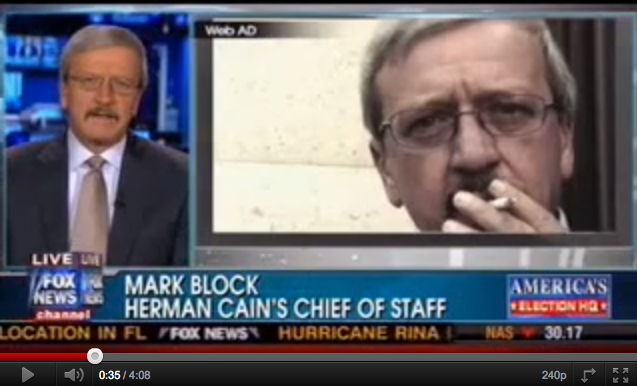
What is Herman Cain’s Communications Director Smoking?

We’re quickly approaching an election year, and you know what that means…political ads 24/7. More and more we’re seeing ads launched and tested online where ROI can be extremely high if an ad goes viral. Even better is an online ad that attracts the attention of traditional media. The result is free exposure when broadcast and cable news outlets spend precious airtime talking about or even screening the online ad.

That may be the strategy behind an online ad for Herman Cain, who is running for the Republican nomination to challenge Barak Obama in the 2012 Presidential race. The ad, with more than 1.2 million views and counting, features Cain’s chief of staff Mark Block who, at the end of the spot, takes a drag on a cigarette. You can watch the ad on [Youtube]. This is an unconventional approach, to say the least. As Block says in the spot, “we’ve run a campaign like nobody’s ever seen.”And while Block says the ad is not intended to promote smoking or to send a subliminal message, that’s not stopping media critics and journalists for looking for the subtext beneath the subtext. Some are suggesting that it is defiant gesture towards the nanny-ism of Big Government that wants to tell people what they can or cannot do.

Another bazaar web ad is the long-form, He Carried Yellow Flowers. Conner Friedersdorf at the Atlantic calls it a “Dadaist Meta-Western.” I don’t know where to begin with this one, so I encourage you to watch it on [YouTube] and leave your comments below. What do you think is the message? And does it make you think of Herman Cain as a viable contender for the office of President of the United States of America?


Social Media and the OWS Movement

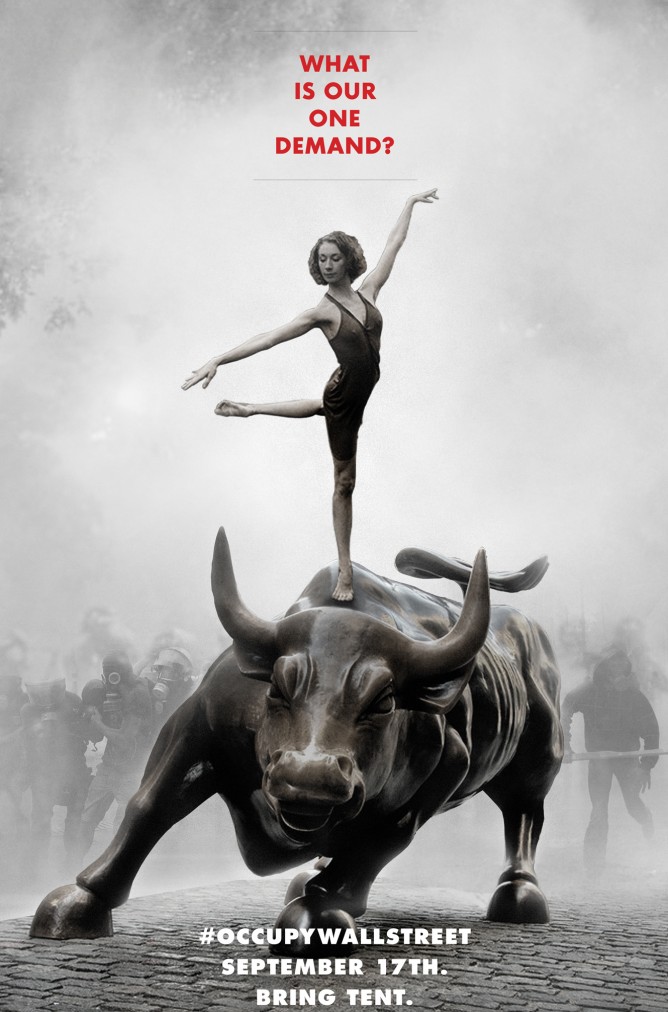
The Occupy Wall Street movement has been generating a lot of attention from the mainstream media in recent weeks. According to a report in the NYT, media coverage has been increasing as the movement gains strength and spreads to other cities. The proximity of the protestors to the nerve center of the US news industry, just blocks away in NYC, certainly helps. Organizers have also worked hard to create stories that the mainstream media are likely to cover, including orchestrated attempts to obstruct traffic and confront police.

The protestors have demonstrated some media savvy as indicated by a sign held by one protester-“Whoever controls the media, the messages, controls the culture.” They’ve got a website and they even have a print publication devoted to getting their story out. The Occupy Wall Street Journal is being supported  using funds raised by a Kickstarter campaign called Occupy Wall Street Media which has raised more than $75K to date. You can find their first issue on Google Docs here. On the Kickstarter site you can view a 3-minute video that includes sound bites from Michael Moore, a documentary filmmaker who has made a career championing the cause of the working class. Speaking of documentaries, the Academy Award winning doc from 2010, Inside Job, is an eye-opening look at the 2008 crash and subsequent attempts to deal with the financial mess that ensued. If you really want to understand the frustration being directed at Wall Street, big business, and the government this documentary would be a good place to start.

But just like the Arab spring and the Tea Party movements that came before, another factor that has helped the OWS movement gain attention and momentum is the use of social media. According to Jeff Jarvis, professor of journalism and author of the blog BuzzMachine, “#OccupyWallStreet is a hashtag revolt.” Jarvis goes on to explain that, “a hashtag has no owner, no hierarchy, no canon or credo. It is a blank slate onto which anyone may impose his or her frustrations, complaints, demands, wishes, or principles.” Using Facebook and twitter is neither new nor innovative in late 2011, but it is and will be an essential part of any current and future populist movement. The raw power of unfiltered, instantaneous mobile communication cannot be denied. The fact that mainstream media are taking their cues from social media certainly helps. While social media is a powerful tool for coordinating and inspiring participants in a populist movement, the mainstream media brings the movement to the attention of a much larger segment of the population.

In an interesting twist with conspiratorial overtones, some have accused twitter of censoring the OccupyWallStreet hashtag and downplaying the size of the twitter stream that is being generated. This alleged censorship may be the result of a cosy relationship that twitter has with investment banks on Wall Street, according to one report.

It is also worth noting that the OWS movement was instigated by the Adbusters organization out of Vancouver, Canada. Adbusters may be best known for their anti-consumerism and anti-capitalistic positions on advertising and consumption. The Adbusters media foundation is, according to their website, “a global network of artists,  activists, writers, pranksters, students, educators and entrepreneurs who want to advance the new social activist movement of the information age. Our aim is to topple existing power structures and forge a major shift in the way we will live in the 21st century.” The Adbusters organization is also known as sponsor of annual social marketing campaigns like Buy Nothing Day and Digital Detox Week.

Whether the OWS movement has legs and can reach critical mass may become evident on November 5th when, according to the Christian Science Monitor, “consumers are being urged to transfer their bank accounts from large, national financial institutions to community banks and credit unions.” If this movement grows, and hundreds of thousands close out their bank accounts, we’ll know that this is not just a fringe movement of leftists and anarchists.


Steve Jobs, Typography and the Mac

Although the passing of Steve Jobs this past week was not unexpected, it still was an emotional event for Apple fans and anyone who followed technology and media. The death of Steve Jobs attracted extensive media attention with much of the coverage focusing on his contributions over the years to the development of a computer and media empire that consistently delivered more than it promised.

To commemorate his passing I had my Media & Society class watch the 2005 commencement address that Steve Jobs delivered to the 2005 graduating class of Stanford University. The speech is only 14 minutes in length and you can see it below. There’s much to reflect on when listening to Jobs talk about his upbringing, his abbreviated college years, the twists and turns of his professional career, and his bout with cancer.

The one thing that stood out to me was the role that a class in typography, from Reed College, had on Jobs’ design of the Macintosh computer and, in many ways, the direction of Apple computer. Font selection, leading, kerning, tracking and ligatures are the concerns of a fairly obscure group of individuals, namely printers and typography geeks, yet Jobs was captivated by the ancient art of arranging letters on a page. Prior to the Apple Mac, computer type was crude and utilitarian. Function certainly won out our over form for screen fonts and printer output. But Jobs equipped the Mac with Postscript font technology and that, married with the personal laser printer, made high quality screen and print typography accessible to the masses. We take for granted font selection and high quality print output…but for that we should thank Steve Jobs and his vision for the Macintosh computer that started when he dropped in on a typography class at Reed College.

css.php