Facebook spammed with explicit and violent images

Facebook, which has heretofore managed to maintain a family friendly reputation, suffered a setback earlier this week when explicit and violent images began to show up on the site. According to news reports, hackers were able to exploit a security weakness to spread images which included “hardcore porn; photoshopped images of celebrities, including teen pop star Justin Bieber, in sexual positions; ‘extreme violence;’ and at least one image of an abused dog.” Images of this nature can be extremely disturbing and numerous victims of the scam have expressed outrage and intent to deactivate their accounts.

Facebook users whose accounts were hacked were unable to see the images that are being posted on their friends walls…even though the images appeared to be coming from their account activity. According to Facebook, “the spam attack all started with users being tricked into pasting and executing malicious JavaScript in their browser’s URL bar.” Some are suggesting that the security flaw was limited to a particular browser…specifically Internet Explorer. In any case, one lesson to be learned is to not click on links from questionable sources, and never copy and paste code into your browser’s URL bar.

Some suspected the hackivist group Anonymous who earlier had warned [YouTube] of a cyber-attack on Facebook for their policies which compromise users’ privacy. However, as of today Anonymous has not taken credit for this event and a new post on ZDNet claims that Facebook has identified the source of the attack.

If you think your Facebook account has been compromised, here’s a link to steps to take to try to restore order.

Social Media and the OWS Movement

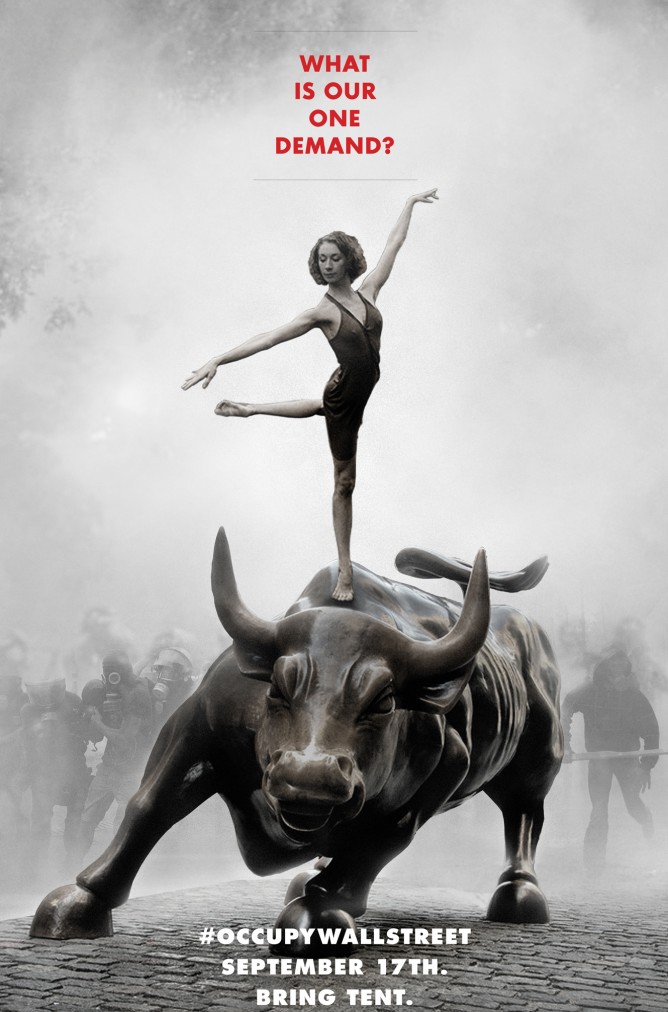
The Occupy Wall Street movement has been generating a lot of attention from the mainstream media in recent weeks. According to a report in the NYT, media coverage has been increasing as the movement gains strength and spreads to other cities. The proximity of the protestors to the nerve center of the US news industry, just blocks away in NYC, certainly helps. Organizers have also worked hard to create stories that the mainstream media are likely to cover, including orchestrated attempts to obstruct traffic and confront police.

The protestors have demonstrated some media savvy as indicated by a sign held by one protester-“Whoever controls the media, the messages, controls the culture.” They’ve got a website and they even have a print publication devoted to getting their story out. The Occupy Wall Street Journal is being supported  using funds raised by a Kickstarter campaign called Occupy Wall Street Media which has raised more than $75K to date. You can find their first issue on Google Docs here. On the Kickstarter site you can view a 3-minute video that includes sound bites from Michael Moore, a documentary filmmaker who has made a career championing the cause of the working class. Speaking of documentaries, the Academy Award winning doc from 2010, Inside Job, is an eye-opening look at the 2008 crash and subsequent attempts to deal with the financial mess that ensued. If you really want to understand the frustration being directed at Wall Street, big business, and the government this documentary would be a good place to start.

But just like the Arab spring and the Tea Party movements that came before, another factor that has helped the OWS movement gain attention and momentum is the use of social media. According to Jeff Jarvis, professor of journalism and author of the blog BuzzMachine, “#OccupyWallStreet is a hashtag revolt.” Jarvis goes on to explain that, “a hashtag has no owner, no hierarchy, no canon or credo. It is a blank slate onto which anyone may impose his or her frustrations, complaints, demands, wishes, or principles.” Using Facebook and twitter is neither new nor innovative in late 2011, but it is and will be an essential part of any current and future populist movement. The raw power of unfiltered, instantaneous mobile communication cannot be denied. The fact that mainstream media are taking their cues from social media certainly helps. While social media is a powerful tool for coordinating and inspiring participants in a populist movement, the mainstream media brings the movement to the attention of a much larger segment of the population.

In an interesting twist with conspiratorial overtones, some have accused twitter of censoring the OccupyWallStreet hashtag and downplaying the size of the twitter stream that is being generated. This alleged censorship may be the result of a cosy relationship that twitter has with investment banks on Wall Street, according to one report.

It is also worth noting that the OWS movement was instigated by the Adbusters organization out of Vancouver, Canada. Adbusters may be best known for their anti-consumerism and anti-capitalistic positions on advertising and consumption. The Adbusters media foundation is, according to their website, “a global network of artists,  activists, writers, pranksters, students, educators and entrepreneurs who want to advance the new social activist movement of the information age. Our aim is to topple existing power structures and forge a major shift in the way we will live in the 21st century.” The Adbusters organization is also known as sponsor of annual social marketing campaigns like Buy Nothing Day and Digital Detox Week.

Whether the OWS movement has legs and can reach critical mass may become evident on November 5th when, according to the Christian Science Monitor, “consumers are being urged to transfer their bank accounts from large, national financial institutions to community banks and credit unions.” If this movement grows, and hundreds of thousands close out their bank accounts, we’ll know that this is not just a fringe movement of leftists and anarchists.

Radical Transparency in the Internet Age

When it comes to managing your online identity you typically find yourself caught between the two extremes of full transparency and complete control of your image (which, BTW, is only possible by avoiding all online interaction). You may know some Facebook and Twitter users who fit into that first category. They post updates about every hiccup,  paper cut, and causal encounter with photo and video documentation for good measure.

Mark Zuckerberg, founder of Facebook, argues that “you have one identity.” What he means is that internet-enabled transparency makes maintaining more than one identity difficult at best and impossible for most. So if you accept his premise that you really have only one identity, the next decision you’ll have to make is how to manage that one identity to ensure that your multi-faceted personality is both appropriately presented but not inappropriately exposed? Whose going to be in control of our digital identity, if not us?

Even if we are limited to one identity online, we have ways to manage that identity so that we can provide some separation between personal and professional roles. We all manage our presentation of self in “real life” based on contextual cues. For example, manners are simply the managing of our behavior and speech to reflect socially accepted norms for treating others with respect and dignity. Our language changes when we move from a close circle of friends to family to professional contacts. We’re constantly adjusting how we present ourselves depending on the social situation, and people who are unable or unwilling to do this are seen as rude, ill-mannered or socially inept. In a similar way, your profile on Facebook may have a very different tone from the one that you keep on LinkedIn. However, the problem here is that public access to both profiles may be possible depending on your privacy settings. An acquaintance may make the transition from friend to professional colleague, or in the other direction, and thus have ready access to both profiles. This may or may not present a problem…my point is simply that managing distinct identities becomes cumbersome or impossible.

Add to that new services or updates that constantly change the ground rules. Facebook has had a string of problems with privacy protection. The launch of News Feed in 2006, Beacon in 2007 and privacy setting changes in 2009 are just some of the examples of Facebook policies that led to user rebellion. Facebook’s own privacy policy makes it clear that personal data “may become publicly available” and may be “viewed by unauthorized persons.” According to David Kirkpatrick, writing in The Facebook Effect, a poll of US companies found that 35% of them had rejected applicants because of information found on social networks. This was not information hacked from the sites, but rather personal information that the applicant had posted without consideration of who might be in the online audience. Facebook itself admits that only about 25% of users actively use the privacy controls.

Walking the fine line that is personal privacy, many make the mistake that they can control their digital footprint. As your digital footprint grows, and as computers “scrape” your online behavior and link it to other databases, managing your exposure becomes increasingly complex. Simply remembering all of the intricacies and complexities of your multiple profiles becomes unmanageable. And if you employ deception, the task is even more difficult. You’ve heard it said lies beget lies. In other words, we often have to tell a lie to cover up another lie, and the web of deception becomes increasingly complex and difficult to maintain. In the words of Abraham Lincoln, “No man has a good enough memory to make a successful liar.”

So it is with your digital footprint. The more data you surrender willingly, and unwillingly, to marketers and social media, the more more vulnerable you become to their schemes. Do you trust Google, Facebook and Yahoo! to protect your interests? And if not, what steps are you taking to ensure that your identity is safe?

For more information about online privacy visit the EPIC: Electronic Privacy Information Center website.

Social Media Revolution: The Whole World is Watching

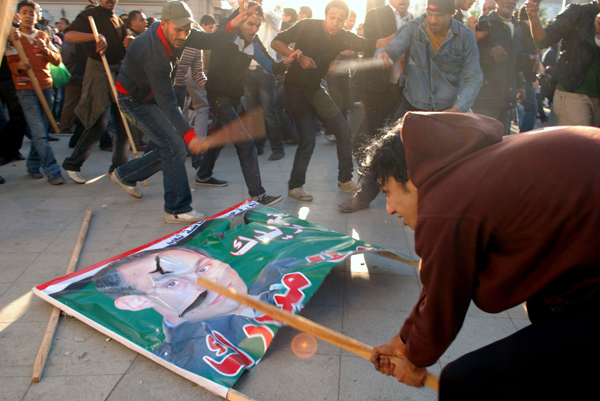
It would be an overstatement to say that recent anti-government protests in Muslim countries have been caused by social media. It would NOT be an overstatement to say that social media has played a very important role in both coordinating protest activities and giving new meaning to the slogan, “the whole world is watching.” The largely peaceful transfer of power in Tunisia that began just weeks ago has been a remarkable event and the current protests in Egypt opposing long-term president Hosni Mubarak are nothing short of miraculous. The Green Revolution in Iran, aka the Twitter Revolution, is another example of the critical role that social media has played in enabling a largely youthful underclass as they’ve challenged autocratic rulers and oppressive regimes.

I’m not a political scientist, but this is what I’ve been able to learn about the current uprising in Egypt from several news accounts that I’ve read. The political unrest is rooted in sluggish economic conditions that have resulted in high unemployment for a growing demographic of young, often well-trained, citizens. Evidence of political corruption has added fuel to the fire as protesters, emboldened by what they observed in Tunisia, have called for the end of the 30-year rule by Mubarak. Protesters have been clashing with police who have been deploying water cannons, tear gas and rubber bullets in response. Just yesterday Mubarak called out the army, but may have been surprise by the results. According to reports, members of the army have been joining with protesters calling for the president to resign. But Egypt is a strong ally of the US, and that makes it complicated for our diplomatic corps. While the US supports peaceful democratic transition, it is also gravely concerned about the potential of loosing one of its strongest allies in the region.

Egypt’s response to the protests has been surprisingly heavy-handed. The government shut down internet and cell phone services on Friday in an attempt to disrupt the protesters’ activities, effectively disconnecting 80 million people from the outside world. According to some reports cell phone service was restored a day later, and dial-up internet numbers are being circulated. “The Net interprets censorship as damage, and routes around it”, a quote from 1993 attributed to John Gilmore, captures the challenge of trying to restrict a system that was built to be bomb-proof. Iranians, Tunisians and Egyptians have found, or are finding, ways around information blockades, with proxy servers and other less technical means for maintaining connection to the outside world.

The role of Twitter, Facebook, YouTube and other social media is being debated, and will continue to be debated long after these revolutions have passed. But one thing is certain; social media is a game-changer, and powerful institutions, be they governments, businesses or social movements, can either learn how to use social media to their benefit or they will have to learn to live with the consequences.

Resources:

  • NPR has published a guide to using Twitter to follow the on-going events in Egypt…you can find it here.
  • Al Jazeera, a Muslim news organization, maintains a blog of on-going events here.

Dot. A very cool stop-motion animated viral video

Check this out. Nokia asked Oscar-winning film makers Aardman Animations – the guys behind Wallace and Gromit – to create an animated short to celebrate the Nokia N8’s 12 mega-pixel camera and a specially designed microscope. The cell phone camera and microscope can be used for a lot of things, including remote diagnosis of medical conditions for people in remote areas of the world.

Watch the short animation, then watch the making of…

[youtube=http://www.youtube.com/watch?v=CD7eagLl5c4]

[youtube=http://www.youtube.com/watch?v=XTbzSiwbRfg]

The short film is in the Book of Guinness World Records as officially “the world’s smallest stop motion character animation.” This is also related to our discussion of social media because the viral success of this short animation is bringing a lot of attention to Nokia and their new phone. Pretty cool, eh? What could you shoot with your cell phone camera?

Craigslist self-censors adult services listings

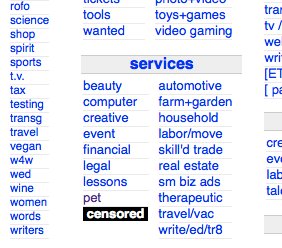
Craigslist, the popular online classified advertising service, has decided to pull adult services listings that have been used by those engaging in prostitution and the sex trade industries. In response to criticism from celebrities and politicians, and facing legal battles from a consortium of 17 attorneys general, Craigslist decided to switch rather than fight. This is despite the fact that the adult services section brought in more than $36m last year, approximately 30 percent of their total revenue.

With a graphic of the word “censored” replacing the listing for adult services, Craigslist indicated an unwillingness to fight a legal challenge that it might actually win if it went to trial. Current regulation of the internet is essentially “hands-off” and does not hold bulletin boards and other listing services responsible for content posted by users. However, it is likely that the media attention focused on the Craigslist Killer, a man accused of robbing and killing prostitutes contacted through Craigslist, was a significant factor in turning public opinion against the classified ad service. Critics claimed that Craigslist facilitated the victimization of women.

Will this be a game-changer for those who want to sell sex online? Many worry that those involved in the sex trade business will simply go underground, move to other online sites, or even find other places on Craigslist to ply their trade.

Here’s a news story from CBS News.

Some interesting stats about Social Media

Facebook passed an important milestone this week…it now has over 500 million users. David Armano at Logic + Emotion posted some interesting stats that were compiled by Marta Kagan, and a few of them are mind-boggling. For example, the population of Facebook. To help you put it in perspective, Facebook’s population lags only behind China and India. Facebook users spend 500 billion minutes on Facebook each month. That is equivalent to just under 1 million years!…each month. And here’s an interesting stat: one-third of women aged 18-34 check Facebook when they first wake up—even before going to the bathroom.

Over at YouTube, 24 hours of video is uploaded every minute. Each day 2 billion of those YouTube video are viewed by people who apparently are taking a short break from updating their fb status.

And no doubt you’ve heard of Twitter. The average number of “tweets” per day is 27 million. It took LeBron James only 7 hours to amass his first 150,000 Twitter followers. Lady Gaga has over 5 million followers, by the way. She celebrated her milestone by posting the following tweet: “Here’s to monsters, music, and 5 million of my closest friends! Cheers! I officially declare this institution ‘Tweeterland'”!

Lady Gaga’s 10 million Facebook “friends” is also a record…and slightly more than the 130 friends that the average Facebook user has. But no one wants to be average… so if you have 130 or fewer friends on Facebook, get out there and get busy. Oh, and if you’re looking for love, you’ll be happy to know that social media is the new place to meet your potential mate. One in six marriages last year were between people who met on social media sites. That’s more than twice the number who met at bars, clubs and other social events combined!

I don’t know about you, but this makes me want to log off and go for a walk!

css.php