Where there’s smoke…

whitesmokeYou may have heard that the Catholic Church is in the process of selecting a new Pope. The Church has been slow to embrace certain changes, e.g. women priests and same-sex marriage, but they have not been as slow to adapt to new communication media. The recently retire pope, Pope Benedict XVI (@pontifex), became the first Pope to join Twitter in December of 2012 and the Catholic Church has more than 413K likes on its facebook page.

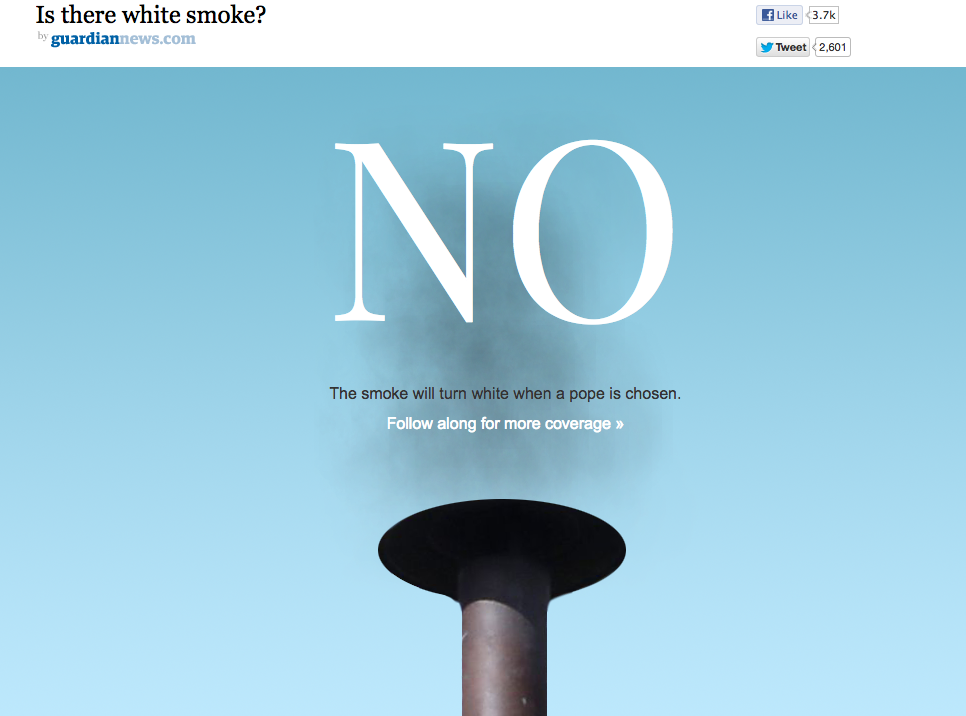
Some may find it ironic then that the Church, in this modern digital age, still uses smoke signals to announce the results of a successful election. When the bishops have selected the new Pope, the smoke from the chimney of the Sistine Chapel will switch from black to white.

In a world of high-tech solutions to most every problem, there are plenty of options for staying informed of the latest news in this breaking story. With the tag line, “when the smoke goes up, you’ll know what’s going down”, the website popealarm.com is on top of the latest developments. At the website you can sign up to receive instant notification of the election by either text or email.

For the ultimate in simplicity you can visit istherewhitesmoke.com.

Or you can download an app for your smart phone. Some of the apps provide biographic background on the candidates. All promise to keep you up to the minute with breaking news. Not to be outdone, the Pontifical Council for Social Communication has released the Pope App. Before you know it the Vatican will have its own YouTube channel.

The Future of Modern Warfare?

No, I’m not talking about the release of Call of Duty: Black Ops II this week, and the $500 million that players dropped on the first day. Rather, I’m talking about real conflict with real casualties, and tweets like this…

Some numbers from the last 3 days: 492 rockets fired from #Gaza hit #Israel + 245 Iron Dome interceptions = 737 rockets fired at us. @IDFSpokesperson

And this photo tweeted two days ago…

And this video posted to Youtube…

[youtube=http://www.youtube.com/watch?v=P6U2ZQ0EhN4]
If you watch the IDF YouTube channel you’ll also find a video that alleges to show Palestinian children taunting Israeli soldiers attempting to provoke a response for the cameras.

In a world where public support is necessary for democratic societies to engage in armed conflict, propaganda is a necessary and essential part of the campaign. According to an editorial in the Washington Post,

The @IDFSpokesperson Twitter account, encouraging followers to show support for the strikes, tweeted Wednesday: “More than 12,000 rockets hit Israel in the past 12 years. RT if you think #Israel has the right to defend itself.” More than 5,500 people have retweeted it.

The social media campaign being waged by the Israeli Defense Force is part PR campaign, part political posturing, part warning intended to minimize civilian casualties, and part intimidation, e.g. “We recommend that no Hamas operatives, whether low level or senior leaders, show their faces above ground in the days ahead.”

Hamas, the pro-Palestinian group responsible for the rocket attacks on Israel, has responded with their own campaign, including the twitter hashtag #GazaUnderAttack. Civilians, especially children, killed by Israeli retaliatory strikes are put on display for the TV cameras as mourners wail in the street.

The Middle East, post Arab Spring, is still a fractious place where opposing forces battle on a daily basis. While some of the conflict is physical, much of it takes place in the media where the battle is fought for the hearts and minds of both regional and global witnesses. And more and more of it is happening in near-real-time.

Is it real, or is it Photoshopped?

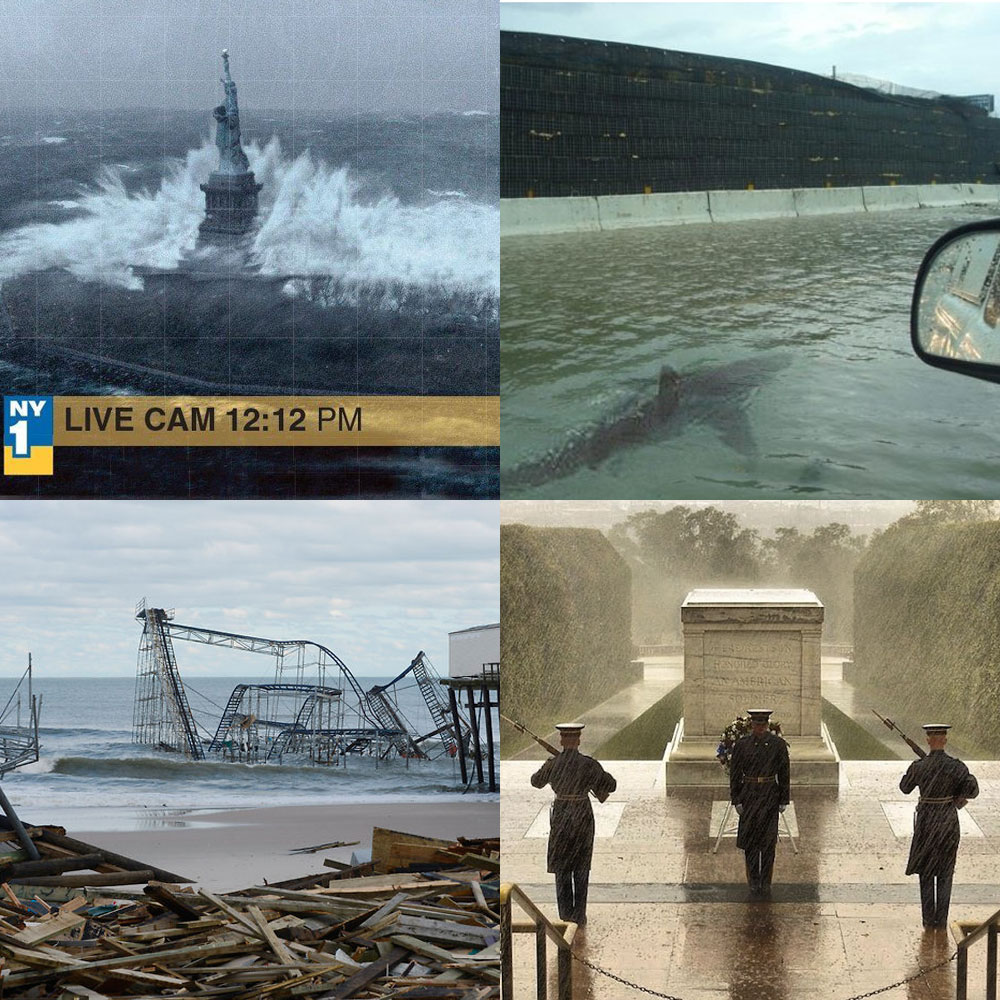
With cell-phone cameras everywhere, and digital photo sharing sites and apps like instagram so easy to use, we are seeing more photos than ever before. And while most of these photos are true depictions of real events, others are intended to mislead or deceive. Take, for example, the photos at right that came out in the days surrounding the “Superstorm” named Sandy. Of the four photos at right, only one is “true” or “real.” Can you guess which one?

Not only are fake photos easy to create, they are even easier to distribute. One cleverly made photo can go viral via social media like twitter, Tumblr and Facebook.

People with Photoshop skills can make composite photos that often defy detection. Photoshop has even become a verb, as in, “I ‘photoshopped’ him out of the picture and put Josh in his place.”

Photoshopped images in advertisements have even attracted the attention of European lawmakers who are threatening to ban the use of Photoshop or digital retouching in ads targeting those under the age of 16.

Oh, and by the way, the only photo that depicts Sandy in an accurate way is the shot of the roller coaster surrounded by water. The photo of Lady Liberty is from the movie The Day After. The shark is photoshopped, and the photo at the Tomb of the Unknown Soldier was taken in September.

Arab Spring Gives Way to the Arab Fall

On the anniversary of 9/11, rioting in Cairo and the murder of Libyan ambassador John Christopher Stevens, and several others, at the US consulate in Benghazi is a stark reminder that we still don’t understand the complex nature of middle-eastern politics and Islamic extremism. In the words of Secretary of State Hillary Clinton, “how could this happen in a country we helped liberate and in a city we helped to save from destruction.” It is becoming increasingly clear that the overthrow of former Libyan dictator Muammar Gaddafi brought new freedom, but also instability, to the region.

There are several connections to mass media in this story. First, much has been made of the role of social media in bringing democracy to Northern Africa and the Middle East. Second, news reports say that a YouTube video criticizing Mohammed was the initial spark that ignited the riots. The two-hour YouTube video, produced and written by Sam Bacile, a California real estate developer, was made for $5 million. A 13-minute trailer/excerpt can be seen here. According to reports, the film portrays the prophet Mohammed as, “a fraud, a pedophile and a womanizer.” Muslims do not allow the portrayal of Mohammed in any form, but are particularly intolerant of depictions that are perceived as an insult. Afghanistan blocked YouTube today in an attempt to prevent access to the controversial video.

While freedom of speech and freedom of expression are highly valued in American culture, much of the world does not share our appreciation for speech that sometimes offends segments of the audience. In this country individuals can safely criticize government entities and religious institutions without fear of reprisal. But that is not the case in many countries and cultures dominated by totalitarian rulers or oppressive religious factions.

While Americans hold their noses and “tolerate” protests by Fred Phelps and his Westboro Baptist “Church”, the response has not been so generous in other contexts. Take, for example, the case of Theo van Gogh. Van Gogh was a Dutch filmmaker who made Submission, a movie that many Muslims found offensive. After the movie was shown on Dutch public television, Van Gogh was killed by a “Muslim extremist.” The killer shot Van Gogh eight time, stabbed him, and attempted to decapitate him. When a Danish newspaper published caricatures of the prophet in 2005, it sparked riots in many Muslim countries.

Because we are in an election season, the news also took a political twist. According to a report by the BBC,

Mitt Romney, Mr Obama’s Republican challenger in the forthcoming presidential election, criticized the US administration’s response to the attacks in Benghazi and Cairo, saying it had appeared to “sympathize with those who waged the attacks”.

Religious freedom, freedom of speech, and tolerance for opposing views are values not to be taken lightly. And when they appear to be in conflict with each other, the stakes are even higher.

Rushing to Judgement

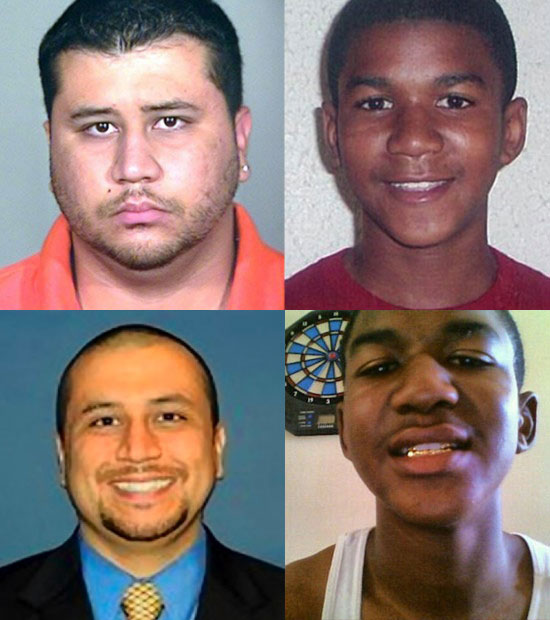
This blog post is in no way intended to add to the current public debate about the guilt or innocence of either Trayvon Martin or George Zimmerman. The tragic shooting has become the center of a national dialogue about race (Martin is African-American and Zimmerman is Hispanic), violence, and media coverage of the same. While there has been little verifiable evidence about the tragic incident, there is no shortage of opinion about what happened on that night of February 26th.

What we do know is that the national media were slow to report the initial shooting. Only after African-American commentators, bloggers and radio talk show hosts took up the cause–and after social media amplified the discussion–did the mainstream media finally pay attention.

Photos of Martin and Zimmerman widely disseminated by the mainstream media have also led some to jump to conclusions. Newer photos of both are now being released. One can’t help but think that the images being presented are part of the process of making a case for either innocence or guilt of those portrayed. Either way it is easy to see how important first impressions can be when forming an opinion in the absence of hard facts.

Additional facts about Martin’s record of suspensions from school are also changing the nature of the debate. Some are claiming that these are irrelevant facts that are being intentionally leaked to the media with intent to destroy the reputation of the victim.

Even coverage of the media coverage has been controversial. The Daily Texan, a student newspaper from University of Texas at Austin, pulled a controversial editorial cartoon that was critical of the media’s coverage of the story.

One of the most important responsibilities of the media in a democratic society is to draw attention to misbehavior and to do so in an even-handed and unbiased way. Crime reporting is just one example. But so is investigative reporting of how police and other civil servants carry out their duty to administer justice. When public outcry about a possible miscarriage of justice by the local police reached a tipping point, the US Department of Justice was called in to investigate the Sanford police department.

Questions remain: Is justice being served by the attention being given to this story? Would justice have been served if a few African-American journalists had not gained the attention of the social media megaphone…which then led to the mainstream media paying attention? Can truth and justice prevail in what some are now calling a “media circus”?


UPDATE 3/30/12

PEW Research has released an interesting study comparing the way that Twitter, blogs, and cable TV and talk radio have covered the story.

Would Narcissus have a Facebook page?

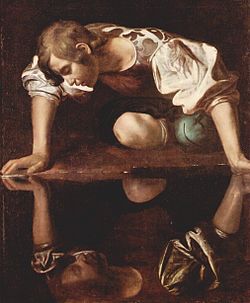
Narcissism, named after the Greek god Narcissus, is defined as, “inordinate fascination with oneself; excessive self-love; vanity.” Narcissus, according to legend, saw his image in a reflecting pool and was so captivated by himself that he was unable to leave  the pool and eventually died.

While the story of Narcissus may be fiction, we all know people who suffer from the affliction of self-love and vanity. According to an article in The Guardian newspaper, a study recently published in the  journal Personality and Individual Differences suggests that there may be a link “between the number of friends you have on Facebook and the degree to which you are a ‘socially disruptive’ narcissist.”

People who score highly on the Narcissistic Personality Inventory questionnaire had more friends on Facebook, tagged themselves more often and updated their newsfeeds more regularly.

Two constructs measured by the researchers–exhibitionism and entitlement–appear to be connected to the number of Facebook friends and may be related to educational trends that have emphasized self-esteem at the expense of other values.

Because social media is still in its infancy many more studies will likely be undertaken in an attempt to better understand what appears to be the dark side to this quickly expanding phenomenon.

The Beginning of the End for Joseph Kony

If you’ve ever wanted to see an internet meme take off…here’s your chance. If you’ve ever wanted to get on the ground floor of a global movement that has great potential to do good…here’s your chance. If you’ve ever wanted to see what it takes to harness social media to motivate millions of people to get up off the couch and take action…here’s your chance.

[vimeo http://www.vimeo.com/37119711 w=398&h=224]

A friend of mine posted a link to this video in facebook yesterday (March 6th) around noon MST. When I started to watch the video I had no idea that it was 30-minutes long…but I was quickly caught up in the story of a madman doing terrible things to children in the interior of Africa. Thirty minutes later I knew several things: 1) this filmmaker knew how to use video effectively to tell a story, and 2) the story was one that would compel anyone who watched to care about this terrible situation. If you read just a few of the many comments on the Vimeo page you’ll see people who have been genuinely moved to action.

I shared the link on fb and twitter and began to see others doing the same. When I watched the video yesterday, it had been viewed by several hundred thousand people. As I write this on the morning of March 7th it has been viewed 5.3 million times! I’ve never seen something take off this quickly. This is big folks, and is only going to get bigger. A couple of days ago the number of people who knew about Kony was a fraction of those who recognize the names Kobe or Kim Kardashian…but that will change. And that is a good thing.

March 8 Update: As promised, here are links to a critique of Koni2012 and Invisible Children’s rebuttal. Remember, as traditional mass media editors and gatekeepers become less important, individual media consumers must become adept at evaluating media messages using a full-range of critical thinking skills. The challenge is to become a critical thinker without becoming overly cynical.

Pink Ribbons and PR Missteps

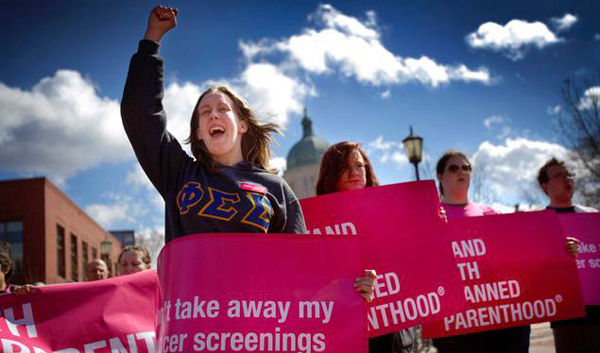
The social media buzz machine turned into a buzz saw late last week for the Susan G. Komen Foundation. If you’ve been anywhere near this social media maelstrom you know that the Komen Foundation has taken a major hit for its decision to cut funding to Planned Parenthood, and then reversing the decision, all within a 72-hour period. According to Advertising Age, the incident “showed how a brand can boomerang from one of the most loved into one of the most reviled in a head-snapping two days.’’

First a little background. Over the years the Komen Foundation, and their Race for the Cure, has raised billions of dollars for diagnosis, treatment and research of a disease that kills about 110 women every day in this country. The foundation gives away tens of millions of dollars every year and some of that money, about $700,000, had been going to Planned Parenthood. Planned Parenthood was using that money to provide screenings and mammogram referrals to women who might not otherwise be able to pay for these services. But Planned Parenthood is also the largest provider of abortions in the US, and that has resulted in close scrutiny by members of congress who want to ensure that government funds are not being used to provide abortions. Planned Parenthood is currently under investigation by congress with regard to its financial dealings and that was the initial reason cited by the Komen Foundation as to why they were withdrawing funding from Planned Parenthood. However, as negative responses mounted the story began to change. The Foundation countered that Planned Parenthood does not provide mammograms, only referrals, and that this change in funding was about being more responsible stewards of precious resources. You can see their initial response in this YouTube video.

Proponents and opponents have taken sides, sometimes determined by their view on the always-contentious topic of abortion. Critics of the Komen Foundation’s decision to halt funding to Planned Parenthood saw the decision as knuckling under to political pressure from the pro-life lobby. As you might guess, the reversal fired up the pro-life crowd who had been pleased with the earlier decision.

This blog is not a forum to debate the relative merits of either side in the culture war raging around abortion, but this case-study provides an opportunity to observe how a non-profit, known for years of service in the battle against breast cancer, could so quickly find itself under attack by many of the people that it claims to serve. The power of social media to aggregate discussions and dissent is once again center stage. Reaction to SOPA and PIPA last month, and now this…demonstrates the raw energy that can be focused by the impassioned use of  these modern-day megaphones. There’s another angle that students of media should consider. How you learned about this event may also be shaping your understanding of the issues at stake. According to an op-ed in the NYT, the media’s coverage of the story has been biased by the media’s failure to understand the perspective of those on the pro-life side of the issue.

Part of the problem facing Komen is that they appear to be giving in to political pressure…first from pro-life, then pro-choice, political operatives. Even after issuing an apology for their earlier decision plenty of anger remains. Some of their funding sources are now saying that they will stop giving to the Komen Foundation and only time will tell if the Foundation can bounce back from this misstep.  Somewhat ironically, both the Komen foundation and Planned Parenthood are reporting increased giving in the wake of the scandal. Planned Parenthood reported that it had raised $3 million in a 72-hour period, including a $250,000 pledge from NY Mayor Michael Bloomberg.

Additional Resources: Kaiser Health News has collected summaries of news organizations’ reports on the debate.

NOTE: if you respond to this post please do your best to keep your comments focused on the media issues related to the story.

Think Twice about SOPA and PIPA

If you plan to work in the media industries as a professional content creator, you need to pay close attention to the current debate over SOPA and PIPA. The two bills being debated in congress are designed, with substantial input from lobbyists representing “old media” interests, to shut down global websites that profit from the illegal distribution of copyrighted material: music, films and TV shows primarily. The issue is being framed by internet and new media companies (largely located in Silicon Valley) as a battle for internet freedom of expression and the rights of end users. Several major internet sites have gone black today or have modified their home page to express solidarity with the protest movement. But what about the rights of individuals and companies (largely located in NY & LA) that create media content?

Much of the early discussion that I’ve seen on Facebook and Twitter has bought into the new media companies’ arguments that this attempt to curtail copyright infringement will stifle creativity and growth on the internet. Others argue that the regulatory oversight will amount to censorship of creative expression. This is completely understandable from the perspective of those who are end users of content rather than creators. For the average consumer, more access to free content seems like a good thing. However, if you’re thinking that you’d like to work in the media industry as a content creator, you might want to consider what the future holds for you if creativity is not rewarded and protected.

Copyright laws exist to protect intellectual property and to reward the creative community for their investment of time and resources in the creative development process. Music, video and film content does not create itself, and those responsible for its creation and distribution deserve legal protection from those who would like to acquire, redistribute, or aggregate that content for their own personal or corporate benefit.

Now, while it may be clear that I am in favor of reasonable protection for copyright holders, I am not convinced that SOPA and PIPA are well-designed legislative tools to accomplish that goal. The video below points out some of the weaknesses of these bills and raises serious questions about their practical application.

[vimeo http://www.vimeo.com/31100268 w=398&h=224]

So, what do you think about SOPA and PIPA? Bad idea? Good idea? Good idea poorly executed?

Show Your Best

The 2012 Olympic Games are coming to London next summer, and the International Olympic Committee wants to attract younger viewers. How will they do that, you ask? Well, how about a website that allows youngsters to upload video clips of themselves performing some athletic feat…then create a mashup with their footage and footage of real Olympic athletes that can be posted to their Facebook page. Oh, and there’s a chance to win prizes and a trip to the London Games in the process. Sounds like a perfect scheme to take advantage of the inflated egos of the “participation generation”…those who grew up getting ribbons and trophies just for showing up. As the campaign says, “everyone’s best is worth celebrating.”

You can watch an introductory video clip here: https://showyourbest.olympic.org/en#!/intro

According to a write-up in the New York Times,

Mike Doherty, the president of Cole & Weber, said the campaign’s theme would resonate with a younger audience since many are used to interacting with others around the world through platforms like social media and video games. Most important, he added, “they certainly all think they are the best at something.”

css.php