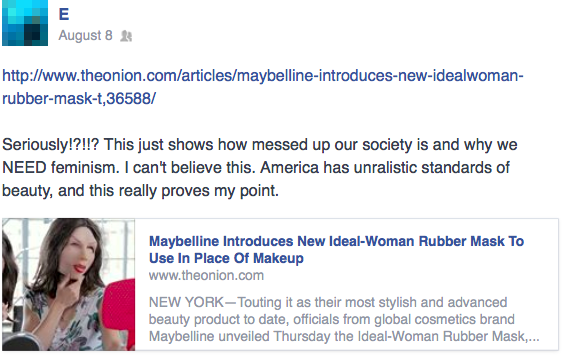
According to a report from Mashable, Facebook is considering adding a “satire” tag to links to stories from fake news sites, e.g. The Onion and The Daily Currant. Apparently the move is a response to requests from Facebook users who want help identifying fake news and distinguishing it from real news. Somewhat ironically, the staff of the Washington Post newspaper could also use a little help. Politico reported that a WP reporter was duped by a fake news report about Sarah Palin joining Al Jazeera.
I have witnessed, on several occasions, Facebook friends re-posting outrageous stories from fake news sites, and on one occasion (that I know of), I’ve done it myself. So I’m not suggesting that the idea of a “satire” tag is unnecessary or silly. However, let’s not assume that the satire tag will somehow eliminate the need for critical thinking on the part of media consumers. Any time that you off-load responsibility for critical thinking on someone (or some algorithm), you risk becoming a victim of that person’s (or algorithm’s) biases.
And there’s another potential downside. If the satire tag works we may have fewer opportunities to have a laugh at the expense of those who believe fake news is real, e.g. the website Literally Unbelievable. Here’s an example from their website:
 You may have heard by now that Facebook cooperated with researchers from two universities to study emotional contagion. The question that they wanted to answer was, does the emotional tone of others’ posts on your Facebook wall affect the tone of your posts? To find the answer they conducted an experiment…on nearly 700,000 Facebook users. The methodology was fairly straightforward; they began by using software to analyze posts in order to categorize them as either negative or positive. Then, they manipulated which posts were more likely to show up on the wall of certain Facebook users. By analyzing those users’ posts they were able to determine if they became more positive or negative as a result. Sounds like an interesting experiment for those of us interested in social science and the effect that mediated interactions may have on our personal disposition or behavior.

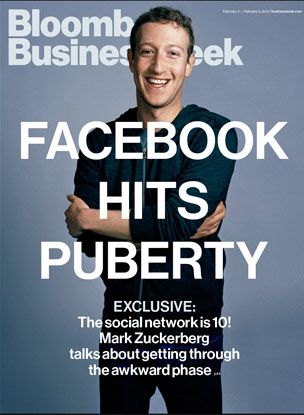 Ten years ago Mark Zuckerberg, a student at Harvard University, launched Facebook. If you want to see a Hollywood version of the beginning and early years of the company, see the 2010 film The Social Network, written by Aaron Sorkin and directed by David Fincher. In the film, Mark Zuckerberg is portrayed as a brilliant, but self-absorbed, geek who takes his own ideas and combines them with ideas from other innovative students to create the foundation of what would become the Facebook we know today. Blinding ambition and underdeveloped social skills aside, Zuckerberg creates a social sharing network that grows beyond his wildest dreams. Of course there are plenty of plot twists, including law suits from estranged partners and competitors, to keep the film humming along. In fact, the DVD case is inscribed, “You don’t get to 500 million friends without making a few enemies.” And just for the record, the current number of