Thanksgiving Week Update

Although we’re off this week, breaking news is not letting up. Here’s a quick recap of media-related news stories of interest to Media & Society…

  • Charlie Rose (CBS, PBS) and Glenn Thrush (New York Times White House correspondent) are new additions to the growing list of media professionals accused of sexual harassment or misconduct. Both have been suspended.
  • The Department of Justice is attempting to block the proposed $85 billion deal between AT&T (a telecom company) and Time Warner (a content producer) on the basis of anti-trust violation. This is despite a similar deal in 2011 when Comcast bought NBC/Universal.
  • FCC Chairman Ajit Pai is considering a roll-back of Net Neutrality policies that were put in place during the Obama administration. More at Politico.
  • Multiple former insiders at Facebook are coming out to accuse FB of building a platform designed to compromise its users. Former engineers, designers, and investors are admitting their own involvement in aiding the tech giant in creating something that has become too big and too powerful for our own good. The person who created FB’s “like” button was quoted as saying, “It is very common for humans to develop things with the best of intentions and for them to have unintended, negative consequences.” There’s an old saying, “Confession is good for the soul.”

Happy Thanksgiving to you and yours!


Celebrity Endorsements

HuffPo recently published data reported by HopperHQ about rates charged by celebrities for social media endorsements. Here’s a list of some of the top dealmakers.

  1. Selena Gomez – 122 million followers – $550,000 per post
  2. Kim Kardashian – 100 million followers – $500,000 per post
  3. Cristiano Ronaldo – 104 million followers – $400,000 per post
  4. Kylie Jenner – 95 million followers – $400,000 per post
  5. Kendall Jenner – 81.7 million followers – $370,000 per post
  6. Khloe Kardashian – 68 million followers – $250,000 per post
  7. Kourtney Kardashian – 57.8 million followers – $250,000 per post
  8. Cara Delevingne – 40.4 million followers – $150,000 per post
  9. Gigi Hadid 34.7 million followers – $120,000 per post
  10. Lebron James – 30.7 million followers – $120,000 per post

As you can see it is largely a numbers game with a couple of notable exceptions, e.g. Kim Kardashian punches above her weight with a cool $500K per post to reach her 100M followers.

Just in case you, or anyone you know, have a plan to become one of these influence marketers, just remember that there are a few million folks in line ahead of you. You should probably have a plan B just in case.

Fake News, Social Media, and Russian Influence

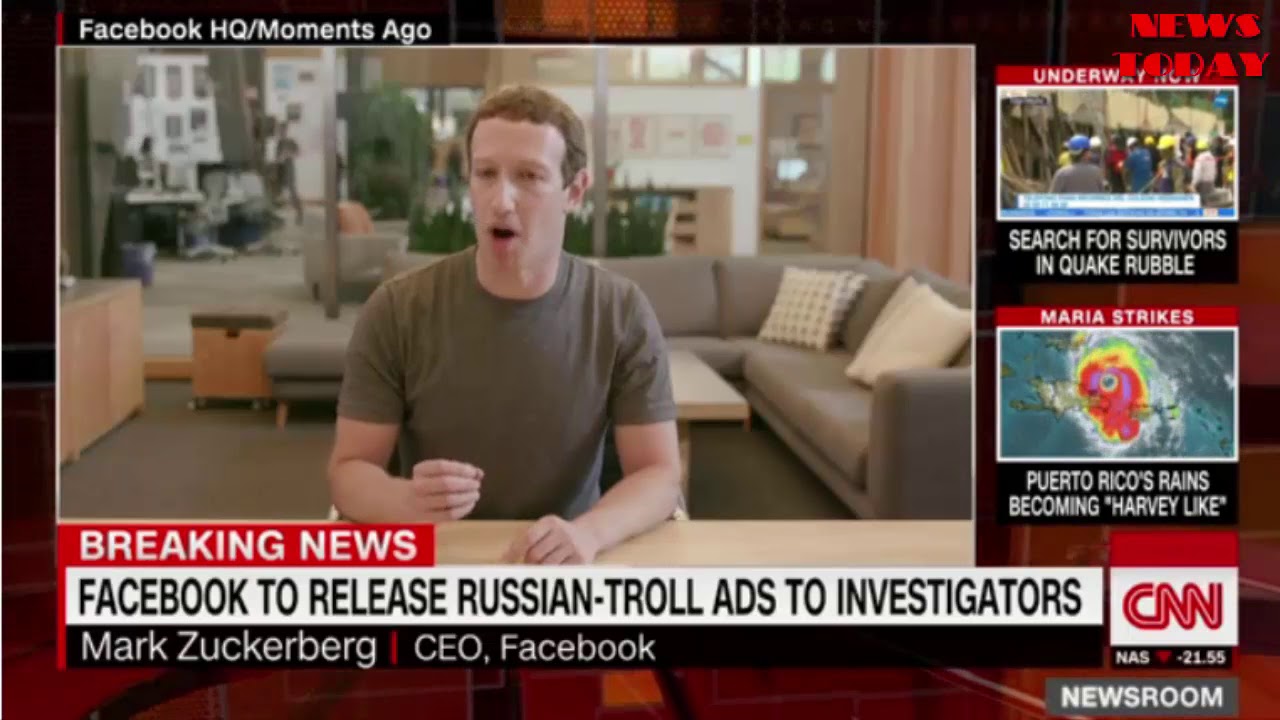
In the days following the 2016 election Mark Zuckerberg said, “The idea that fake news on Facebook, of which it’s a very small amount of the content, influenced the election in any way I think is a pretty crazy idea.” Since then Facebook has uncovered more than $100,000 of ad spending by Russian operatives designed to highlight divisive election issues. In late September Zuckerberg issued an apology saying, “Calling that crazy was dismissive and I regret it.”

It now appears that social media regret is more widespread as well. This past week Twitter admitted to a Congressional panel that it too was targeted by Russian operatives attempting to influence the election.

According to Recode,

Twitter informed congressional investigators of its findings in a series of briefings in Washington, D.C., on Thursday — and the revelations are sure to stoke further speculation on Capitol Hill that Kremlin agents sought to co-opt social media platforms to stir social and political unrest in the U.S.

In a separate report, Recode reported…

…about 20 percent of tweets sampled around the U.S. presidential election qualified as “polarizing and conspiracy content,” including links to “junk news,” WikiLeaks or Russian sources, like Sputnik and RT.

Next on the stand will be Google. Congress wants to know whether its email, advertising, and YouTube services were compromised by Russian operatives attempting to manipulate the outcome of the Presidential election.

In all of these instances it is becoming apparent that the meddling was intended to influence the outcome of the election not by promoting or attacking any one candidate, but by stoking political unrest on a variety of hot-button social issues, including: immigration, gun control, religion, LGBT, and racial issues such as Black Lives Matter.

CNN reported that a Russia-backed account called Blacktivists used Facebook and Twitter to promote racial tension and its Facebook account had more “Likes” than the Black Lives Matter Facebook account.

According to a report published in the Washington Post,

These targeted messages, along with others that have surfaced in recent days, highlight the sophistication of an influence campaign slickly crafted to mimic and infiltrate U.S. political discourse while also seeking to heighten tensions between groups already wary of one another.

Even if Congress cracks down on reporting of political ads on social media there is little evidence that much will change. After all, these are not political ads by traditional definitions.

There are, however, a couple of take-aways from these reports. First, if you’re consuming news exclusively on social media you are vulnerable to manipulation. And second, hyper-partisanship makes us even more likely to believe propaganda and lies. The first issue is fairly easy to address…the second will take significantly greater effort.
Russia used Facebook to Try to Influence the 2016 Election

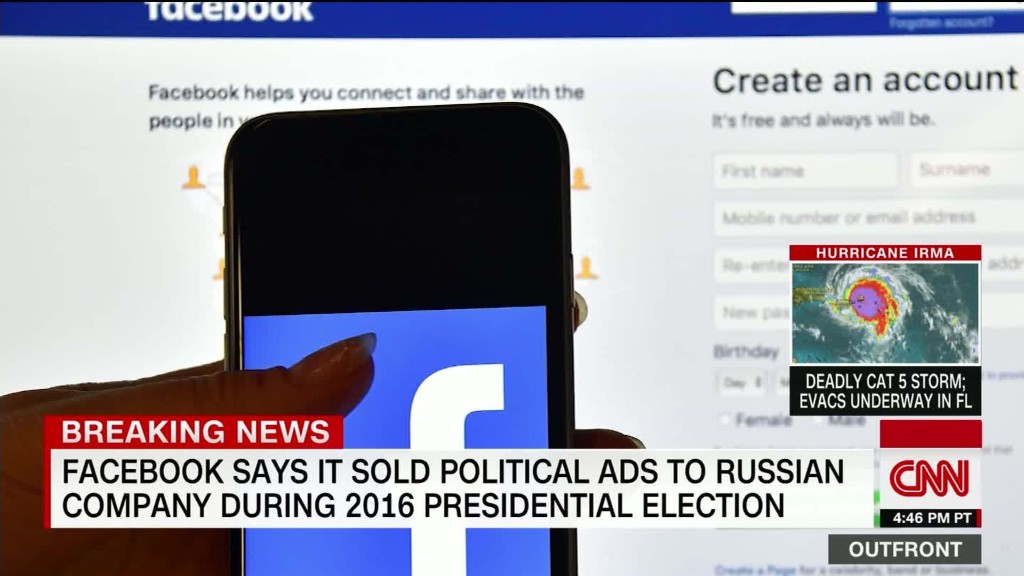
New reports are surfacing claiming that Russia was behind an effort to influence the 2016 Presidential election. Facebook itself is releasing information suggesting that it carried approximately $100,000 of advertising that was “connected to about 470 inauthentic accounts and Pages in violation of our policies.” Using fake Facebook accounts, highly-targeted ads pushed traffic to websites designed to promote a narrative that was pro-Trump and/or anti-Clinton.

Zuckerberg had previously claimed that social media manipulations were not responsible for the Trump victory, but these new revelations may reopen that debate. In response, some lawmakers are calling for regulations that would make political ad buys on social media more transparent.

Twitter has also indicated that it will look into Russian meddling that may have targeted their platform.


Hacking, Leaking, and Weaponized Data

The press, and by that term I mean the media industries devoted to journalistic enterprise, love a good leak. Inside information not intended for public consumption that suddenly appears in a package tied with a pretty bow is a gift of great value and consequence.

Leakers come in every form imaginable, and do so for a wide variety of reasons: true whistleblowers looking out for some greater good, disgruntled employees who don’t like what they see happening behind closed doors, an injured party to a dastardly deed, or hackers looking to profit from rich corporations (e.g., the hack of HBO and threat to leak spoilers for upcoming episodes of Game of Thrones)…all find reasons to go the the press with their inside scoop.

It strikes at every level of nearly every organization or power structure. It is one of the power levelers—a way for those near the bottom to inflict damage on those near the top. Presidents, CEOs, celebrities, and clergy…all are susceptible to a well-timed leak.

Sometimes the leaker is passing along information that they came by honestly, and other times it may involve a breach of security protocol or even illegal hacking.

Recent leaks have been widely reported, including: the DNC emails hacked (or were they?) and released to Wikileaks last year, transcripts of President Trump’s phone calls to heads of state, Jared Kushner’s off-the-record meeting with congressional interns (see Wired magazine), FBI director Comey’s anonymous leak to the press,  and the leak of an internal memo at Google that ignited a firestorm of controversy over sex discrimination in the tech industry (see more here and here). The last example also raised questions about when and where it is safe to speak out when speaking out may be controversial and politically incorrect.

In all of these cases the leakers were only part of the equation. The leakers need the assistance of a willing journalist and a willing publisher to distribute the information to the public. Journalistic history is filled with stories about investigative reports that broke because of leakers; perhaps the most infamous being Deep Throat of Watergate fame. But these symbiotic relationships are risky when the motives of leakers are unclear. Leakers may be seeking revenge, or may even leak information in an attempt to promote their own agenda. Sometimes those in positions of power use leaks through intermediaries in order to advance their own version of events. Without corroborating evidence, a leak is simply a rumor…or worse.

The legality of leaking to the press is complicated. Prosecution of illegal leaks that compromise national security is rare but does happen, e.g. Chelsey Manning’s conviction and sentence, which was later pardoned by President Obama. But more often than not the leaker and the news organization escape punishment. This inclination to protect journalists, and their sources, is part of our First Amendment tradition.

For more information about leaks and the media, see this page at the Newseum and listen to this podcast at On The Media.

Influencer Marketing: It’s Not Just for Celebrities Anymore

It used to be that you had to be a bonafide celebrity to land a celebrity endorsement deal. Win a gold medal, release a gold album, or star in a blockbuster movie and advertisers would line up asking you to pitch their products. The association principle of advertising works by associating a brand, product, or service with an intangible, but desirable, positive attribute. And celebrity status is a particularly attractive association that many brands crave.

Things have changed. Celebrity endorsements have given way to influence marketing. If you have influence, no matter how you’ve earned it, you can cash that in for…well, cash. You’ve got thousands reading your [insert hobby here] blog on a daily or weekly basis? …great, how about mentioning our brand and we’ll send you some free product.  One hundred thousand subscribers to your beauty secrets YouTube channel? Fantastic…how’d you like to represent our product line for a nice monthly salary? A million or so followers on Twitter? We need to talk!

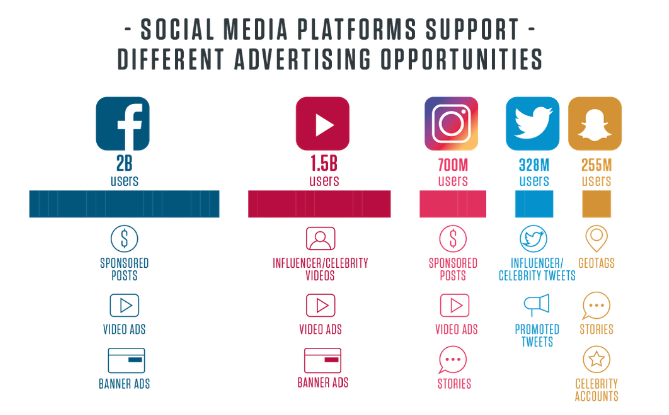
The reason why this is such a thing is because of the power and reach of social media. At the same time, traditional advertising has been suffering from shrinking audiences and diminishing credibility. We’re more likely to believe a friend’s recommendation than an advertising pitch-man’s exaggerated promises. Word of mouth (or online word of “mouse”) is where it’s at. This graphic is from an informative post by Aaron Orendorff on the Mashable website.


The title of this blog suggests that this new form of marketing is not just for celebrities anymore. Maybe the point is that the barrier to becoming a celebrity is much lower in this digital, social-mediated landscape. However, if you want to play, you need to know the rules. The Federal Trade Commission (FTC) recently published guidelines governing endorsement deals and has been cracking down on influencers engaging in unethical behavior.

Selfies: Not just an American thing

I just returned from a vacation in Italy where we saw many wonderful sites. Seeing Saint Peter’s Basilica in person was truly amazing. The Colosseum, the Sistine Chapel, and the cathedrals in Sienna and Florence were highlights of the trip. Seeing these sites up close and personal was a reminder that a picture seldom does justice to the real thing. However, as the modern expression goes, “if there’s not a picture, it didn’t happen” …which leads me to the point of this post.

Present everywhere we looked was the ubiquitous selfie stick. And for those traveling with friends, lots and lots of cell phone cameras being used to document every step of the way. I didn’t take my cell phone but I did carry a camera…so I’m not above criticism.

Lining up the shot

But what surprised me a bit was the posing that seemed to accompany the act of documentation. Watching people paste on their smile or pouty lips just before pushing the button was a reminder that what we see on social media is a carefully curated version of our lives. We take multiple pictures until we’re satisfied with the shot that will be uploaded to Facebook, Instagram or Snapchat.

Posing or praying?

To the right is a picture of a gal and her friend in the baptistry at the cathedral in Florence. Please forgive me if it appears that I’m judging her personal piety, but it did seem odd that she folded her hands just long enough for her friend in the dark blue dress to capture the shot.

Elsewhere I saw plenty of folks taking pictures of themselves or their companions in poses that shouted, “I’m having the time of my life in this very famous place!”

Something that has been a real game-changer is the low cost and instant publishing made possible by digital photography’s marriage to the mobile phone.

Digital killed Kodak

The irony of this struck me as I took a photo of a young girl having her photo taken with a Kodak sign visible nearby. Just a decade or two ago photographic film and processing required made photography a fairly expensive hobby that required delayed gratification (waiting for the film to be processed and printed) before you could even think about sharing the experience with others. Now the picture is taken, reviewed, and uploaded to a global audience in seconds, without any consideration of cost.

But it is not just digital photography that has changed the way we live our lives.

Video games are a constant distraction for young and old. I watched children and adults playing games on their portable devices even while on vacation in amazing locations. Playing video games and having a paniniMy wife calls it “playing Gameboy in the middle of the Grand Canyon” syndrome. This little guy may have been a local so perhaps he was just killing time the way youngsters do in nearly every developed country.

Digital media that connects us instantly to our friends across the room or around the world has changed us…whether for the better or worse is up for discussion. As we explore mass media this summer let’s remember to think critically about how our experiences creating and consuming media change us and those around us. Only then will we be “smart” users of our smart devices.

Survivors and Victims of Reality TV’s Deception

Reality TV is constantly inventing new ways to shock its viewers. This past week on Survivor it was the outing of transgender contestant Zach Smith by gay competitor Jeff Varner. In a side story (in real life), Varner was subsequently fired from his job as a real estate agent by a boss who was quoted as saying that Varner is “in the middle of a news story that we don’t want anything to do with.”

The uproar on social media was immediate and unforgiving. Some of the harshest criticism was for Varner and his use of the word “deception” to describe Smith’s secret. Others were harshly critical of CBS for deciding to include the scene after months of deliberation.

But it turns out that CBS and Smith worked closely to prepare for the episode’s airing this past week.

According to the New York Times,

From the moment the episode was filmed nearly 10 months ago, the “Survivor” producers had been consulting with Mr. Smith about how best to handle airing the incident, which included a strategic media rollout and working with Glaad, the gay, lesbian, bisexual and transgender rights group, before the episode’s broadcast.

Jeff Probst, the show’s host and executive producer called it “one of the most raw and painful studies of human behavior that has ever happened on ‘Survivor.’ ”

But I’m left with a question that goes to the heart of reality TV as a programming genre. For the Survivor-type shows where contestants compete for a grand prize, deception, betrayal, and backstabbing are not only allowed, they are encouraged. Deception is how you play the game on reality TV…and, unfortunately, increasingly so in the world of politics and international relations. But I digress.

One viewer took to Twitter refusing to accept Varner’s apology saying, “Apologies only have meaning when they are expressing sincere regret for a mistake. What Varner did was no mistake. He intentionally humiliated Zeke and tried to justify it.” Exactly! That is how you play the game on Survivor. The drama created by conflict is why most people watch, and have been watching Survivor for more than 13 years. The business model for Survivor and CBS is based on people doing outrageous things in front of cameras and microphones. CBS will cash that check over and over again…or at least as long as the audience shows up asking for more.

But we’re still left with the question; why did this tactic by Varner elicit such a strong response from viewers? Just like the collective judgement directed at United Airlines, the moral outrage targeting Varner and CBS is indicative of society’s desire for justice. We know when something is over the line. But whose line is it, and where should it be drawn?

Some of the ugliest disagreements (on social media and elsewhere) are between people who want to draw the line in a different place than where others think it should be drawn.

Bad PR for United

United Airline has experienced some self-inflicted wounds recently and the latest PR pratfall shows little sign of easing. The forcible removal of a man from a plane at the Chicago airport was video recorded and shared far and wide on social media, including in Asia where David Dao lived before immigrating to the USA.

Bumping passengers from over-booked flights is pretty standard practice. Nearly half a million passengers voluntarily gave up their seat last year, including 63,000 on United. My son took a bump this weekend and got a nice meal and a $500 voucher for his trouble. When not enough passengers volunteer their seats, airlines are allowed to bump passengers. However, they must give them compensation in the form of vouchers, gift cards or cash.

But the execution of the bump in this instance was anything but routine. Not only was the passenger forcibly removed but he was injured in the process. Adding insult to injury, the airline responded with
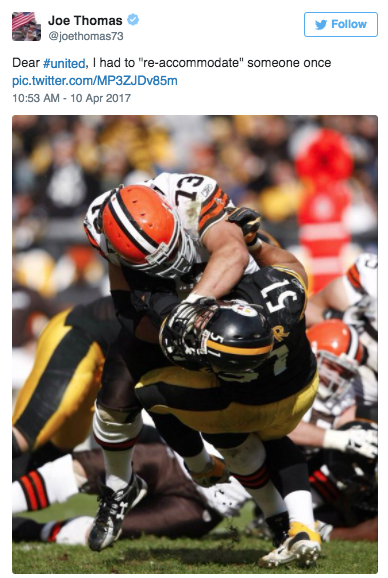
the kind of statement that gives PR a bad name. Social media lit up when the procedure was referred to as “having to ‘re-accommodate’ these customers” …customers who, we might add, were ejected to make room for United employees traveling to Louisville. That led to this meme by NFL player Joe Thomas………


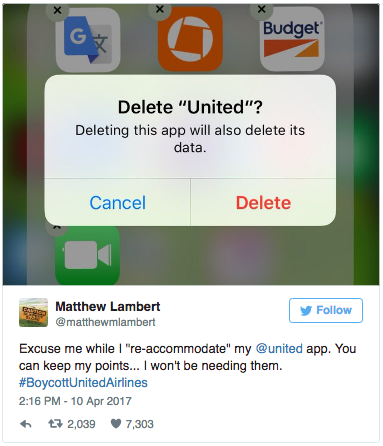
And this tweet…


The story is complicated by the passenger’s troubled history including the suspension of his license to practice medicine. But that doesn’t excuse United’s behavior and public outrage has been pronounced. According to USA Today, at its low point on April 11, United’s stock lost nearly $1 billion.


Alternative Facts and Rogue Tweets from Alt Federal Agencies

Journalists have their work cut out for them. With public faith in journalistic credibility at an all-time low and a combative White House that uses social media to circumvent traditional news channels, journalists are facing new challenges that have the potential to either make or break the industry.

A democracy depends on an information electorate, and information, for most of our recent history, has been the responsibility of a free and fair press. Newspapers, magazines, television networks, and internet websites have been the backbone of the journalistic enterprise in recent decades. Investigating and exposing corruption, reporting without bias, holding those in power to account…these are the responsibilities of a profession that is recognized and protected by the First Amendment to the Constitution. But more and more news consumers are turning to alternative sources of information, including social media and internet websites that frequently traffic in a different type of information.

Not all information is created equal and it is becoming increasingly difficult to ascertain the value and credibility of the barrage of information that vies for our attention. Take for example the estimates of the size of the crowd attending the Presidential Inauguration. Competing claims, some with photographic evidence, were made by partisan sources and reported by journalists…facts and “alternative facts” if you will.

On Facebook the other day I followed a link to a report of a catastrophic pipeline rupture. A photograph was presented as evidence, calling into question the safety of the Dakota Access pipeline. But the article falsely represented a photo from 2010 (taken in Texas) as a current photo from a Pennsylvania spill by the company connected to the Dakota Access project. Regardless of whether you support or object to a pipeline near this Native American community, this is not journalism.

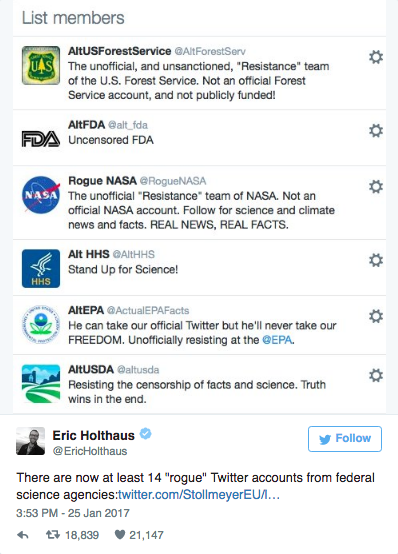
You may have seen the eruption on Twitter from various “alternative” governmental organizations after President Trump ordered a suspension of the official social media accounts. While these rogue accounts may be just that…actions of government employees acting on their own initiative on their own time…it is also possible that they are simply fake accounts created by partisans who are participating in a grass-roots resistance to the new administration.

As such they are newsworthy, but not for the same reason they would be if indeed they are actually the work of federal employees. According to one blog,

For now, at least, most of these unverified accounts seem to be pushing positive agendas: the climate change facts that many of them tweet are unequivocal, and the planned march of scientists on Washington promises to raise legitimate concerns about scientific progress in the United States. But a dejected left-wing and liberal group should remember that these accounts are emotionally gratifying, not edifying. Embracing such gratification without critical analysis veers close to the Trump administration’s embracing of “alternative facts” — lies that suit the narrative you’d prefer.

Disclaimer: the above quote is from The Verge, a website that has a mixed record as a credible source of news/information.


css.php