Dear Rolling Stone…

…please stick to music. Believe it or not, the magazine used to have a reputation for quality investigative journalism. But recent high-profile ethical failures have tarnished that seanpennreputation. First it was the campus rape story that was retracted after the accuser’s story disintegrated. In this case irresponsible journalism damaged not only the reputation of individuals and the UVA campus community, it did damage to the cause of those working hard to reduce sexual assault on college campuses. You can read about the debacle here.
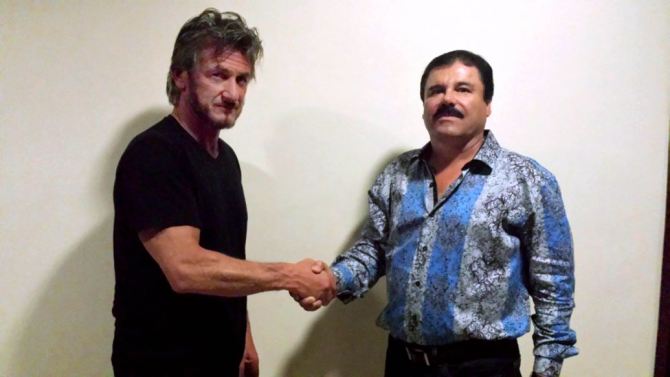
The Sean Penn interview with El Chapo puts another nail in Rolling Stone‘s coffin when it comes to journalistic integrity. According to an interview with David Folkenflik on National Public Radio,

the agreement that Rolling Stone made was extraordinary and, I think, wrong. It agreed to allow Joaquin Guzman, the real name of El Chapo, to review and demand changes in the article before publication. Rolling Stones says he chose not to do so. But what an abrogation, what a relinquishment of editorial control and authority.

Another reason for concern is the role of Sean Penn. We’ve seen other attempts at celebrity activism fail miserably. Remember Dennis Rodman’s basketball diplomacy with North Korea? When celebrities inject themselves into serious news stories, the story is often overshadowed by the celebrity’s fame or political baggage.

Perhaps the best thing to come of the interview was the capture of El Chapo. According to the AP as reported in the Washington Post,

Associated Press quoted Mexican authorities saying that Penn’s contacts with Guzmán helped them track down the fugitive in a rural part of Durango state.

UPDATE: Sean Penn feels terrible regret over his interview with El Chapo.

Sleepless in Austin

SW-THE-FORCE-AWAKENSLast week the Alamo Draft House, a theater in Austin, TX, hosted a special screening of the Star Wars movies. Each of the six episodes were screened, followed by the new film, The Force Awakens, on repeat until all but one viewer succumbed to sleep. That final nod happened after Jim Braden had watched the first six episodes, and nine viewings of episode 7; nearly 48 hours of intergalactic shenanigans. According to the Washington Post, the winner won Star Wars cards and artwork, seven years of free tickets and a theater seat named in his honor.
The Hollywood Reporter corresponded with Braden after his victory about what he described as “a grueling ordeal, even though I loved the movie.” You can read about his impressive achievement here. Here’s an excerpt:

You said you’ve watched all the earlier films multiple times, and now you’ve seen the newest installment nine times in one sitting. Is that enough? Can you imagine ever wanting to see it again?

I left the marathon convinced I’d never be able to watch it again. I had been Clockwork Orange‘d. I went home and slept for a few hours — my first sleep in over 50 hours — and dreamed, or hallucinated, about the movie the entire time. I woke up and immediately felt the urge to watch the movie again.

I think it has a bit of a Stockholm Syndrome-like hold on me now. I’ve come to love my tormentor. My parents are coming into town for Christmas, and I’ve already gotten us tickets to see the movie while they’re here. And I can’t wait to see it again. I’m a sick, sick man.

Journalists Behaving Badly

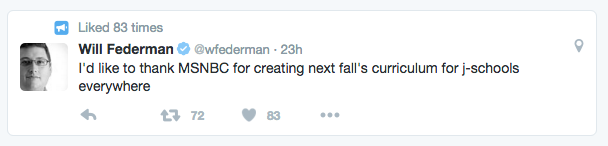
A tweet by Will Federman, an Audience Engagement Editor at Fortune Magazine, captured the essence of a bizarre incident that took place yesterday at the home of Syed Rizwan Farook and Tashfeen Malik, suspected of the recent mass shooting in San Bernardino, CA.

ThanksMSNBC

The tweet was a response to live news coverage from inside the home of the accused couple, where reporters from MSNBC, CNN, the LA Times, and other new organizations, were combing through the house and the occupants’ personal belongings. Social media erupted as the live coverage of the “home invasion” played out on the screen. According to reports, the landlord (the accused were renting) used a pry bar to gain access to the home.

For more coverage of the “coverage”, NPR has photos and commentary.

The fact that police and FBI agents apparently stood by as journalists entered and began sifting through personal belongings does not excuse their behavior.

Problems, of course, include: the invasion of privacy of people associated with the accused, the voyeuristic nature of the coverage, the inability to make editorial decisions on the fly when broadcasting live, and possible contamination of a crime scene. Journalists, and other members of the public, are typically kept out of crime scenes until after the police and investigators have done their work. In this case the police realized too late what was going on and failed to close down the scene until after the integrity of the home was compromised.

The lesson for students attending j[ournalism] school is that reporters should know their ethical and legal rights when covering criminal news, and should not allow a mob mentality to overtake them when doing their job. I’m sure that some of the journalists present knew that they were acting in a way that was unprofessional and potentially illegal, but the fact that others were doing it…potentially “scooping” them in the process…was enough to convince them to join in. Of course there may have been a few who were confused by the apparently lack of direction from those in authority. However, ignorance is not a defense and access to private property should always follow appropriate legal procedures.

So there you go j-school students…you don’t have to wait until next fall to learn this lesson.

  • know the law
  • don’t be swayed by the mob mentality
  • question authority…even if the authority figures in question appear to be aiding rather than obstructing your efforts to get the scoop

Selling Out

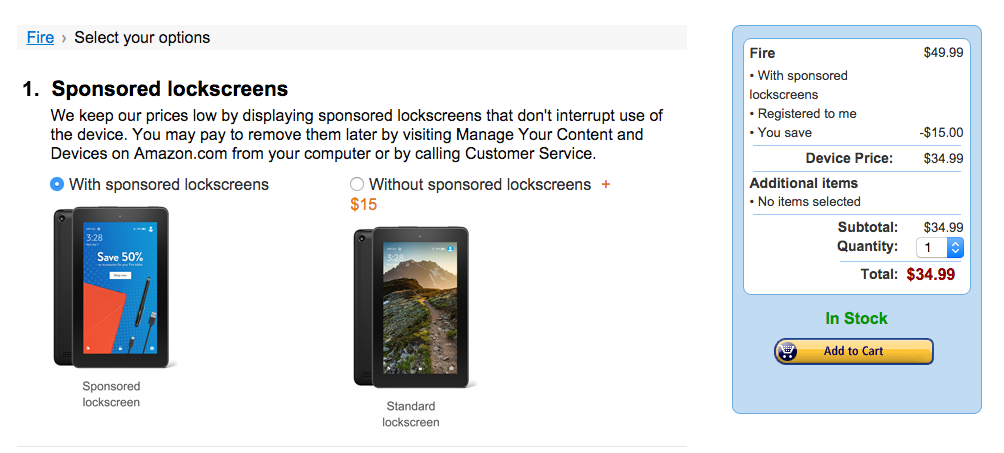
I bought an Amazon Fire tablet today for the ridiculously low price of $34.99. That’s $15 less than their usual ridiculously low price. Today’s special is not just a Black Friday “door buster” bargain. No, the additional $15 off is available to anyone who is willing to let Amazon place an ad on the tablet in place of the lockscreen image. That’s right, I sold the lockscreen on my tablet to Amazon, and invited them to use it to advertise to me so that I could save $15. I don’t know whether to feel like a smart shopper or a sell out. Actually I do, but I’d rather think of myself as a smart shopper.FireLockScreenAd

Internet Cats to the Rescue

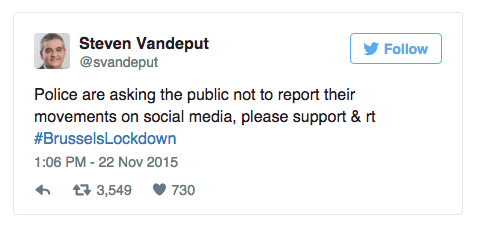
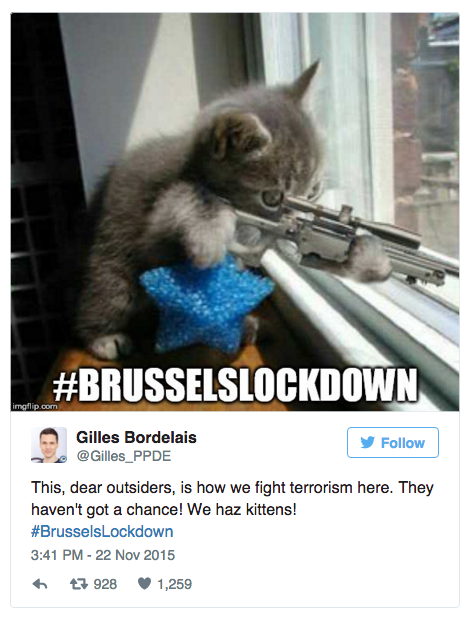
Everyone knows that the Internet is for cats. Keyboard Cat, Colonel Meow, Grumpy Cat, and now…the BrusselsLockdown Cats! In response to recent attacks in Europe, Belgian security forces have been conducting raids intending to root out remaining terrorists. Police

In response to requests for social media silence by Belgium’s minister of defense and local police, Belgians and members of the international community have responded with the hashtag #BrusselsLockdown and lots and lots of cat photos.

BrusselsLockdown

Every once in awhile the concerted silliness of the millions of inhabitants of the interwebs gives one reason for hope…even if you’re not a cat person.

The Magic of the Moment

A precious moment was captured with a video camera and microphone, and then shared for the world to see. There are many ways to document reality—to capture a moment in time and preserve it for others to experience. A painting, a photograph, a quote, a poem, a story; they all have their own way of capturing reality so that others can experience something similar to the experience of actually having been there. This is one of those moments that, had it not been captured, would still have been precious and significant. But the fact that it was captured at a time when the power of digital technology and social media have been fully unleashed on this global village we call home makes it precious and significant for millions.

http://www.youtube.com/watch?v=xkM-SDNoI_8

Security v Privacy: Choose Carefully

The recent terrorist attacks in Paris have raised new questions about safety and security in a globally connected world. According to an article in yesterday’s New York Times, readily available encryption is easy to use, and impossible to access even by government agents with warrants.

Some of the most powerful technologies are free, easily available encryption apps with names like Signal, Wickr and Telegram, which encode mobile messages from cellphones. Islamic State militants used Telegram two weeks ago to claim responsibility for the crash of the Russian jet in the Sinai Peninsula that killed 224 people, and used it again last week, in Arabic, English and French, to broadcast responsibility for the Paris carnage.

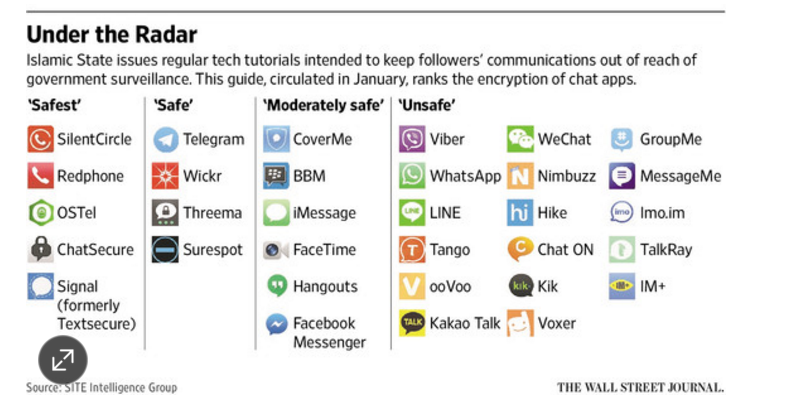
Another report, this one published in the Wall Street Journal, provided the following graphic to show which apps are most secure, and therefore most likely to be deployed by those intent on avoiding the attention of military and police counter-terrorism forces.

TerrorTech

A lower-tech approach to terrorist communications is to use the online gaming platforms, e.g. PS4, to share information. According to this approach the terrorist are counting on the sheer volume of messages using similar violent language to mask their terrorist communications.

Meanwhile the cyber-hacking group Anonymous is waging its own war on ISIS. “Vowing to silence extremist propaganda and expose undercover operatives,” Anonymous claims to have deleted 5,500 Twitter accounts that had been used by ISIS. In a video just released they warned, “Expect massive cyber attacks. War is declared. Get prepared.”

According to the WSJ,

The bloodshed in Paris will likely exacerbate a tense debate between governments that want inside access to those encrypted tools and tech companies that say [they] are trying to protect customer data and are wary of government overreach.

What do you think? Does personal privacy trump security, or vice versa?

I Need Some Muscle Over Here

Rarely is the 1st Amendment on such public display as it has been in recent days at the University of Missouri. On the bright side, the right to free speech, to peaceably assemble, and to petition Congress for a redress of grievances has been front and center. But so too has been some pretty ugly behavior that makes one wonder if people really understand why press freedom is such an important part of the 1st Amendment.

A video of the demonstration contains a startling statement (at 6:30)…and even more so when you realize who said it!

According to the New York Times,

As the video nears its end, the person taking the video, Mark Schierbecker, emerged from the scrum and approached a woman, later identified as an assistant professor of mass media, Melissa Click, close to the tents. When he revealed that he was a journalist, Ms. Click appeared to grab at his camera.

She then yelled, “Who wants to help me get this reporter out of here? I need some muscle over here.”

In what may provide some consolation to journalists and 1st Amendment supporters, Ms. Click resigned her position with the School of Journalism the following day.

Again, according to the NYT,

Mitchell S. McKinney, the chairman of the department of communication, released his own statement, saying: “We applaud student journalists who were working in a very trying atmosphere to report a significant story. Intimidation is never an acceptable form of communication.”

You can watch the full video here

In this version of the video the confrontation is @ the 7:15 mark

Jan 27, 2016 update: The Chronicle of Higher Education published an article that explores the content of Melissa Click’s email inbox in the days after the incident.

Political PR and Symbolic Gestures

Last week you read a blog post about the public relations difficulties facing the nuclear power industry…an industry that could be an alternative to fossil fuels such as coal and oil. We also looked at the issue of climate change and the PR war that is being waged by big oil, the environmental movement, and those who stand to gain when alternatives such as solar and wind are put into service.

Last Thursday President Obama vetoed the Keystone pipeline, a project that has been in the works for seven years. The pipeline would transport tar sands oil from Canada to refineries on the gulf coast of the US. The environmental opposition to the project is grounded in a belief that oil is bad, and that tar sands oil is one of the worst forms of oil when it comes to negative environmental impact. According to the New York Times, “The process of extracting that oil produces about 17 percent more planet-warming greenhouse gases than the process of extracting conventional oil.”

But the debate had come to be more symbolic than real. The oil will likely make it to market regardless of the fate of the Keystone pipeline and the pro-jobs and pro-economy arguments were largely overstated.

But the New York Times report suggests that Obama’s decision is mostly about cementing his legacy as a friend of environmentalists. It even makes the point that the decision is about sending a message to the international community.

But advocates of the agreement said that the Keystone decision, even though it is largely symbolic, could show other countries that Mr. Obama is willing to make tough choices about climate change.

Perhaps Obama’s decision is a chess move in a global PR strategy designed to affect the outcome of UN’s Conference on Climate Change when they meet in Paris later this month.

Ad of the Day, featuring MCCNM alum Megan Matousek

Every so often one of our amazing MCCNM alums does something really fantastic…and this time it is Megan Matousek, class of 2005. Megan works for Industrial Light & Magic, and most recently had a hand in the making of a commercial spot for Duracell.

You can read more about the spot here, at the Ad Week website. Scroll to the bottom for Megan’s credit.

css.php