Prognostications about Political Programming

The first Tuesday in November is typically election day…the day that ordinary citizens voice their preferences for candidates and ballot issues. This year is an off-year election, meaning that candidates on the ballot will be those running for school board, city council, mayor, etc.–not governor of the state or president of the United States. The national election for the office of president will come next year.

But 2016 will be here before you know it, and the major political parties are well under way with their process of determining who will be their candidate for the general election. While the Democratic party appears to have settled on Hillary Clinton as their candidate, the Republican party is still struggling to find the best candidate to go toe-to-toe with Hillary.

The surprising strength of billionaire Donald Trump’s candidacy is having an equally surprising effect on TV ratings. The three Republican debates thus far have generated much higher ratings that similar events in the past. Trump, the media celebrity, has leveraged his “star”-power and bombastic personality to attract viewers to TV programming that might otherwise be about as exciting as watching C-SPAN.

Which brings us to a very strange phenomenon. The appeal of huge ratings has the TV networks fighting over these political debates as if they were NFL games. Winning the contract to televise a presidential candidate forum has become a permit to print money…and the candidates know it. That is why representatives from each of the major candidate’s campaigns recently met to agree to new rules that will allow them to dictate to the networks how to structure future debates. The candidates are in the driver’s seat and they are going to decide where they want to go.

And one place they want to go, collectively, is away from networks and moderators who are less than friendly. The most recent Republican candidate debate, hosted by CNBC, a subsidiary of NBC, was widely criticized by political observers, and the candidates themselves. According to RNC chairman Reince Priebus,

While debates are meant to include tough questions and contrast candidates’ visions and policies for the future of America, CNBC’s moderators engaged in a series of ‘gotcha’ questions, petty and mean-spirited in tone, and designed to embarrass our candidates.

CNBC’s approach will work if the candidates are at the mercy of the TV networks to get their message out. But in this day and age with social media and websites and competing news outlets, the control is slipping away from TV networks. If they want to keep the debates, and the associated advertising dollars, they will have to make concessions to the news-makers.

In all of this journalists and TV news networks need to remember that credibility is their primary product. If and when they lose credibility they will have little to offer. And according to a recent Gallup poll journalists’ credibility is below business executives, on par with lawyers, and just a few notches above advertisers, politicians, and lobbyists.

So How’s that Media Fast Thing Working Out?

Fasting, abstaining, cleansing, detoxing, going Walden, Amish month…whatever you call it, dialing back the media technology for a period of time may just help you get your head on a little straighter. I know it’s not comfortable, or fun. Shoot, it’s barely tolerable at times. You’ll get bored (but that’s not necessarily a bad thing) and fidgety. You’ll probably do more homework and cleaning, or working out and sleeping, than usual. You may even spend more time having real interaction with real people…you know, the face-to-face variety of interaction.

In a recent blog post on AdAge’s website, Jamie Barrett described their attempt at the ad agency BarrettSF to make meetings tech-free for all but the presenter. They called it “Amish month”, and the rules were pretty simple…

When you’re in a meeting, and you’re not presenting, you can’t look at your laptop. Or your tablet. Or your smartphone. Or your Apple Watch. Or your discontinued Google Glasses. Or your contact lenses if they receive a wi-fi signal.

According to Barrett,

There is some wild stuff that happens. With no keyboards to pound or screens to stare at, heads tilt up and start to look around the room. There’s eye contact. Facial-expression recognition. People speak words and others hear them, and can perceive whether those words are serious or funny, sincere or sarcastic, angry or glad.

Like I said, it’s wild stuff. We’ve decided to extend Amish Month into October.

Maybe the Amish are on to something.

Are You Ready for Some Star Wars?

star-warsLast week’s Monday Night football game on ESPN was an excellent opportunity for Disney (parent company of ESPN) to promote its latest Star Wars movie. In case you didn’t know, Disney bought Lucas Films (creator of the Star Wars franchise) in 2012 for $4B. That acquisition was what happens, “when you wish upon a death star” according to one report.

Advertising is when one company pays another to promote its products. But if the company that wants to advertise is a media company, and it wants to promote its own products by using its own media space to do so, we call that promotions. TV networks promote specific programs to targeted demographics watching other programs. Radio stations promote themselves with their own airtime trying to build brand identity and loyalty. Even newspapers and magazines promote upcoming features or issues.

Disney using ESPN’s broadcast of NFL football to promote its upcoming film release is a no-brainer. NFL football is hugely popular…and a perfect audience for the new blockbuster. But this promotion actually worked both ways. The ESPN telecast actually saw a ratings spike as people tuned in to see the world-premiere of the latest trailer. That’s right, people tuned into the program to see the commercial! Now that’s marketing mojo. Theater servers crashed as fans rushed to pre-buy tickets for the latest installment. According to Josh Rottenberg of Tribune News, in the first hour after the half-time trailer, 1.3 million people interacted with it on Facebook and the Twitterverse lit up with some 17,000 tweets per minutes. AMC Theatres sold out more than 1,000 shows nationwide in less than 12 hours. Now THAT’s a force to be reckoned with!

You can see the buzz-generating promo on YouTube at https://youtu.be/sGbxmsDFVnE


#NoNotoriety for Killers

You may have seen the hashtag #NoNotoriety in response to the latest mass killing at the community college in Oregon. The idea has plenty of support from well-meaning and thoughtful people who want the violence to stop. If only, they argue, the perpetrators could be banished from the front page and forced out of the limelight. Unfortunately it’s not quite that simple. Yes, media coverage likely contributes to copy-cat killings. But media coverage contributes to lots of things, good and bad.

What is a realistic alternative? Are we going to selectively decide to cover some stories when we think it will lead to positive outcomes and not cover other stories when we have reason to suspect that readers/viewers/listeners will  take the information and use it inappropriately? The dictionary definition of “slippery slope” might as well use this scenario to illustrate the concept.

Steve Henson, CSU-Pueblo Mass Communications alumnus, editor of the Pueblo Chieftain, and guest speaker to our class last week, wrote a column recently addressing this very issue. You can read it here. In his column Mr. Henson lays out his argument for why the Chieftain will not refrain from naming killers. Henson argues that more information, not less, is likely to help us prevent future instances like these. What do you think?

The Magic of Motion Pictures

Movies, aka films, aka motion pictures, are actually optical illusions. To capture motion on film, or as digital bits, simply involves capturing still images in quick succession. How quickly depends on how much temporal resolution you want to capture…but for the illusion to be believable it should probably be, at a minimum, in the neighborhood of 18-24 frames each second. That’s it…just a new picture every 18th to 24th of a second and our eye/brain thinks it is seeing motion. Persistence of vision is the technical phrase used to explain the illusion that makes motion pictures possible.

So when you see TV or film images flicker on the screen just realize that you’re really seeing a bunch of still pictures displayed at a rate that is fooling your brain into thinking that you’re seeing motion. Animation is based on the same principle. There are many forms of animation, but if you remember Gumby, or the California Raisins, you can thank stop-motion animators for this technique that involves taking a photograph, then moving a real object in front of the camera, then taking another photograph…repeat until you’ve made a short movie. I once shot a claymation TV commercial for a local cable TV company and I can tell you that it is a very tedious process.

Equally tedious is a process of animating drawings to create a fluid appearance of motion. Check out this ad from Honda…

According to Ad Age,

The spot, called “Paper,” weaves together roughly 3,000 hand-drawn illustrations using stop-motion filming that takes viewers through a paper-flipping, historical journey of Honda products.

So if motion is an illusion, what do you call a short film made up of many very short motion clips? Move.

Help Us, Please, Somebody Help Us

What’s more fun than going out to a baseball game? Well, for a group of sorority sisters from Arizona State University the only thing more fun than the game was taking selfies. While the game continued in the background, the TV crew and commentators became mesmerized watching the gals enjoy their cell phones. The commentators offered their own perspective, calling for someone to “help us, please…somebody help us.” They went on to ask for an intervention, suggesting that someone go out and “collect all the phones.”

This raises serious questions about several issues:

  1. What is appropriate cell phone behavior at your local __________ (insert public venue of your choice)?
  2. Is living life through your smart phone screen a viable substitute for living life without the assistance of technology?
  3. Does the announcers’ commentary cross a line into public shaming? And if so, is that an appropriate response?
  4. Why is social media so obsessed with calling people out for what is perceived bad behavior (on the part of either the gals or the commentators)?

Here are two of the comments I read on posts about this topic:

Yeah, the announcers are correct. You are completely wrong and asinine. We have a pathetically Narcissistic, ego-manically infantile society. Selfies are the most disgusting revelation of the new century. People used to take pictures of other people, places, things… Now they just take pictures of themselves.

and

How mature of a bunch of middle aged me to mock girls for doing what girls do. They should stick to baseball comments and stop bullying people.

This Ain’t Your Father’s Television

rabbitearsIt used to be easy to explain what television was. The TV was the thing that sat in your living room, den or family room. It was standard definition, 4:3 aspect ratio, and had a 27-inch (or so) diagonal screen. When you turned it on and tuned in a channel, (you could choose from ABC, CBS, NBC, PBS, and maybe an independent station or two), you could watch a TV program that was either a game show, sitcom, drama, news or variety show.

That was then. Modern TV has morphed into something that defies easy description. TV “programs” can be watched on any one of many devices with screens from a few inches wide to, well…humongous. You can access TV programming using an antenna (surprised?, you’re not alone), cable or satellite subscription service, internet streaming from various service providers such as Netflix and Hulu, or for free on various internet websites.

TV programming used to always be 30 or 60 minutes in length. Of that, about 22 minutes or 46 minutes was actual program…the rest was commercial spots for products and services and promos for other TV shows.

The technology involved in getting a standard definition television signal to your home used to rely on a TV station transmitting a signal from an antenna to your receiving antenna, which was mounted either on your roof or on top of the TV set (aka, rabbit ears). That is actually still an option and more and more TV viewers are rediscovering free, Over-The-Air (OTA) TV and the benefits of an HD signal without a monthly bill. Switch from a pay service such as cable or satellite TV to free OTA is often referred to as cutting the cord. I’ve already posted to this blog about “cord cutters” (here and here) so I won’t revisit that in this post.

Instead, I want to discuss streaming video, and more precisely, the sharing of subscription passwords. If you watched the Emmy awards last week you may have heard the host, Andy Samberg of SNL fame, give out his HBO username and password to a viewing audience of just under 12 million people. What was intended as a joke by Samberg is actually a real problem for the streaming TV business. According to a recently published report, streaming media sites like Netflix and Hulu stand to lose $500 million this year because of unauthorized sharing. A survey of 1,000 US adults conducted in early September of this year found that 36% say that they share premium TV app credentials with others. An HBO Now account ($14.99 per month) permits three simultaneous users, and additional attempts to connect will result in an error message….something that lots of Emmy viewers experienced when they tried to login with Samberg’s account info.


The Beat Goes On

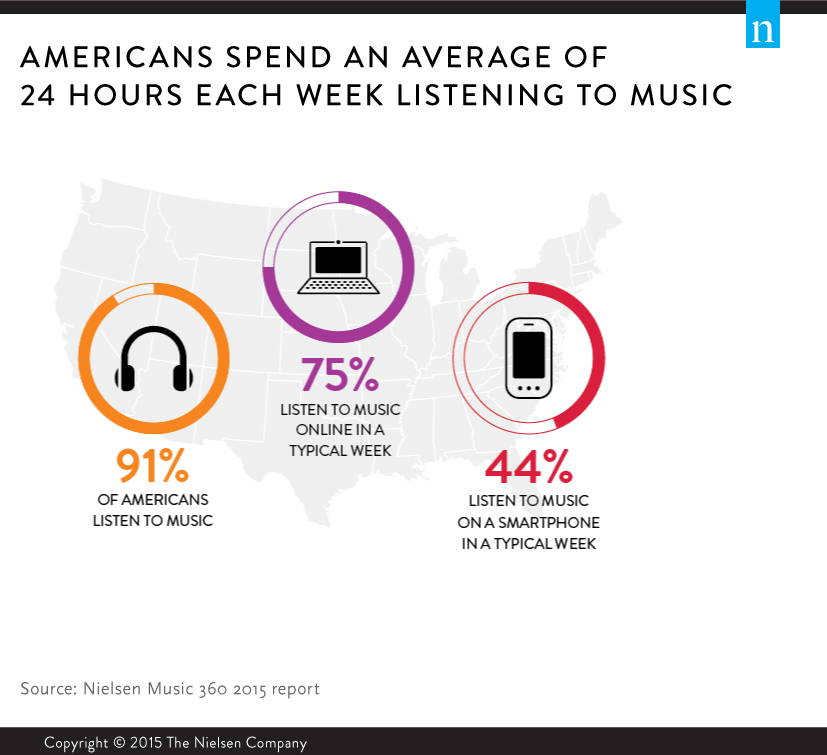
A new report from Nielsen confirms that music is still an important part of most Americans’ lives. The Music 360 2015 Report found that 91% of us listen to music and we spend an average of 24 hours each week listening. That’s an average of 3.4 hours/day…that’s more time than college and university students spend on work and related activities (2.5 hours) and even more time than they spend on educational activities (3.3 hours) (link).

According to Nielsen,

Radio continues to be the No. 1 source of music discovery in the U.S, with 61% of respondents saying they find out about new music from AM/FM or satellite radio, a 7% increase over last year. Word of mouth is also important, particularly for teens: 65% say they discover new music through family and friends, well above the average of 45%.

music-360-chartAccording to another report from Nielsen, “On average, U.S. consumers report spending $109 each year on music. So aside from albums, what other types of music options are consumers spending their money on? Surprisingly, live events are gaining momentum, as they now account for more than half of total music activity spending each year.”how-we-spend-money-on-music-final
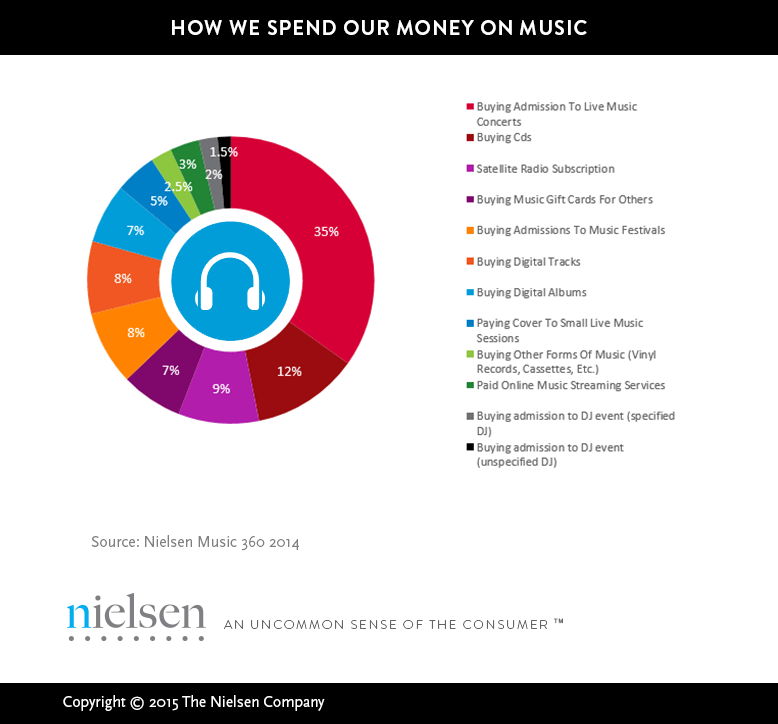
The chart on the right shows how American music consumers are spending (or not spending) their dollars to acquire music. As you can see, live concerts and CDs are the top two ways of purchasing access to music. While this chart may not describe your spending patterns, it is interesting to note that traditional means of acquiring music are still important. And you may also be interested in knowing that two albums alone sold a combined 7 million units last year…dominating album sales. “Combined, Taylor Swift’s 1989 and the Frozen soundtrack accounted for almost half of the year’s top 10 album sales.”


Between the Devil and the Deep Blue Sea

The title is a saying that is intended to capture the painful choice between two equally bad options. You may have also heard someone use the phrase “between a rock and a hard place.” Both are idioms used to describe a dilemma.

When I saw this AP (Associated Press) photo in my local newspaper a few days ago I knew that this was one of those photos. It grabbed my attention and forced me to acknowledge a painful reality. Refugees from Syria and other nations under siege by the Islamic State are trying to get to safety, and some are dying in the process. Three-year-old Aylan and his five-year-old brother Galip, along with their mother, were just three of the victims of this tragically failed bid for freedom. To see a lifeless body of a young child is never easy…but is it necessary? That’s a question for journalists and reporters…and media ethicists.restricted-refugee-boy

The decision to take the photo or to record audio/video of an event unfolding is fairly straight-forward. Unless you can do something to change the outcome, your journalistic responsibility is to shoot the photo and record the event. Once you get back to the office, away from the urgency of the situation and with the support and counsel of colleagues who are emotionally one step removed from the situation, you can make the decision whether to use some part or all of the material.

As expected the photo was widely distributed, not just by AP but by social media users: some who were shocked by the photo, others by the reality that it represented, and still others by the decision to publish the photo at all. It’s not an easy call. Those who published the photo argued that the shocking nature of the photo may serve a greater purpose. According to the BBC article linked below, the UK newspaper The Independent said it had decided to use the images on its website because “among the often glib words about the ‘ongoing migrant crisis’, it is all too easy to forget the reality of the desperate situation facing many refugees.”

This incident is not without precedent. There have been other photos that have forced us to face harsh realities and the dilemmas inherent in life-and-death moments captured on camera. In an earlier blog post I asked similar questions about photos of men who were seconds away from dying. Years and continents away, a South African photojournalist, Kevin Carter, took a Pulitzer Prize winning photo of a Sudanese child as a vulture waited for her to die. Carter later took his own life. You can read more here and here.

If you believe that these photos should not be published, then you see me as contributing to the problem. I thought about that…and decided to take the risk. I hope that you think deeply about what this picture means, and what it means for you. If we turn away and go back to our Twitter feeds, our video games, or our Netflix movies…or even back to work or whatever else we might be doing this Labor Day weekend…without asking soul-searching questions about our role in the world and how this tragedy might be averted for future Aylans or Galips, everyone loses.

For more information:

css.php