Is This Mic On?

Plenty of people have ended up in hot water after saying something that was picked up by a “live” mic that they forgot they were wearing. President Obama leaning in to promise Russian president Dmitry Medvedev “more flexibility” after the election; President George W. Bush calling a NYT reporter “a major-league a@*%#*!”; and Jesse Jackson issuing a fairly graphic threat to President Obama for “talking down to Black people.”

This is such a common occurrence that Time magazine has assembled a Top 10 list for our amusement.

But the latest “caught on mic” moment may lead to a murder conviction for an eccentric (to say the least) character who was the subject of a recent HBO documentary. According to a report in the New York Daily News,

The LAPD recently reopened its Berman investigation, bolstered by new evidence in the HBO documentary by Andrew Jarecki, “The Jinx: The Life and Deaths of Robert Durst.”

Durst appears to make a chilling confession in the final episode of the six-part series when he says off-camera — while his mic is still live — “What the hell did I do? Killed them all, of course.”

Fame and fortune have an odd way of bringing out the worst in people…but if there’s one thing for sure, this real-life, made-for-TV drama will continue to attract attention and win ratings. For you binge-viewers, the entire series will be airing back-to-back on HBO, starting at 3pm on March 21st.

MJ Advertising and the Case for Audience Research

I teach a course titled, Audience Research Methodology.  Over the years I have attempted, with varying degrees of success, to make the case for the importance and value of applied audience research. Audience research is happening all around us all the time, but it is often invisible to the average observer. But thanks to marijuana advertising, finding applied examples of audience research just got easier.

When Colorado passed Amendment 64 allowing for the legalization of marijuana they also created laws controlling the process whereby legal MJ would be cultivated, processed, marketed, and distributed. One part of the Colorado Retail Marijuana Code governs the advertising of MJ. For the sake of brevity I’ll cut to the chase. The legal requirement for advertisers is that they provide “reliable evidence” that no more than 30% of the consumers of said advertising are “reasonably expected” to be under the legal age (21 years). This provided a teachable moment in class last week when we discussed how audience research methodology might inform the issue of what percentage of a target audience falls within (or out of) a particular demographic range for various media products.

Some have questioned whether this part of the law would stand a legal challenge. According to a news report released March 17 by the Colorado Press Association, a legal challenge to the 30% requirement brought by the CPA and The Pulp (a local independent news magazine) was found to be without standing. In other words, the challenge on First Amendment grounds was dismissed because the parties bringing the lawsuit were unable to demonstrate that they suffered harm imposed by the legal requirement of no more than 30% underage readers. Claims that the law created a “chilling effect” were likewise dismissed.

Since this 30% requirement appears to be the law for the time being, any retail MJ establishment (or the media company hoping to sell MJ ads) will have to secure the services of audience research companies who can provide “reliable evidence” that can be used to meet the legal requirement. Companies such as the research giant Nielsen can provide data for TV and radio broadcasters and their Scarborough audience analytics for print media can provide reliable data (for a fee). According to the CPA news release, “the [Colorado Department of Revenue] found Scarborough research to be ‘reliable’” for the purpose of legal justification.

Mass Communications majors sometimes (and, I believe, unfairly) think of themselves as math-challenged. But understanding basic data analysis is not a luxury anymore. Nearly everyone working in or around the media industries will, at some time or another, be expected to make sense out of a spreadsheet or graph or table that contains or summarizes data. Quantitative illiteracy is not a reasonable alternative, and MJ advertising is just one example that brings that home.

Are we all ADD now?

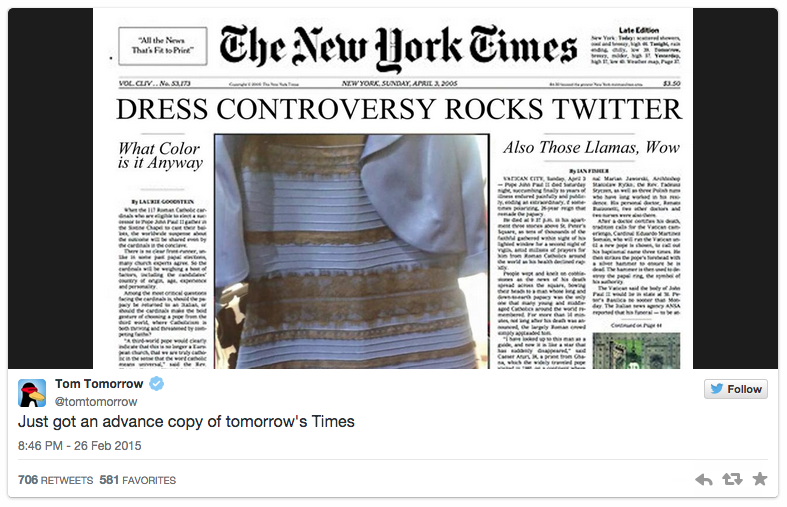
Black and Blue, or While and Gold? It’s the question that appears to have captivated the ever-so-brief attention span of the online world. The more philosophical are asking again the age-old questions; what is the nature of reality and perception?…and, can we ever know for certain what we think we know? Yes I’m talking about #TheDress. And if you haven’t been paying attention, suffice it to say that the “twitterverse” has been embroiled in a heated debate about the real color of a dress that was worn to a wedding in Ireland. Here’s just one of the many tweets having a bit of fun with the whole thing.dress

Well, that was before the llamas got loose in Arizona…which was just briefly before Leonard Nimoy passed away. We are an easily distracted lot, humanity. One might argue that we need a distraction every now and then to give us relief from the pressure and demands of real life.

But seriously, is this what we’ve come to expect from our media? Was there nothing important going on in the world at the end of last week? Oh yeah, there was. “Jihadi John” was  identified as a college grad from West London; Net neutrality was adopted by the FCC (thanks, perhaps, to John Oliver); and a Russian politician, and foe of Putin, was executed on a city street.

But perhaps there is an explanation. According to this article by Mel Robbins at CNN, “the emotions that make a story go ‘viral’ are not fear and anger — they are awe, laughter and amusement.” Well, there you go. I feel just a little better now about #TheDress and #LlamaDrama.

David Carr, Gone at 58

At the risk of this blog becoming a collection of obituaries, it is important to recognize the passing of a man who The New York Times executive editor called, “the finest media reporter of his generation.” Arthur Ochs Sulzberger Jr., the Time’s publisher and chairman, said, “David Carr was one of the most gifted journalists who has ever worked at The New York Times.”

David Carr, media reporter for The New York Times newspaper, was an enigma. No one who knew him in his earlier life as a crack addict and single parent on welfare could have seen his rise to celebrity reporter for, arguably, the greatest journalistic enterprise of the modern age.

In his regular Monday column, The Media Equation, Carr dissected the media industry and many of its key players. His writing was often acerbic but always insightful. If all that you knew about the media industries was what you read in David Carr’s columns, you’d be pretty well-informed. If he hadn’t died last week I’m sure that he would have had something pithy to say about the 3.5 hour-long 40th anniversary of SNL that aired this past weekend. And you can be sure that he’d have written something both relevant and revealing about the upcoming Academy Awards telecast this Sunday. Carr did live long enough to weigh in on the very public implosion of NBC News anchor Brian Williams and his article will give you insight into both Williams and Carr, (and the delicate balance between fame and trust), if you take the time to read it.

You can read more about David Carr at the NYT website. Or, for the visually-inspired crowd, watch Page One, a documentary about The Times, in which Carr has a starring role.

When the News Reporter Becomes the News Maker

Brian Williams, anchor of NBC Nightly News for more than 10 years, is stepping down from his nightly responsibilities. While it is unclear for how long he will be gone, it is a sign that Williams and NBC are beginning to take seriously the damage that has been done to his professional career by his failure to accurately remember (or his intentional misrepresentation of) events that took place in the recent past.

At question is an incident while reporting on the war in Iraq. According to various recollections by Williams he was in a helicopter that was either under fire, took a hit from an R.P.G., and/or was forced down. Military personnel who were there recall it differently and have been upset that Williams has been twisting the facts to make it appear that he was in greater danger than was the case. In a separate case, Williams’s reporting after Hurricane Katrina is also being questioned.

Social media has not been kind. The hashtag #BrianWilliamsMisremembers has dogged Williams since the story broke and fellow journalists are not coming to his rescue. Some are piling on, according to the New York Times. “Brian Williams will be fine,” Andy Levy, a Fox News commentator, wrote on Twitter. “If he can survive being hit by an R.P.G., he can survive this.”

Journalism is a business that trades in credibility and the fair exchange of accurate information in a timely manner. If any part of that equation is missing, the value of the information plummets. For a network anchor who is reported by the New York Times to be worth about $2M a year, the loss of value is significant. According to the Times, at his recent contract negotiations “Deborah Turness, the president of NBC News, called him one of ‘the most trusted journalists of our time.’” Also according to the Times,

Before the episode, Mr. Williams long had been considered one of the most trusted people in not only in the news business but in the country as a whole. He was trusted by about three-quarters of consumers, making him the 23rd-most-trusted person in the country, according to the celebrity index of The Marketing Arm, a research firm owned by Omnicom. That places him alongside the likes of Denzel Washington, Warren E. Buffett and Robin Roberts.

That was then, this is now. Brian Williams’s credibility is on the line and only time will tell if American consumers of news will forgive him the lapse in judgement.

Net Neutrality and the Jester

Net neutrality, the idea that the internet should be an open network where internet service providers cannot restrict or prioritize content from any particular source, is one step closer to becoming the law of the land. FCC Chairman Tom Wheeler outlined his position in an editorial published by Wired magazine, and barring any last-minute hijinks it now appears that the Obama administration will prevail in a long, drawn-out, battle with those (mainly large telecom providers) who have argued that net neutrality will stifle technological innovation and reduce incentives for expanding service.

In late 2014 President Obama staked out his position in a short video calling for the FCC to act to implement net neutrality regulations. In order for the FCC to step in they would need to reclassify the internet as falling under Title II of the Telecommunications Act–essentially treating access to the internet as a public service utility not unlike your phone, water, or electric service. Many argue that the internet has become such an essential part of our daily lives that to be without it is unthinkable.

As I was reading an article in the WSJ about the ongoing debate I came across a paragraph that caught my eye…

At the same time, Mr. Ammori tried to build wider public support for net neutrality. Last May, he spoke with a researcher for “Last Week Tonight with John Oliver, ” the HBO comedy series. On June 1, Mr. Oliver unleashed a 13-minute rant in an episode of the show, comparing Mr. Wheeler to a dingo and encouraging viewers to bombard the FCC with comments.

If you’re not familiar with John Oliver, he was a former correspondent for The Daily Show.  Now that he has his own show he continues to poke fun at serious topics, just as he did when he worked for Jon Stewart. Below is the video by Oliver.

The video was produced and posted in the summer of 2014, so the framing of the debate does not take into account the developments that have transpired since. But the video does two things very well: 1) it explains in easily accessible terms the nature of the debate, and 2) it allows us a few laughs in the process. That may be the genius of Jon Stewart, Stephen Colbert, and now John Oliver. Like court jesters of old, they make their point and wield tremendous influence while we laugh along; while all too often remaining oblivious to the subtleties of their arguments.

Cord Cutters Gaining Options

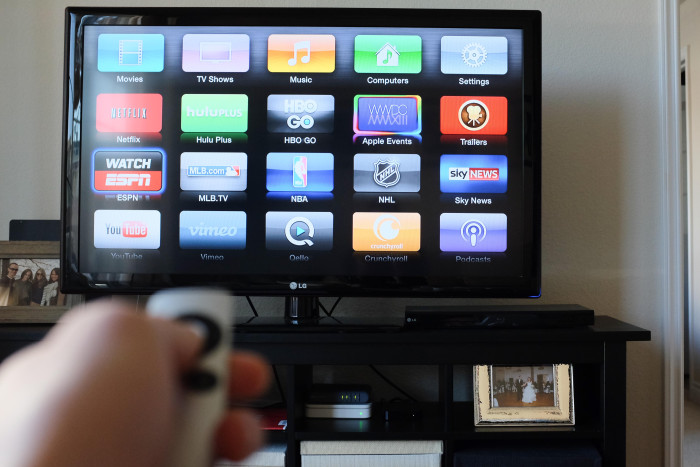
apple-tv-streamThe cable and satellite TV industry is beginning to face the inevitable. With broadband internet widely available on multiple screens, TV viewing options are morphing from the traditional fixed time and space (appointment TV in your living room) to flexible viewing (anytime, anywhere). Having resisted a la cart pricing for many years, cable and satellite TV providers are slowly coming to terms with the future…and hoping that they haven’t waiting too long to become viable players in a future where content is packaged by the buyer–not the seller.

In the past if you wanted access to broadcast and cable network programming you had, at most, only a few options. Depending on where you lived you could subscribe to cable (basic and tiered packages at prices ranging from $50-$100+ per month), satellite (pretty much the same deal but with a dish instead of a wire), or, in some markets, a variation known as wireless cable. Or, (see my earlier post), you might consider OTA (Over The Air) broadcast TV for only the cost of an antenna!

Most of these “packages” were available directly from the provider or bundled with your phone and/or internet service. Telecom and cable providers rushed to create packages of video, voice and data (i.e. television, telephone and internet) and the result was often a monthly bill between $100-$200.

But Millennials have been slow to buy in to these marketing plans. Tech savvy and often financially squeezed, they have looked for other, (read, less expensive) alternatives. These alternatives still required internet access or a data plan on their phones…but landline phones and cable/satellite TV were for older folks, e.g., their parents, and seemed redundant at best. With so many media options literally at their fingertips, younger consumers found that a mix of YouTube (seriously?, you need a link for YouTube?), Hulu, and Netflix provides a wealth of “television” programming without the sticker shock.

The problem is that, up until recently, live sports were seldom available online (unless you wanted to watch a choppy stream from some former Soviet-bloc website). But DiSH TV’s Sling TV (their slogan is Take Back TV), will soon be offering a basic package available for $20/month that will include ESPN, ESPN2, Disney Channel and CNN along with a handful of other popular networks. All you need is a smart TV or one of several streaming devices (e.g., Apple TV, Roku, Chromecast) and you’re in business. Or just sign up and watch on your computer, tablet or phone. In either case there is no long-term contract to sign. However, if you need your DVR’s time-shifting capability, or your weekly fix of Mad Men or The Walking Dead, Sling TV may not be for you. But others may find that it’s time to Take Back TV!

One other significant development is that cable networks and program providers are beginning to offer stand-alone streaming packages. In addition to deals announced last year by HBO, Showtime, and CBS, you can now subscribe to Nickelodeon, Comedy Central, and Sesame Street via Google’s Chromecast service, and the necessary hardware will only set you back a one-time fee of $35.

As you can see it will be fairly easy to cobble together some sort of TV programming package from a variety of sources to build a customized set of choices–and probably for a good bit less than you’d pay for a cable or satellite package.
RIP Peggy Charren

PEGGYCHARRENA powerful advocates for children’s television died today. Peggy Charren, founder of Action for Children’s Television (ACT), passed away after a long life of advocacy for quality TV programming for children. Dismayed by the rampant violence and commercialism that marred children’s programming in the ’60 and ’70s, Charren became a crusader and reformer. Her steadfast devotion to the cause led to the Children’s Television Act which was passed into law in 1990. The legislation limited the amount of commercial content in children’s TV programming and required stations to show evidence of the educational value of its programming.

According to an article in the Boston Globe, Charren’s group seized upon “one tiny clause in the 1934 Federal Communications Act that required broadcasters using the public airwaves to ‘serve the public interest‘ if they wanted to keep their licenses. Ms. Charren’s group, which grew to 20,000 members, insisted that federal authorities and network executives take that mandate seriously.”

Current FCC chairman Tom Wheeler was quoted as saying,

Parents across America owe a debt of gratitude to Peggy, who single-handedly turned the vast wasteland that was children’s television programming in the 1960s and 1970s into the plethora of educational, informational and entertaining programming families enjoy today.

Peggy Charren was recipient of a Peabody award, an Emmy award, and the Presidential Medal of Freedom in 1995.

Don’t Shoot the Messenger

Newspaper headlines this morning provide another grim reminder that terrorism by Islamic extremists is often directed at media outlets and media professionals who dare to poke them in the eye. What constitutes a “poke in the eye” is partly the issue. In this particular case, employees of a satirical magazine that caricatured the Prophet Muhammad were executed in a military-style attack by gunmen with possible links to al-Qaida.

It may be difficult for Westerners to understand how a religious insult escalates to this level of hatred and violence, but we certainly have no shortage of examples. You may remember the Benghazi attack that resulted in the death of our ambassador to Libya and two of his security detail. That attack, and widespread rioting in the Middle East, was blamed on the YouTube release of a controversial movie produced in the US. In 2005 a Danish newspaper published cartoons of the prophet leading to widespread riots and  violence in Muslim countries. And the year before, Dutch filmmaker Theo van Gogh was murdered for his film Submission, which took a critical look at the treatment of women in Muslim culture.

Adding insult to injury, a guest oped in today’s edition of USA Today, by radical Islamic cleric Anjem Choudary, suggests that the French newspaper had it coming and blamed the victims for their own fate.

The Social Responsibility model of the press, and the 1st Amendment of the US Constitution, call for a very different response to speech that may offend.

According to an editorial published in today’s Pueblo Chieftain,

It is both a fundamental right and a sacred duty of newspapers to consider and publish all opinions and angles of a news story, including those that are unpopular with certain readers. Any attack on this right is an attack on the very foundation of a free press.

Unfortunately this story, like life itself, it’s a bit more complicated than first appears. Journalism, the kind the 1st Amendment was designed to protect, is morphing into something that might be unrecognizable to our founding fathers. Charlie Hebdo, the satirical French magazine that was attacked today, should not be compared to Time magazine, The Guardian, or Le Monde. Don’t get me wrong, the actions of the radical terrorists is inexcusable…it was brutal, repugnant, and evil, and I am in no way offering a defense of their actions. But I’m also not ignoring the fact that news organizations (and pseudo-news organizations) are increasingly engaging in activities that are not entirely defensible under the old rules of engagement.

Hacking, Journalism, and Moral Treason

The hack of Sony Pictures and subsequent release of salacious emails and other confidential information has been the talk of the town (read Hollywood) in recent days. Much of the information obtained by the hackers (aka Guardians of Peace) is very personal and potentially damaging to careers and reputations of employees, executives, and celebrities connected to Sony. Medical records, compensation packages and their private negotiations…even jokes about President Obama that have a racial component…are on display for all to see.

But the hackers alone cannot do serious damage to Sony without the willing participation of journalists. What the hackers have stolen, journalists are now distributing with the protection of the first amendment and the claim that these are important and relevant issues to be discussed in a public forum.

But not every one is willing to give the news media a pass when it comes to reporting this story. Appearing on Howard Stern’s radio show, Seth Rogen (co-star of The Interview) claimed that journalists are profiting from doing exactly what the criminals/hackers want.

Television writer Aaron Sorkin has been another outspoken critic saying, “Every news outlet that did the bidding of the Guardians of Peace is morally treasonous and spectacularly dishonorable.” Sorkin acknowledges, in his op-ed piece in the New York Times, the importance and role of the media when it comes to whistle-blowing and exposing wrong-doing, e.g. the Pentagon Papers. But he makes a clear distinction between that and these gossipy morsels that have little or no value for the preservation of democratic ideals.

As demented and criminal as it is, at least the hackers are doing it for a cause. The press is doing it for a nickel. ~Aaron Sorkin

I suppose one could argue that this hack reveals facts relevant to issues of importance: gender disparity for celebrity compensation, race-tinged jokes about the President by Sony execs who support him and gave to his political causes, and allegations of journalistic malpractice by New York Times columnist Maureen Dowd. But these exceptions are not what’s generating all the buzz on blogs and social media.

Not too long ago when nude celebrity pictures were hacked from the cloud “real” journalists were careful to keep their distance for fear of being seen as accomplices to the crime. But this time the “gift that keeps on giving” has fewer detractors and the benefit of readers’ fascination with celebrity culture. The hackers have promised a “Christmas gift” of new information while Sony’s lawyers are sending threatening letters to news organizations in an attempt to discourage further dissemination. But if there’s one thing on which we can be fairly certain, it’s that attacking journalists won’t go over well.

css.php