

Uber’s Image Problem

UberPerhaps you’ve heard of Uber, the smartphone-enabled ride-sharing alternative to traditional taxis. Uber, along with Lyft and Sidecar, work on the premise that a person with a car can offer a service to someone who need a ride, and make a few bucks in the process for both the driver and the company. Now that most everyone has a smartphone–and with real-time location services knowing your every move–connecting drivers and riders is really pretty simple.

But Uber, like the other start-ups, has a few natural enemies. Taxi cab companies don’t like having their business syphoned off by competitors who are not licensed and have little to no overhead.

But it is Uber’s CEO and a senior VP who may become the company’s greatest liability. CEO Travis Kalanick, whose aggressive leadership has been credited with the quick rise of the company, has ruffled more than a few feathers with his aggressive business practices. Uber has been accused of violating its own privacy policy and tracking users for suspect reasons. (You can read more about that on the ACLU blog.) And recently, Uber VP Emil Michael has suggested that Uber should investigate journalists who have been investigating Uber.

Specifically Michael targeted Sarah Lacy, co-editor of the Pando Daily website. Lacy has been critical of Uber’s treatment of women and has been leading the call for Uber to clean up its act. And for that, according to The Tech Bulletin, “A top executive of Uber explained a Nixonian plan to dig up dirt on the journalists who are critical towards Uber and sully their reputations.”

One doesn’t have to be a PR pro to see that this is not a smart move by Uber. Picking a fight with journalists is seldom a good idea. As Bill Greener, press aide to Gerald Ford and Donald Rumsfeld in the 1970’s once said, “Never pick a fight with someone who buys ink by the barrel” (Lewis).


#GamerGate

Over at Vox, Ezra Klein has written an interesting, 25-paragraph essay Gamergate and the Politicization of Absolutely Everything. For those who have not been introduced to the raging debate swirling around the video game industry, gamergate is a controversy that touches on many of the media topics and themes that we’ve been addressing this semester: media effects and concerns related to sexual and violent content, politically incorrect stereotypes, censorship, and journalistic ethics just to name a few. Here’s Gawker‘s attempt to explain what all the fuss is about. Want more?  Here’s a great article by Erik Kain at Forbes.

Klein’s thesis is premised on the idea that everything has been politicized in the extreme. The gamergate battle lines have been drawn between waring factions. On one side the “young, white, male” demo (that has historically been at the core of the gamer community) and on the other side, feminists (more here). It’s hard to ignore the fact that real differences exist between gamers who like to blow things up and those who like to build things together. And finally, differences exist between those who feel marginalized by the present systems and,…well…those who feel marginalized by the present system. In fact the entire controversy has something to offend nearly everyone. It’s as though the controversy is a kind of ink blot test on which we are invited to project our own worldview and moral objections. As Klein notes, “Video games are the excuse for this fight, not the cause of it.” For those with political biases on the left, it’s about “sexism and online harassment,” but for those on the right it’s about “political correctness and speech policing.”

Klein’s essay ends on a cautionary note that predicts other battles, like gamergate, but with even greater consequences. As the culture wars escalate and battles lines are drawn, the battlefield itself will be the online space where digital avatars battle to the death over controversies large and small. Thankfully, digital wars are not nearly as painful as analog wars. After all, when your digital self is mortally wounded or killed a quick reboot is all that’s needed to get back in the fight.

An Epidemic of Fear

about-ebolaI watched a few Sunday news shows today and, thanks to the DVR, was able to fast-forward through their Ebola coverage. It’s not that I don’t want to know what’s going on in the world. Rather it is precisely because the coverage that I have seen this past week has been long on sensationalism and short on useful information.

Journalists have a difficult job and I don’t want to Monday-morning quarterback their attempt to cover this fast-moving and emotional story. But I also don’t want to defend the fear-mongering and ratings-whoring that is being pawned off as journalism.

There’s always a delicate balance between keeping people informed and keeping things in proper perspective. For example, Ebola is a deadly disease that does not have a vaccine or a cure. It is spread by contact with bodily fluids of an infected carrier. And because of modern air transportation, any viral disease can travel around the world in a matter of hours. On the other hand, as of October 19th only two individuals have contracted Ebola in the US and both were healthcare workers who were treating a patient who had carried the disease from Liberia to the US. Most medical experts are confident that modern treatment and aggressive containment can prevent the virus from becoming an epidemic.

If you saw the movie Contagion (2011), you may recall that this fictional account of a global pandemic shares some similarities with the Ebola crisis. Hollywood loves a narrative because we, the viewing public, love narratives. A story allows us to make sense of the onslaught of information that is frequently confusing and contradictory. In this case the storyline is simple: a deadly disease appears (usually in some dark corner of the globe) because of mankind’s lack of respect for nature. It quickly spreads and threatens population centers in the western world. Science comes to the rescue and the hero is usually someone who defies conventional wisdom to save the day.

Sadly, life doesn’t follow the script. While we obsess over the fate of folks on a plane or cruise ship who MAY have come in contact with someone who MAY have been exposed to Ebola, fear keeps people from living life.  And meanwhile, in Western Africa, the true crisis continues out of the glare of the media spotlight.

Protecting the Brand

NFLShieldThe Broncos and Seahawks gave us a great game this afternoon. Millions tuned in to see the rematch of last year’s Superbowl, and this time it was a much more interesting affair. But if you’ve been paying attention to the news the past few weeks you know that the NFL is in the spot light…but not for the right reasons.

The PR debacle that has the media in an uproar didn’t start with Ray Rice and Adrian Peterson, nor will it end there. But eventually the media attention focused on NFL players behaving badly will come to an end because the NFL is first and foremost about money…and these momentary distractions, if left unchecked, will get in the way of making money and that would be (according to owners and league officials) an even greater problem than this current mess.

Anheuser-Busch spends upwards of $200M a year advertising on NFL broadcasts and have publicly said that they are “disappointed” in the NFL. That kind of money talks, and Commissioner Goodell is listening. That’s why Goodell made a public apology…or at least I think that’s what the press conference a few days ago was supposed to be. The top three rated TV programs last week were…you guessed it…Sunday Night Football, Monday Night Football, and Thursday Night Football. As long as American continue to watch NFL broadcasts, and as long as advertisers pay big bucks to reach those viewers, the NFL will continue. Sure they’ll make a few changes and get rid of a few bad actors. But when the average “career” of a pro player lasts only four years, losing a player or two over bad behavior off the field will not change the game or the bottom line.

I realize this perspective comes across as cynical and jaded. I wish it were different. I wish that the institutions surrounding professional sports, including the media empires that have learned to monetize and merchandize athletic achievement, were more sensitive to the long-term cultural implications of their choices. I wish the NFL brand stood for something more.


Hello! It’s a Joke!

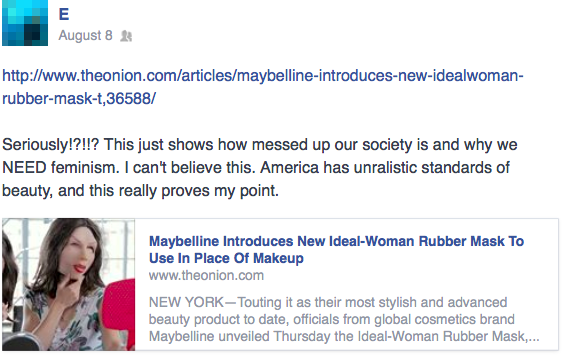
According to a report from Mashable, Facebook is considering adding a “satire” tag to links to stories from fake news sites, e.g. The Onion and The Daily Currant. Apparently the move is a response to requests from Facebook users who want help identifying fake news and distinguishing it from real news. Somewhat ironically, the staff of the Washington Post newspaper could also use a little help. Politico reported that a WP reporter was duped by a fake news report about Sarah Palin joining Al Jazeera.

I have witnessed, on several occasions, Facebook friends re-posting outrageous stories from fake news sites, and on one occasion (that I know of), I’ve done it myself. So I’m not suggesting that the idea of a “satire” tag is unnecessary or silly. However, let’s not assume that the satire tag will somehow eliminate the need for critical thinking on the part of media consumers. Any time that you off-load responsibility for critical thinking on someone (or some algorithm), you risk becoming a victim of that person’s (or algorithm’s) biases.

And there’s another potential downside. If the satire tag works we may have fewer opportunities to have a laugh at the expense of those who believe fake news is real, e.g. the website Literally Unbelievable. Here’s an example from their website:

TheOnionSatire

Copyright Monkeybusiness

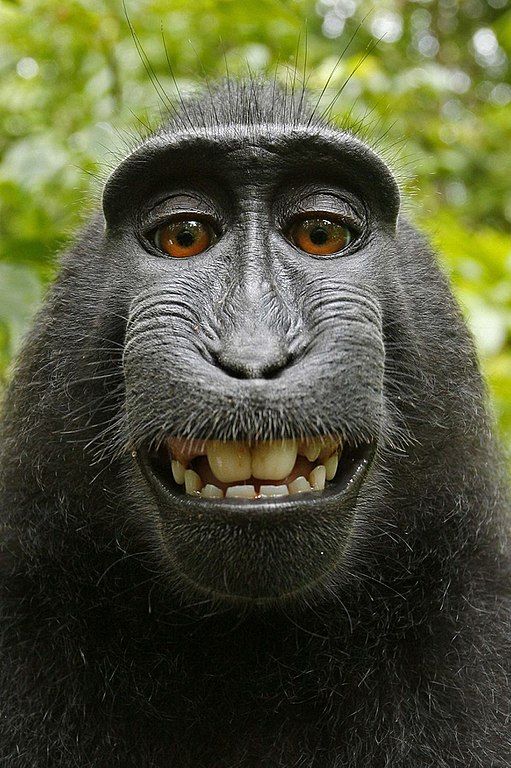
Perhaps you’ve seen this picture of a female Celebes crested macaque. The picture is unusual in several ways. First, the expression is priceless. To peer into the soul of a subject and capture it on film in such a powerful way is truly amazing.

But that brings us to the second way in which this photo is unusual. It is a selfie. That’s right, the photo was taken by the subject. According to an article on the Mashable website, the photographer David Slater was on a trip through the jungles of the Indonesian island Sulawesi in 2011 when he had his camera swiped by the macaque who then turned the camera on herself.

Okay, pretty interesting story so far, but it gets better. Several years later someone uploaded the photo to Wikimedia Commons. Slater, who claims copyright on the photo, asked Wikimedia to remove the photo. Wikimedia denied Slater’s request claiming that Slater did not own the photo since he didn’t take it.

Alex Magdaleno, writing for Mashable, continues…

according to Wikimedia’s licensing report, it remains in the public domain “because as the work of a non-human animal, it has no human author in whom copyright is vested.”

There you have it. Once the courts settle this case we’ll know whether animal selfies enjoy the protection of copyright. And what if the courts say that the copyright belongs to the critter who pressed the shutter? In the US, copyright is awarded for the life of the author plus 70 years. If a Giant Galapagos tortoises snaps a selfie it could remain under copyright for upwards of 250 years!

UPDATE, April 24, 2018: The court has ruled, and the monkey cannot make a copyright claim. Okay, you can go back to your monkey-business as usual.

Virtual Tragedy

The growth of online gaming and virtual reality technology has exploded around the world, but perhaps nowhere more dramatically than in the nation of South Korea. With some of the fastest internet connectivity and a cultural tendency towards all things high-tech, Koreans are experiencing internet addiction at unusually high rates.

Case in point is the tragic story of a young couple who allowed their infant daughter to starve to death while they played an online game in which they raised a virtual child. The irony is striking. Last night HBO aired a documentary, Love Child, which told the tragic story as a cautionary tale to those who are too easily distracted by virtual worlds. Here’s the trailer.

The parents were charged with a lesser crime of involuntary manslaughter because of the nature of their “addiction” and the father served one year in jail. They’ve since had another baby and we can only hope that this outcome will be different.

While this is an extreme example of internet addiction and its horrific outcome, milder forms of the ailment may be present closer to home. If you’re wondering if you suffer from net addiction, you can take this self-guided quiz.


Cutting the Cord

antennaHigh price of cable or satellite TV got you down? Not a fan of their customer service? Looking for a cheaper way to access your favorite TV shows and sporting events? Never fear…cord cutting is getting easier every day, and you don’t have to be a computer geek to pull it off. I’m not going to explain the details of what ‘s involved, there are plenty of sites that do that. Here are a few links: WSJ How To,  WSJ MarketWatch, WSJ Q&A, Digital Trends, Reddit, and Gizmodo. And for those unsure of the difference between a streaming box, (e.g. Apple TV or Roku) and a Chromecast stick, see dealnews.

The availability of Over The Air (OTA) TV reception using good old rabbit ears or an outdoor antenna may also be an option. Modern TV antennas don’t look like your grandfather’s TV antenna and they are designed to receive digital TV signals. Many of those born after 1980 have never known anything besides cable or satellite TV so the idea of an antenna sounds pretty old-school. But for access to HD TV for only a small upfront investment and no monthly bills, it may be just what you’re looking for. The picture is of an outdoor antenna designed for digital TV reception. And if all you need is ABC, CBS, NBC, PBS, FOX, Telemundo, and CW (along with their subchannels), and are willing to put up with the usual TV ads, you’re all set.

To be fair, there are a number of half-truths swirling around the free-TV ether. Lifehacker has assembled the most common myths that you should take into account before you pull out the scissors.

Facebook’s Social Experiment

BigBroYou may have heard by now that Facebook cooperated with researchers from two universities to study emotional contagion. The question that they wanted to answer was, does the emotional tone of others’ posts on your Facebook wall affect the tone of your posts? To find the answer they conducted an experiment…on nearly 700,000 Facebook users. The methodology was fairly straightforward; they began by using software to analyze posts in order to categorize them as either negative or positive. Then, they manipulated which posts were more likely to show up on the wall of certain Facebook users. By analyzing those users’ posts they were able to determine if they became more positive or negative as a result. Sounds like an interesting experiment for those of us interested in social science and the effect that mediated interactions may have on our personal disposition or behavior.

Here’s an excerpt from the abstract:

Emotional states can be transferred to others via emotional contagion, leading people to experience the same emotions without their awareness. [snip] In an experiment with people who use Facebook, we test whether emotional contagion occurs outside of in-person interaction between individuals by reducing the amount of emotional content in the News Feed. When positive expressions were reduced, people produced fewer positive posts and more negative posts; when negative expressions were reduced, the opposite pattern occurred. These results indicate that emotions expressed by others on Facebook influence our own emotions, constituting experimental evidence for massive-scale contagion via social networks.

Unfortunately for Facebook, this little experiment (conducted in 2012 and published last month) will likely become a PR case study of what NOT to do to your social media subscribers. The issue here is one of “informed consent.” In a nutshell that means that human participants in any study must be given sufficient information about the potential risk/harm/benefits of a study before being asked to give their consent to participate. Only after giving consent are human participants subjected to the experimental procedures. In this case the researchers said that Facebook users had already given consent for their data to be used by Facebook in a variety of ways–including research. Facebook’s TOS (Terms of Service) do make reference to using users’ data for research purposes, but according to some sources that clause was added AFTER the experiment was conducted.

While all the negative attention is certainly a problem for Facebook, it is noteworthy that this little scandal has drawn attention to a much larger issue with much more sinister implications. Social media users need to be aware that their data are being used for a variety of purposes…the most obvious being marketing, advertising, and research. Personal privacy is but a mirage and signing up for any of these services constitutes selling oneself on the open market. I hate to be too pessimistic, but short of complete disconnection any hope of control of one’s digital destiny is mere wishful thinking.

You can read the study at http://www.pnas.org/content/111/24/8788.full


Mining Mountains of Crap

SADYOUTUBE_4This blog post is prompted by a segment that I heard recently while listening to the On the Media podcast from NPR. On this particular segment (you can listen to the 8-minute segment at Hunting for YouTube’s Saddest Comments) TLDR hosts PJ Vogt and Alex Goldman interviewed Mark Slutsky, a filmmaker behind the website SadYouTube.com.

In the segment Slutsky mentions the idea that archeologists frequently gain an understanding of ancient cultures by excavating their garbage dumps. Supposedly we can learn a lot by examining the discarded refuse of ordinary life. Of course the local dump is where all of our refuse is collected in one nice convenient place. If the world is still around in a few millennia I’m sure that our landfills will yield equally compelling artifacts of what we value and what we don’t.

But what does this have to do with comments on Youtube? Or, you might ask, what do archeologists and communication scholars have in common? Simply that there is a lot of garbage in Youtube comments…and an occasionally gem as well. Slutsky is mining the comments for gems, and saving them for the future. Tough work. But after listening to a few of the gems I can understand what keeps him going.

css.php