Cannibalism, Cable News Style

newsI can’t take credit for the catchy title…it is a line by Joe Concha of the website Mediaite. Concha is referring to the over-the-top coverage of Malaysia Airlines flight 370 by one cable news network in particular, and how other networks have taken to bashing CNN for their overboard speculation and sensational reporting for the past three weeks. The thing that is most disconcerting about the coverage is that there has been very little new information to report. Imagine being asked to fill the airwaves for 24/7 for three weeks with little to no new information. This kind of over-coverage has made CNN and easy target for competitors MSNBC and Fox News.

CNN has taken this “all-in” approach before with the Boston Marathon bombing and the Trayvon Martin story/trial. Critics of MSNBC and Fox News have pointed to MSNBC’s obsessive coverage of Governor Chris Christy’s Bridgegate and Fox News’ relentless coverage of ObamaCare.

For now it appears that CNN has found success with their approach. Wall-to-wall coverage of “Breaking News” (regardless of whether there is anything currently “breaking”) seems to be attracting ratings and advertising dollars…and that will no-doubt ensure that the practice continues.

Concha was interviewed by Howard Kurtz on his show Media Buzz. You can watch the clip at the link below.

http://video.foxnews.com/v/3410330300001/pundits-sniping-over-missing-plane/

Disaster du jour and Limited Attention Spans

carjackLast week I was late for work because I was watching a live, high-speed car chase near Denver. The driver had car-jacked a vehicle which, unfortunately, had a 4-year-old in the back seat. At times going the wrong way on the interstate, the suspect was involved in several accidents and car-jacked two more cars before being captured by police. You can see the highlights here.

In the end nobody was hurt, but at any point in time it could have turned into a disaster. It can be hard to look away from real life as it is imploding. Maybe it is the novelty that comes from the possibility that you’ll see something that has slipped by the gate-keepers and editors.

Live television and breaking news can be a powerful combination. Watching events unfold and listening to reporters and anchors search for words to describe the indescribable is unscripted TV at its best and worst. The best is the energy and excitement that comes with the immediacy and urgency of the dramatic pictures and sounds. The worst is the exploitation of disaster and mayhem for ratings.

According to some, the recent wall-to-wall coverage of the missing airliner, Malaysia Flight 370, is another case of media exploitation. While reporting has given way to speculation by a long line of experts and analysts, audience members continue to flock to their TVs to watch the story unfold one drop at a time. The New York Times is reporting that the story has led to exceptional ratings for CNN. But CNN’s coverage has not been without its critics. The Times reported that “comedian Bill Maher, referring to the CNN founder, posted on Twitter: ‘Ted Turner wishes he was dead so he cld roll over in his grave.'”

Perhaps the greatest tragedy is that the coverage of Flight 370 has distracted us from paying attention to Russia’s play for the Ukraine…which was a distraction from the atrocities in Syria…which became the topic of attention after we grew bored with the uprising in Egypt…which…well, you know.

Social Media & Breaking News

If you’ve been paying attention to international news you’ve probably noticed that while the Winter Olympic Games in Sochi, Russia were winding down, a geo-political revolution was heating up in the neighboring state of Ukraine. Demonstrators battled riot police and security forces in the capital city of Kiev and, as the saying goes, the whole world was watching.

Over the weekend the tide appears to have shifted in favor of the demonstrators. Charged with mass murder, former president Yanukovych fled leaving behind a palatial estate complete with zoo and  golf course. Corruption has been a problem for this democratic state for many years, and it is still too soon to tell if this latest revolution will put them on the road to political stability.

But this is a blog primarily about media, not politics. Conveniently social media was an important component in the Kiev uprising of 2014, and one viral video in particular helped to focus attention on the plight of the Ukrainians. In case you didn’t see it…

Social media is being used increasingly as a source of news for teens and young adults. A recent survey of >5,000 adults by the Pew Research Journalism Project found that Reddit, Twitter and Facebook lead other social media for users reporting that they get news online. Of those who report using social media sites for news, most use only one site for news, while 26% get news from two sites, and 9% get news from 3 or more sites. It is also worth noting that the study found that social media news consumers also seek out news from traditional legacy media outlets such as cable TV and radio.

But social media as a source of news has some interesting strengths and weaknesses. One obvious strength is the speed of social news. A twitter feed from the front lines can literally provide a play-by-play account in near-real-time. Another strength is the democratization of sources. Citizen journalists and eyewitnesses can now transmit to a global audience. The barrier to entry has never been lower. As Mathew Ingram asserted in GigaOm, “social media is the only media that matters” in these contexts.

Of course these strengths are also weaknesses. Speed is frequently the enemy of accuracy. And the lack of gate-keepers and editors to vet content means that a lot of half-truths and out-right lies also make it into the mix. As Mark Twain once said, “A lie can travel half way around the world while the truth is putting on its shoes.” And these criticisms don’t even begin to raise questions about overt and covert propaganda. Who is behind the I am a Ukrainian video on YouTube and what should we believe about their efforts to elicit support? Remember, if you get your news from social media, you need to be prepared to be your own filter and fact-checker.

Cashing in on Legal Pot

retail potThe state of Colorado is involved in a grand social experiment. Recreational marijuana is now legal for adults (over the age of 21), and since January 1st is available through retail establishments known as dispensaries. A similar experiment is underway in the state of Washington, but for now I’ll focus attention on the state that I call home.

Plenty of time and energy has been devoted to the debate over the wisdom of making marijuana available over the counter. This post is not about the decision itself, but how media outlets are responding to the opportunity to cash in by carrying advertising for dispensaries. Any discussion about the legality and propriety of accepting advertising is compounded by the fact that marijuana use remains a federal crime. And while federal authorities have promised to look the other way with regard to Colorado’s new law, the fact that radio and TV broadcasters are licensed by the Federal government is having a chilling effect on local broadcasters. According to Justin Sasso, president and CEO of the Colorado Broadcasters Association, the CBA doesn’t think it’s wise for stations “to risk their license–or the legal fees required to fight for their license–if the federal government decides to crack down on broadcasters” (Broadcasting & Cable, Feb 3, 2014, p. 28).

The State of Colorado has a few things to say about advertising retail pot. Last fall the Colorado Department of Revenue issued a 136-page document that stipulates, among other things, that advertisers must have reliable evidence that the audience for the ad does not contain more than 30% under the age of 21. According to the website The Cannibist, the publications High Times and Westword have sued the State of Colorado claiming that the restriction on advertising is an infringement of First Amendment rights. In addition to age restrictions, advertisers may not use outdoor advertising, may not buy out-of-state ads, nor promote marijuana tourism.

Cable TV is subject to different regulations than broadcast TV so if we see TV ads anytime soon we would expect them to appear first on select cable channels. Websites, of course, are subjects to even fewer regulatory restrictions. The Cannabist, a website by The Denver Post newspaper, is staking out territory on the web and will likely become a venue for advertising in the future. The Post even has its own marijuana editor, Richardo Baca.

In some ways this debate is made moot by the fact that marijuana dispensaries have been overwhelmed with business. That, and the free publicity provided by the news media, makes advertising unnecessary for now. However, as more vendors compete for customers, as supply matches and exceeds demand, and the novelty and media attention fades away, advertising will become increasingly important. And then the difficult decisions will have to be made.


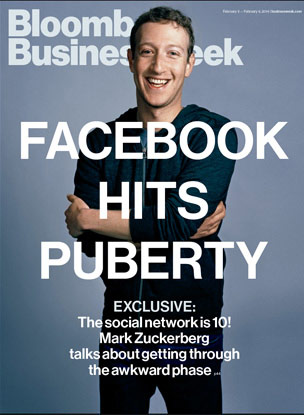
Facebook turns 10

FacebookHitsPubertyTen years ago Mark Zuckerberg, a student at Harvard University, launched Facebook. If you want to see a Hollywood version of the beginning and early years of the company, see the 2010 film The Social Network, written by Aaron Sorkin and directed by  David Fincher. In the film, Mark Zuckerberg is portrayed as a brilliant, but self-absorbed, geek who takes his own ideas and combines them with ideas from other innovative students to create the foundation of what would become the Facebook we know today. Blinding ambition and underdeveloped social skills aside, Zuckerberg creates a social sharing network that grows beyond his wildest dreams. Of course there are plenty of plot twists, including law suits from estranged partners and competitors, to keep the film humming along. In fact, the DVD case is inscribed, “You don’t get to 500 million friends without making a few enemies.” And just for the record, the current number of monthly active users is just north of 1.2 billion!

Since the early 200s, much has changed for Facebook and a host of social network services (SNS) competing for your attention. Some start-ups, like Instagram, were purchased by Facebook, while others, e.g., Snapchat, rejected Zuckerberg’s advances (and his $3 billion offer)!

Rumors and speculations about the teen market abandoning Facebook (even as their parents and grandparents join up) have been growing. A recent study by two Princeton University PhD students uses comparisons to Myspace to predict a rapid decline of Facebook users over the next several years. While many bloggers and experts have criticized the methodology and conclusions of the study, (Facebook itself offered up a rather humorous and snarky rebuttal) there appears to be mixed evidence regarding the decline of teens and college-age users.

Long a proponent of radical transparency, Zuckerberg created a network that asks users to log in as themselves without the option of hiding behind a pseudonym or avatar. The requirement that users “own” their own content is seen by some as a benefit, and by others as a limitation. In social media spaces where anonymity is allowed and encouraged, loss of civility is too common and other users can feel victimized by empowered bullies. Case in point: YouTube comments recently overhauled their comments to make users more accountable for their posts.

As Facebook approaches its pre-teen years it is important to look carefully and critically at what it has become and what we are becoming as we spend more and more time online.

In 6 New Facts about Facebook, PEW research identifies several interesting facts about Facebook.

  1. Our greatest fears about Facebook are about “oversharing”
  2. …but sharing is why we love Facebook.
  3. The median number of friends is 200
  4. …and some of us have been asked to “unfriend” someone on Facebook.
  5. We like to “like” and comment on others’ posts…but we’re not as fond of posting.
  6. And, even those without Facebook accounts are likely to live with someone who does.

Mac turns 30

Thirty years ago Steve Jobs and Apple Computer introduced Macintosh to the world. You may recall that the 1984 TV spot aired only once, and that was during the Superbowl in 1984. Of course the ad has appeared in many places since then, and is still held up as one if not the greatest TV spots of all time.

But I’ve addressed the 1984 spot in earlier posts so I’d like to focus on the affection that the creative community has for the Macintosh operating system and the Apple hardware that runs it. Whether you’re a graphic artist or musician, video editor or animator, the Mac is probably your computer of choice. From the start Apple’s attention to design and style was noticed by people who care about such things. In fact, Steve Jobs admits that his inspiration for building a better computer started with a typography class.

In the mid 1980s a Macintosh computer, a laser printer, and PageMaker software allowed graphic designers to create flyers, posters, pamphlets and other print pieces that rivaled what could be produced in a small print shop. A few years later audio recording and video editing software made large studios and production facilities appear to be unnecessary. The iLife software (iMovie, iPhoto, GarageBand, etc.) that shipped free with every Mac provided access to simple-to-use tools capable of creating amazing works of art. Of course, in the hands of amateurs there was plenty of dreadful art as well.

I was fortunate to have a MacPlus as my first computer at work. It had 1MB of RAM, a single floppy disk drive, and it cost about $2,599. I was able to create documents that I saved to a 720K floppy disk. Then I took the disk next door to my colleague who had his Mac attached to a laser printer. Those were exciting days!

This video by Apple captures some of the excitement and creative energy that Macintosh brought to the community of artists and those who defied the reign of Big Blue.

http://www.youtube.com/watch?v=Xp697DqsbUU

16 and Not-So-Pregnant

16 and PregnantFinally some good news about teen pregnancy as reported today in the New York Times. If we can believe a study that is being released today, teen pregnancy is down and one factor may be (drum roll please) the media. Yes, you heard correctly. If the study by the National Bureau of Economic Research is to be believed, teens who watch more of 16 and Pregnant on MTV are less inclined to become teen moms. According to one quote presented in the NYT article, “people just don’t understand how influential media is in the lives of young people.”

The study compared Nielsen ratings and birth records to discover that teenage pregnancy was declining faster in areas with higher ratings for this and similar reality TV shows. The researchers also found that social media activity and internet searches related to contraception also showed positive correlations to broadcasts.

Critics of these types of shows argue that they glamorize teen pregnancy and give tacit approval to risky behavior. Because of the counter-intuitive nature of these findings, this study should be reviewed carefully and replicated by other researchers. If reality TV really is teaching teens what is and isn’t acceptable behavior, there should be more examples of shows that are having a positive effect on this demographic by showing the negative consequences of poor choices.

Keg-Stands, Casual Sex and Scare Tactics: The Selling of Obamacare

got_insuranceA new set of advertisements intended to get young people to sign up for Obamacare have been released online. Produced by  The Colorado Consumer Health Initiative and ProgressNow Colorado, these ads are designed to be an antidote to conservative ads designed to scare young people away.

Rather than pay airtime or insertion rates, these ads are designed to generate social media buzz which, they hope, will drive traffic to the website. One way to create buzz is to push the envelope. The tactic has been used many times before. You might remember the GoDaddy.com Superbowl ads that were “too hot” for broadcast TV. Recently Kmart has been raising some eyebrows with a series of TV spots for the retailer. One recently played on the phrase “ship my pants” and another features an unusual performance of Jingle Bells.

What the Obamacare ads are attempting to do is to attract young healthy customers…the very demographic that is needed to fund medical care for the poor and elderly. Here’s a link to a video from HuffPo that provides running commentary on whether the approach will work with Millennials. What do you think? Are these ads effective and will they convince young people to sign up?

Swimming in the Deep End

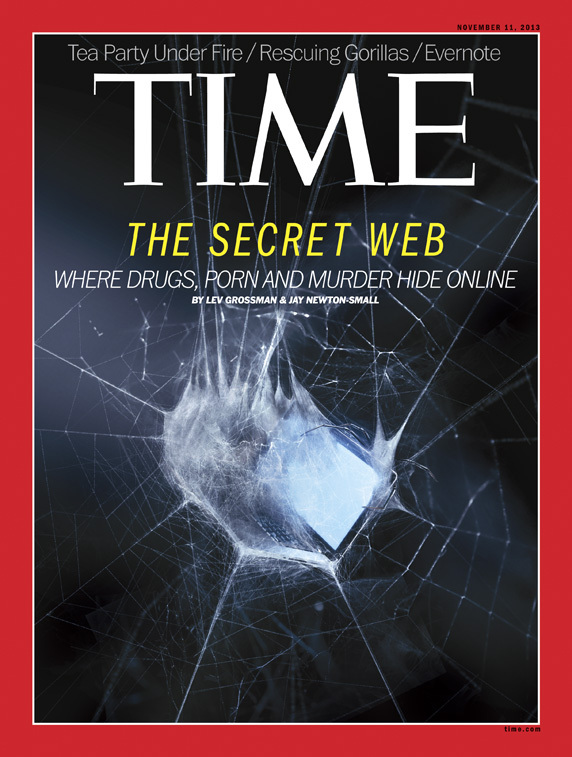
Time magazine: The Secret WebTime magazine’s cover story this past week was about a part of the internet that remains hidden to most of us. Estimated to be 500 times larger than the “Surface Web,” the “Deep Web” has legitimate uses, e.g. confidentiality for journalists and their sources, anonymity for undercover police operations, a safe haven for political dissidents, and a place for ordinary citizens to store information safe from nosy busybodies. While Google, Facebook and a host of other internet companies continue to harvest and exploit our user-data for commercial gain, the Deep Web provides a counterbalance; freedom from the prying eyes of corporate and governmental operatives.

But this safe haven also provides cover for those who traffic in illegal drugs, weapons, fake IDs, child porn, and other forms of contraband. Secrecy and anonymity in the hands of criminals and evildoers yields potential for the worst kinds of behavior.

The technology that makes this possible is powerful encryption software (Tor) and untraceable digital currency (Bitcoin). The combination of these two technologies makes it possible to operate with complete anonymity and privacy–with virtually no chance of being identified by law enforcement officials.

The recent arrest of Ross Ulbricht, the person accused of operating the illegal drug trading website Silk Road, was only possible because Ulbricht carelessly interacted in the “Surface Web” where his actions were noted by FBI operatives.

Speculation abounds as to the future for nefarious activity online but odds are pretty high that the closing of Silk Road will lead to a virtual Hydra. In case you have forgotten your Greek mythology, Hydra was a serpent monster with many heads. The tricky part was that it grew two new heads each time one was cut off. According to an article at The Daily Dot, “The Deep Web won’t die. It’s just going to plunge even deeper.”

Here’s a short video that explains more about the Deep Web. Try not to be too distracted by the voice-over that sounds like it came from a 1970’s episode of The Twilight Zone.

[youtube=http://youtu.be/_-g9kfpEjaw]

Word of Mouse and Reputation Management

WordOfMouseResearch suggests that personal recommendations are  preferred by most of us when making decisions about future purchases. Whether you’re buying a car or selecting a movie, knowing what your friends and acquaintances think about a particular brand, model, or company can be an important factor in your decision. Word of mouth advertising has been around since the beginning of time (“Hey Adam, check out these delicious apples”) and it continues to be highly effective.

When WOM moves online, i.e., Word of Mouse, things get a little more complicated. The complication comes from the way that we define online relationships. Facebook “friends” are often not friends at all, but distant relatives or causal acquaintances. Even more removed are the reviewers on Amazon or Yelp. They are most often completely unknown to us yet we often grant them more influence than we ought. We decide which movie to see based on reviews at RottenTomatoes.com and we avoid certain restaurants because of what strangers post at Zagat.com. Most of the time that works out just fine.

However, like any trend this one is being hijacked by unscrupulous individuals and businesses out to make a quick buck. Just Google Ryan Holiday or read this article at Forbes to see how far someone will go to hoodwink gullible people, including reporters. Or check out this news story about Samsung hiring bloggers and students to attack rival HTC.

Public Relations firms and professionals have been involved in the business of reputation managements from the early days of  Bernays and Lee. As this business moves online, new strategies and tactics are needed to stay ahead in the game. What to do if your law firm is getting bad reviews online? Write your own reviews under a fake name. What to do if your company’s Wikipedia entry does not present your brand in a favorable light? Just hire wiki-pr.com to come to the rescue. Wiki-PR will write or edit your Wikipedia entry and monitor it for future edits/changes. Because Wikipedia is consumer-generated it is vulnerable to manipulation by anyone who has a motive and, in many cases, money to hire others to do the dirty work. Wikipedia is aware of the problem and is trying to stay ahead of the curve, but the task for the editorial staff at Wikipedia bears a strong resemblance to Wack-a-Mole.

Bottom line: whether you’re reading an online review or an article at Wikipedia, a healthy dose of skepticism is your first line of defense. Don’t assume that the person on the other side of that recommendation or scathing review is honest and fair. Too often they are neither. And sometimes they are crooks with a financial interest in duping you.

css.php