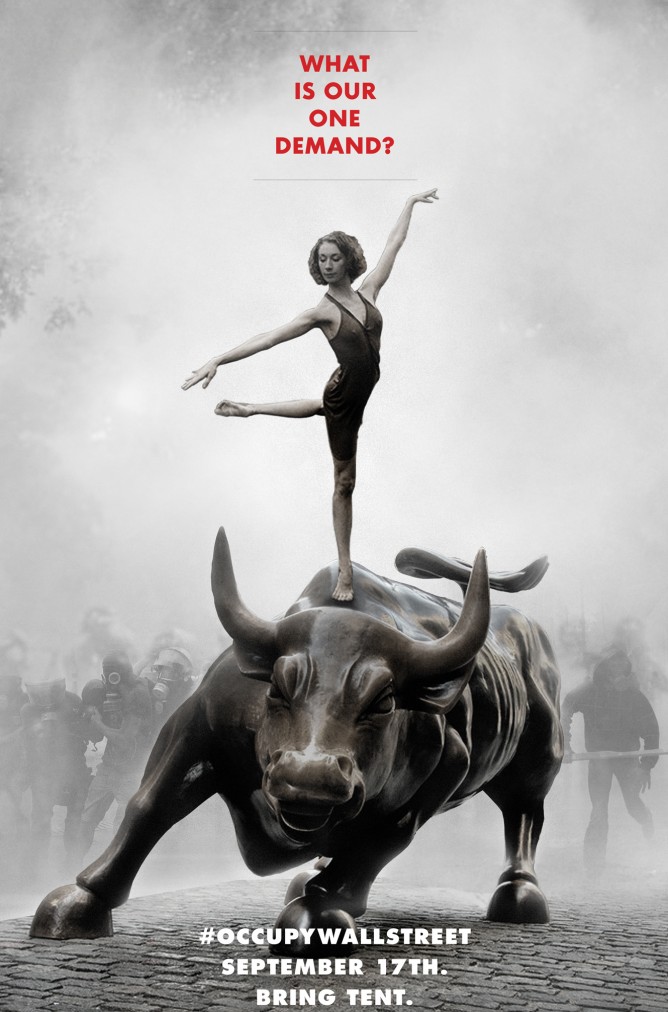
 The Occupy Wall Street movement has been generating a lot of attention from the mainstream media in recent weeks. According to a report in the NYT, media coverage has been increasing as the movement gains strength and spreads to other cities. The proximity of the protestors to the nerve center of the US news industry, just blocks away in NYC, certainly helps. Organizers have also worked hard to create stories that the mainstream media are likely to cover, including orchestrated attempts to obstruct traffic and confront police.
The protestors have demonstrated some media savvy as indicated by a sign held by one protester-“Whoever controls the media, the messages, controls the culture.” They’ve got a website and they even have a print publication devoted to getting their story out. The Occupy Wall Street Journal is being supported using funds raised by a Kickstarter campaign called Occupy Wall Street Media which has raised more than $75K to date. You can find their first issue on Google Docs here. On the Kickstarter site you can view a 3-minute video that includes sound bites from Michael Moore, a documentary filmmaker who has made a career championing the cause of the working class. Speaking of documentaries, the Academy Award winning doc from 2010, Inside Job, is an eye-opening look at the 2008 crash and subsequent attempts to deal with the financial mess that ensued. If you really want to understand the frustration being directed at Wall Street, big business, and the government this documentary would be a good place to start.
But just like the Arab spring and the Tea Party movements that came before, another factor that has helped the OWS movement gain attention and momentum is the use of social media. According to Jeff Jarvis, professor of journalism and author of the blog BuzzMachine, “#OccupyWallStreet is a hashtag revolt.” Jarvis goes on to explain that, “a hashtag has no owner, no hierarchy, no canon or credo. It is a blank slate onto which anyone may impose his or her frustrations, complaints, demands, wishes, or principles.” Using Facebook and twitter is neither new nor innovative in late 2011, but it is and will be an essential part of any current and future populist movement. The raw power of unfiltered, instantaneous mobile communication cannot be denied. The fact that mainstream media are taking their cues from social media certainly helps. While social media is a powerful tool for coordinating and inspiring participants in a populist movement, the mainstream media brings the movement to the attention of a much larger segment of the population.
In an interesting twist with conspiratorial overtones, some have accused twitter of censoring the OccupyWallStreet hashtag and downplaying the size of the twitter stream that is being generated. This alleged censorship may be the result of a cosy relationship that twitter has with investment banks on Wall Street, according to one report.
It is also worth noting that the OWS movement was instigated by the Adbusters organization out of Vancouver, Canada. Adbusters may be best known for their anti-consumerism and anti-capitalistic positions on advertising and consumption. The Adbusters media foundation is, according to their website, “a global network of artists, activists, writers, pranksters, students, educators and entrepreneurs who want to advance the new social activist movement of the information age. Our aim is to topple existing power structures and forge a major shift in the way we will live in the 21st century.” The Adbusters organization is also known as sponsor of annual social marketing campaigns like Buy Nothing Day and Digital Detox Week.
Whether the OWS movement has legs and can reach critical mass may become evident on November 5th when, according to the Christian Science Monitor, “consumers are being urged to transfer their bank accounts from large, national financial institutions to community banks and credit unions.” If this movement grows, and hundreds of thousands close out their bank accounts, we’ll know that this is not just a fringe movement of leftists and anarchists.