Net Neutrality Regulations Under Review

Network neutrality is back in the news as FCC Chairman Ajit Pai has announced plans to review the Obama-era regulation. An upcoming vote by the five FCC commissioners will likely overturn the rules that attempt to level the playing field for businesses that depend on the internet to deliver their content to users. According to the Washington Post, Pai claims that his proposal would,

…restore a ‘light-touch’ regulatory framework for Internet services and would stop the government from micromanaging the Internet.

If you’re still unsure about what Net Neutrality is all about, or want to hear about the debate from multiple points of view, see this excellent card stack by Vox. MediaShift also has a nice 2017 guide on the topic.

As with any debate, the heated rhetoric on the margins often overlooks the nuance that captures the real issues at stake. You owe it to yourself to read carefully before taking a position on this divisive topic.

Thanksgiving Week Update

Although we’re off this week, breaking news is not letting up. Here’s a quick recap of media-related news stories of interest to Media & Society…

  • Charlie Rose (CBS, PBS) and Glenn Thrush (New York Times White House correspondent) are new additions to the growing list of media professionals accused of sexual harassment or misconduct. Both have been suspended.
  • The Department of Justice is attempting to block the proposed $85 billion deal between AT&T (a telecom company) and Time Warner (a content producer) on the basis of anti-trust violation. This is despite a similar deal in 2011 when Comcast bought NBC/Universal.
  • FCC Chairman Ajit Pai is considering a roll-back of Net Neutrality policies that were put in place during the Obama administration. More at Politico.
  • Multiple former insiders at Facebook are coming out to accuse FB of building a platform designed to compromise its users. Former engineers, designers, and investors are admitting their own involvement in aiding the tech giant in creating something that has become too big and too powerful for our own good. The person who created FB’s “like” button was quoted as saying, “It is very common for humans to develop things with the best of intentions and for them to have unintended, negative consequences.” There’s an old saying, “Confession is good for the soul.”

Happy Thanksgiving to you and yours!


Paying for Media

Paying for media is both unavoidable and, at the same time, pretty unusual. All media content is paid for by someone, but for the end user that “cost” is not always visible. It used to be very obvious every time you bought a book or a movie ticket or a CD (remember those?). But most folks don’t buy books, movie tickets or CDs anymore. And a lot of our media content appears to be free. It’s not, but the cost is hidden from view and only apparent in the form of annoyingly-hard-to-avoid advertising.

According to an article in Politico, some of this is changing. Partly because of the gradual acceptance of online services that have a small monthly fee (e.g. Netflix and ad-free streaming music services) Millennials are starting to consider paying for other forms of media.

The other contributing factor that the article identifies is the election of President Trump. It appears that online journalism is getting a boost from those opposed to Trump, and that has been good news for online news providers…especially those that have taken an aggressive stance  to the current administration. The ideological factor is substantial according the following excerpt from the article.

Newman said that 29 percent of Americans responded to the survey that their reason for paying for news was, “wanting to help support or fund journalism,” which was twice the average for all countries included in the study. Americans on the political left were four times more likely than those on the right to cite supporting journalism as their reason for paying, Newman said.

But there are still concerns. Again, according to Politico…

For all the good news, the truth remains that those willing to pay for journalism still represent a relatively small group—according to the Reuters Institute study, 84 percent of Americans do not pay for online news. Subscriptions are not cheap, and Newman pointed out that there is danger in quality journalism becoming an increasingly elite product. “The danger is that you get a two-tiered system,” he said.

This notion of two classes–information “haves” and information “have nots”–is disconcerting for those who see income inequality as a barrier to political engagement.

Still, for an industry that has been pummeled for more than a decade by terrible financial news and, for the last 10 months, by the President of the United States, the growing willingness of millennials to open their wallets is welcome news.


Trust and Credibility Issues Growing for Journalists

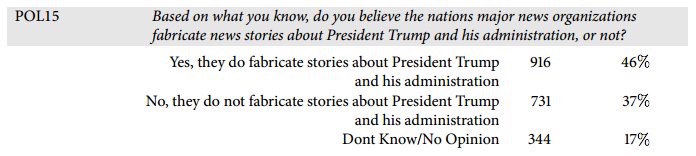
Last fall a Gallup poll found that Americans’ trust in mass media had reached a new low at 32%. A new study out this week led Politico to write a story with the following headline: “Poll: 46 percent think media make up stories about Trump“.  Here’s the question that produced the polling data.

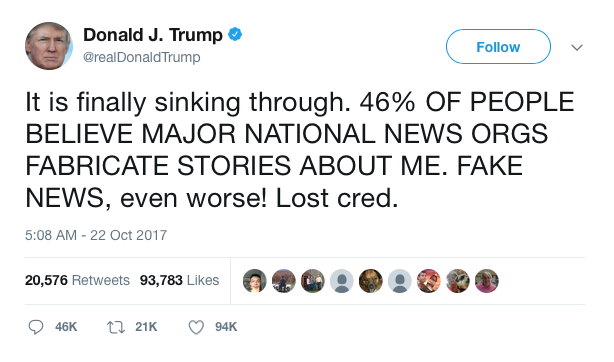
Of course President Trump tweeted the poll results blaming the media’s loss of credibility on what he labels “fake news.”

Even if you’re not a journalist this should be cause for concern, and here’s why. Journalism is a profession that serves the public by reporting the news of the day with fairness and accuracy. It is important that reporters get their information from multiple reliable sources, contextualize the facts based on other relevant information, and present it to the public in a timely manner. It is good to be fast, but never at the expense of being right…in other words, journalists need to take time to double-check their facts and do everything within their power to strive for accuracy. If they make a mistake there should be a correction and an apology. If they make too many mistakes, they become accountants (sorry, I couldn’t resist). No seriously, if they screw up too many times they’ll be looking for a new profession.

For news reporters (as opposed to commentators) it is also important that they make every effort to set aside their personal beliefs in order to report the facts without bias. No reporter can do this perfectly, but s/he must work tirelessly to eliminate bias that constantly tries to insert itself into the story. After reading a story from a seasoned journalist you should be unable to ascertain that reporter’s beliefs about politics or any other number of personal choices that they’ve made.*

In journalism, fabrication is a fireable offense. There are many journalists whose names will go down in infamy because they fabricated stories…in whole or in part. Here’s a top-10 list that should provide plenty of motivation for any young journalist who might be tempted to cut corners or embellish a story.

This is why this poll result is so startling and disturbing. The fact that nearly half of those polled think that “major news organizations fabricate news stories about President Trump  and his administration” is shocking. It reveals a deep distrust of “the press” by a significant portion of the population. Consider for a moment the fact that trust is the only thing of value for members of the press. It doesn’t matter how much information you have or how good it is, if half of your potential audience thinks that you sometimes make things up you’re wasting your time. It’s like asking people if they believe that employees at major fast food chains spit on your food before serving it. If half the people think that they do, chances are they’re not eating fast food. (My apologies to the squeamish.)

This poll, and another from Marist College, led a commentator at the Washington Post to declare that Trump has won his war against the media. While it may be too soon to make that claim, it certainly is not too soon to sound the alarm.


The poll was conducted October 12-16, surveying 1,991 registered voters. The margin of sampling error is plus or minus 2 percentage points.

Morning Consult is a nonpartisan media and technology company that provides data-driven research and insights on politics, policy and business strategy.

More details on the poll and its methodology can be found in these two documents — Toplines: http://politi.co/2xMOykV | Crosstabs: http://politi.co/2kU6DYm

*According to a study by Harvard University, reported in the Chicago Tribune, some of the loss of credibility by the news media may be a direct result of biased coverage of the first 100 days in office for the Trump administration.

Are the Media Complicit in Harvey Weinstein’s Sexual Abuse?

The avalanche of accusations against movie mogul Harvey Weinstein continued unabated this week as more women came out to accuse him of  sexual harassment, groping, and even rape. In hindsight it appears that the only people in Hollywood who didn’t know about Weinstein’s behavior were members of the media. Or worse…perhaps they did know but couldn’t bring themselves to report it.

The abuse by Weinstein was so well known in Hollywood that it even served as a joke by Seth MacFarlane on the 2013 Academy Awards  telecast. While McFarland describes the joke as “a hard swing in his [Weinstein’s] direction”, others are describing MacFarlane’s joke as just another example of not taking these allegations seriously. Here it is…you decide:

https://youtu.be/KCNvREKTnQc

This kind of behavior is, sadly, not new. The infamous Hollywood “casting couch” has never been so clearly revealed to anyone who cares to look past the flimsy curtain. The sad reality is that men in positions of power have been able to prey on victims who are afraid to report the crimes.

What is new here is the scope and size of the offense, and the reach and influence of the perpetrator. Few media moguls are as big as Harvey Weinstein. According to a report by PBS, “Between his work at Miramax and The Weinstein Company, which he co-founded, Weinstein’s films have received more than 300 Oscar nominations and secured 81 wins for films like ‘Pulp Fiction,’ ‘Sling Blade’ and ‘Shakespeare in Love’”.

Weinstein’s clout was not just felt in Hollywood, but also New York (the center of the news media), and Washington D.C. A long time political donor to Democratic politicians, the Clintons and Obama counted on Weinstein to deliver both dollars and votes. Michelle Obama called Weinstein “a wonderful human being, and good friend” and the Obama’s daughter Malia worked as an intern in his office.

But what really has people scratching their heads is the official silence from news organizations. Why did it take so long for the story to break in The New Yorker? Decades after the fact, reporters are now telling stories of how their reporting on Weinstein was spiked by editors and publishers who didn’t want to offend Weinstein. Why would media outlets that take seriously the oath to “seek the truth no matter where it leads” turn away when the path leads to Weinstein’s door?

According to recent reports, the sexual assault allegations have exacted a toll. Weinstein was fired by his production company, his wife left him, political friends have denounced him, and he has been expelled from the Academy of Motion Picture Arts and Sciences. But for the many women who were harmed by Weinstein, this is only the beginning of justice being served.

Update: After posting this I ran across this article in the Weekly Standard. More food for thought.


Televised Sports and Politics


I’m sure you’ve seen and heard the noise in recent weeks around the topic of politics and sports. From ESPN sportscaster Jemele Hill’s critique of President Trump to the #TakeAKnee protest this past Sunday, sports and politics appear to be on a collision course. LeBron James and Steph Curry have traded tweets with President Trump regarding the Warrior’s invite to the Whitehouse.

I don’t know about you, but my social media feed is overflowing with opinions as NFL players responded today to President Trump’s comments a few days ago calling out players who have protested racism during the playing of the National Anthem.

Thankfully this is a media blog and not a political blog…so I’ll do my best to limit my comments to the issues related to the mass media industries and free speech and expression protected by the First Amendment.

Televised sports has largely been a place where fans have gone to escape politically charged issues. With a highly integrated roster, pro sports teams have actually been able to avoid much of the racially divisive issues that have troubled other sectors of society. There have been notable exceptions of course: the Black Power protest at the 1968 Olympic games, Muhammad Ali’s protest of the Vietnam War, and others.

Even though we have been experiencing a highly polarized political climate of late, TV programmers (with the exception of Sunday morning political talk shows, cable news networks, and late night comics) typically avoid political debates. When advertising revenue is your bottom line, political issues are dangerous because they risk alienating large segments of viewers who turn on their TVs to be entertained, not excoriated.

To be clear, professional athletes, like all Americans, have a First Amendment right to express their political concerns. But the First Amendment does not apply to non-governmental entities. So while the government can do nothing to penalize these protests and protestors, team owners can legally enact policies that restrict players’ rights to express themselves while representing the team. That’s how MLB owners can restrict visible tattoos that contain brands, the NBA can fine Kobe Bryant for an anti-gay slur, and any team can discipline a player for his/her private use of social media. In an interesting twist, college athletes playing for a state-school are legally much more protected for their personal use of social media since the university is an agent of the state which is an extension of government. (see more here)

P.S. No matter what you’re political opinions, you might have strong feelings about the Unsportsmanlike Conduct penalty against Von Miller in Sunday’s game against the Bills! 🙂


Media Conglomerates, Comedians, and Political Influence

If you’ve watched John Oliver’s show Last Week Tonight you know that he has a knack for discussing pithy issues by injecting more than a smidgen of sarcasm and irreverence. His show last week was about Sinclair Broadcast Group, a media company that owns numerous local TV stations and which is poised to grow even larger by buying up the Tribune Media network of stations.

Here’s the show.  (CAUTION: language)

You’ve already seen how Clear Channel became the powerhouse of radio consolidation and how that led to cookie-cutter formats and a loss of local control. That is part of what is causing anxiety for those watching the Sinclair deal unfold.

But there is another factor in this equation. Sinclair Broadcast Group is known for holding conservative political positions. In a media world that tends to skew to the liberal side of the political spectrum this is giving some media pundits a severe case of heartburn.

While cable TV news networks have historically leaned to one end or the other of the political spectrum (e.g. Fox News leans right while CNN and MSNBC lean left), local television stations and their news programs historically reflect the political diversity of their local viewers. It is unusual for local TV news to take a clear position on a politically hot-button issue for the obvious reason that they stand to alienate a significant portion of their viewers, which is bad for ratings, which is bad for the bottom line.

The fact that much of John Oliver’s criticism of Sinclair is delivered with a heavy dose of alarmism suggests that Oliver is himself well to the left of not just Sinclair but a significant segment of the American public. Oliver is not alone. He is joined on the left by former comedic journalist Jon Stewart and current late-night comic Stephen Colbert (both alumni of Stewart’s The Daily Show).  All three (as well as many other comedians throughout history) have been effective messengers for various progressive political causes.

Media companies and media stars can exert political influence overtly or covertly. But if there’s one thing that comedians have shown time and time again it is that getting us to laugh at the absurdities of the target of our scorn may be the most powerful political weapon of all.


The News Media Bubble

Politico, a left-leaning web magazine, just published an essay about the bubble in which journalists live. According to the authors the bubble is not just geographic, but also ideological. According to Politico, the media bubble served to insulate journalists from the people and issues that ultimately led to the election of Donald Trump. For most journalists it was not an issue of whether Hillary Clinton would win, but by how great a margin. Was it perhaps because they didn’t understand what was happening across the country? According to Politico,

Nearly 90 percent of all internet publishing employees work in a county where Clinton won, and 75 percent of them work in a county that she won by more than 30 percentage points.

Another essay, this one by pollster and statistician Nate Silver, (the golden boy of recent electoral race coverage), makes the argument that the national media were the victims of group think leading up to the 2016 Presidential election. Silver’s essay spends some time reviewing a premise introduced by James Surowiecki in his book The Wisdom of Crowds. Surowiecki’s thesis is that networking theory, applied to information flow, can yield superior results given certain conditions. Whether the crowd is professional journalists or citizen journalists, the idea is that collective wisdom is superior to the wisdom of any one member of the group. That is fine if the conditions are met. If not, group-think, an idea popularized in the 1970s by Irving Janis, leads to poor judgement and low-quality decision-making. According to Janis,

the more amiability and esprit de corps there is among the members of a policy-making ingroup, the greater the danger that independent critical thinking will be replaced by groupthink, which is likely to result in irrational and dehumanizing actions directed against outgroups. (https://web.archive.org/web/20100401033524/http://apps.olin.wustl.edu/faculty/macdonald/GroupThink.pdf)

Both articles point to a serious problem for national media coverage of politics. More than ever, national journalists are more highly educated, more liberal, less religious, richer, younger, more urban, and much more likely to live in communities with like-minded neighbors. The liberal, coastal, elite journalist is becoming the norm when it comes to national media coverage, and that is a problem for the future of the industry. Some have argued that this trend has led to an erosion of trust and created a credibility vacuum where fake news and lies can thrive.

This was not always the case. Journalists have not always been so out of touch with the audience that they serve. The failure of local and regional newspapers is a significant contributing factor. According to Politico, labor statistics are a clear indication of the trend.

In late 2015, during Barack Obama’s second term, these two trend lines—jobs in newspapers, and jobs in internet publishing—finally crossed. For the first time, the number of workers in internet publishing exceeded the number of their newspaper brethren. Internet publishers are now adding workers at nearly twice the rate newspaper publishers are losing them.

As news shifts from local newspapers and local reporters who reflected their communities’ values, to national news organizations located in major metropolitan centers on the coasts, it has becoming increasingly likely that the news that we’re consuming on social media and television is out of touch with mainstream values and main street sensibilities.


Another theory that may be useful to understand what is happening is Elisabeth Noelle-Neumann’s Spiral of Silence theory. According to this theory, unpopular ideas are pushed to the margins, where they slowly lose favor and spiral downward to eventual silence. We’re fine with this if it’s a bad idea, one that does not deserve to be sustained. But what about when an unpopular idea is silenced because those in authority don’t want to give it a hearing? What about unpopular ideas that are banished to the margins because groupthink has created a hostile climate for those kinds of ideas? What if the lack of ideological diversity in our newsrooms creates an echo chamber that drowns out dissenting voices?

Conservatives have consistently accused the national media of having a liberal bias, and that appears to be supported by these essays. But I’ll close with this quote from the Politico article…

Resist—if you can—the conservative reflex to absorb this data and conclude that the media deliberately twists the news in favor of Democrats. Instead, take it the way a social scientist would take it: The people who report, edit, produce and publish news can’t help being affected—deeply affected—by the environment around them. Former New York Times public editor Daniel Okrent got at this when he analyzed the decidedly liberal bent of his newspaper’s staff in a 2004 column that rewards rereading today. The “heart, mind, and habits” of the Times, he wrote, cannot be divorced from the ethos of the cosmopolitan city where it is produced. On such subjects as abortion, gay rights, gun control and environmental regulation, the Times’ news reporting is a pretty good reflection of its region’s dominant predisposition. And yes, a Times-ian ethos flourishes in all of internet publishing’s major cities—Los Angeles, New York, Boston, Seattle, San Francisco and Washington. The Times thinks of itself as a centrist national newspaper, but it’s more accurate to say its politics are perfectly centered on the slices of America that look and think the most like Manhattan.

Something akin to the Times ethos thrives in most major national newsrooms found on the Clinton coasts—CNN, CBS, the Washington Post, BuzzFeed, Politico and the rest. Their reporters, an admirable lot, can parachute into Appalachia or the rural Midwest on a monthly basis and still not shake their provincial sensibilities: Reporters tote their bubbles with them.
 

Survivors and Victims of Reality TV’s Deception

Reality TV is constantly inventing new ways to shock its viewers. This past week on Survivor it was the outing of transgender contestant Zach Smith by gay competitor Jeff Varner. In a side story (in real life), Varner was subsequently fired from his job as a real estate agent by a boss who was quoted as saying that Varner is “in the middle of a news story that we don’t want anything to do with.”

The uproar on social media was immediate and unforgiving. Some of the harshest criticism was for Varner and his use of the word “deception” to describe Smith’s secret. Others were harshly critical of CBS for deciding to include the scene after months of deliberation.

But it turns out that CBS and Smith worked closely to prepare for the episode’s airing this past week.

According to the New York Times,

From the moment the episode was filmed nearly 10 months ago, the “Survivor” producers had been consulting with Mr. Smith about how best to handle airing the incident, which included a strategic media rollout and working with Glaad, the gay, lesbian, bisexual and transgender rights group, before the episode’s broadcast.

Jeff Probst, the show’s host and executive producer called it “one of the most raw and painful studies of human behavior that has ever happened on ‘Survivor.’ ”

But I’m left with a question that goes to the heart of reality TV as a programming genre. For the Survivor-type shows where contestants compete for a grand prize, deception, betrayal, and backstabbing are not only allowed, they are encouraged. Deception is how you play the game on reality TV…and, unfortunately, increasingly so in the world of politics and international relations. But I digress.

One viewer took to Twitter refusing to accept Varner’s apology saying, “Apologies only have meaning when they are expressing sincere regret for a mistake. What Varner did was no mistake. He intentionally humiliated Zeke and tried to justify it.” Exactly! That is how you play the game on Survivor. The drama created by conflict is why most people watch, and have been watching Survivor for more than 13 years. The business model for Survivor and CBS is based on people doing outrageous things in front of cameras and microphones. CBS will cash that check over and over again…or at least as long as the audience shows up asking for more.

But we’re still left with the question; why did this tactic by Varner elicit such a strong response from viewers? Just like the collective judgement directed at United Airlines, the moral outrage targeting Varner and CBS is indicative of society’s desire for justice. We know when something is over the line. But whose line is it, and where should it be drawn?

Some of the ugliest disagreements (on social media and elsewhere) are between people who want to draw the line in a different place than where others think it should be drawn.

Take the Oscar Challenge

logo_oscars_3d-colorIf you’re 18 years of age or older, are a legal resident of the USA, not a felon, not an employee of the Academy (or family member of an employee), and don’t mind signing in with your Facebook account…you can enter the Oscar Challenge sweepstakes for a chance to win a trip to  next year’s ceremony.

Just go to http://challenge.oscar.com/ and submit your ballot by picking the winners in 24 categories up for selection. The grand prize winner (randomly selected from those with the highest number of correct predictions) will win,

… one (1) Oscar® All-Star Winner prize package, which consists of a 3-day/2-night trip for two (2) to Los Angeles, CA and tickets to sit in the bleachers next to the red carpet arrival area at the 90th Academy Awards® tentatively scheduled to take place on March 4, 2018 (“Trip”). The exact date of the 90th Academy Awards® is subject to change; exact date will be provided to winner at least sixty (60) days prior to the event. Grand Prize Trip includes round-trip coach class air transportation for two (2) to Los Angeles, CA from an airport near winner’s residence (as selected by Sponsor in its sole discretion); two (2) nights’ hotel accommodations (one room, double occupancy) at a Los Angeles area hotel (as selected by Sponsor in its sole discretion); ground transportation between Los Angeles area airport (of Sponsor’s sole choosing) and hotel; and two (2) tickets to the bleacher section next to the red carpet arrival area at the 90th Academy Awards®.

Please note, “GRAND PRIZE DOES NOT INCLUDE ADMISSION TO THE 90TH ANNUAL ACADEMY AWARDS® CEREMONY OR ENTRANCE INTO THE DOLBY THEATER.” You can read all the rules here!

Of course if you want to witness the grand spectacle from INSIDE the venue, you could always look into becoming a seat filler. Or, if you prefer, just kick back and watch the show, hosted by Jimmy Kimmel (for the first time). The live show is scheduled for Sunday, Feb 26 at 5pm MST.

This year there are nine nominees for Best Picture. The film with the most nominations is La La Land with 14 (including Best Picture)!

Recently on Kimmel’s show Viggo Mortensen had some advice for Jimmy.

css.php