Journalists have their work cut out for them. With public faith in journalistic credibility at an all-time low and a combative White House that uses social media to circumvent traditional news channels, journalists are facing new challenges that have the potential to either make or break the industry.
A democracy depends on an information electorate, and information, for most of our recent history, has been the responsibility of a free and fair press. Newspapers, magazines, television networks, and internet websites have been the backbone of the journalistic enterprise in recent decades. Investigating and exposing corruption, reporting without bias, holding those in power to account…these are the responsibilities of a profession that is recognized and protected by the First Amendment to the Constitution. But more and more news consumers are turning to alternative sources of information, including social media and internet websites that frequently traffic in a different type of information.
Not all information is created equal and it is becoming increasingly difficult to ascertain the value and credibility of the barrage of information that vies for our attention. Take for example the estimates of the size of the crowd attending the Presidential Inauguration. Competing claims, some with photographic evidence, were made by partisan sources and reported by journalists…facts and “alternative facts” if you will.
On Facebook the other day I followed a link to a report of a catastrophic pipeline rupture. A photograph was presented as evidence, calling into question the safety of the Dakota Access pipeline. But the article falsely represented a photo from 2010 (taken in Texas) as a current photo from a Pennsylvania spill by the company connected to the Dakota Access project. Regardless of whether you support or object to a pipeline near this Native American community, this is not journalism.
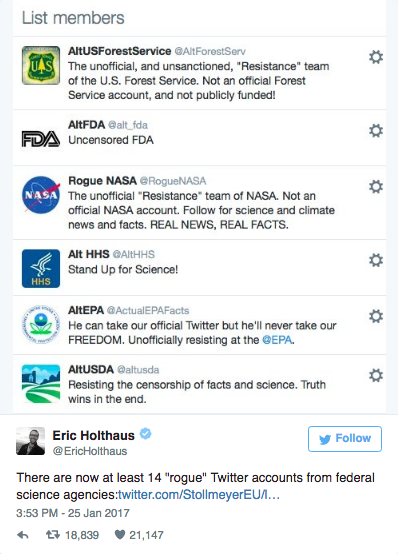 You may have seen the eruption on Twitter from various “alternative” governmental organizations after President Trump ordered a suspension of the official social media accounts. While these rogue accounts may be just that…actions of government employees acting on their own initiative on their own time…it is also possible that they are simply fake accounts created by partisans who are participating in a grass-roots resistance to the new administration.
As such they are newsworthy, but not for the same reason they would be if indeed they are actually the work of federal employees. According to one blog,
For now, at least, most of these unverified accounts seem to be pushing positive agendas: the climate change facts that many of them tweet are unequivocal, and the planned march of scientists on Washington promises to raise legitimate concerns about scientific progress in the United States. But a dejected left-wing and liberal group should remember that these accounts are emotionally gratifying, not edifying. Embracing such gratification without critical analysis veers close to the Trump administration’s embracing of “alternative facts” — lies that suit the narrative you’d prefer.
Disclaimer: the above quote is from The Verge, a website that has a mixed record as a credible source of news/information.
 New Years is a time of reflection and looking forward. It is a time to take stock of what is working and what is not…making plans to maximize the good and minimize the bad. I just finished an interesting book…The Attention Merchants by Tim Wu, and, if I may be so bold, I would like to make a suggestion that I think will improve your focus and productivity in 2017. And that suggestion is…..(drum roll)…..change the way you currently give your attention to media.
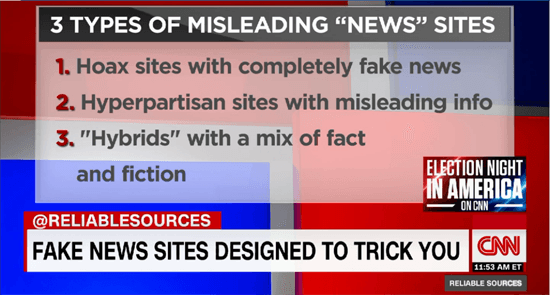 There’s been a lot of discussion lately about the potential danger of fake news. Apparently we’re a lot more gullible and susceptible to misinformation than anyone imagined, and IT IS KILLING DEMOCRACY! Okay, that conclusion may be overstating it a bit, but the number of media and political analysts who are wringing their hands over the outcome of the recent election seems to be growing. And seeking an explanation (or scapegoat), some are pointing the finger at fake news.
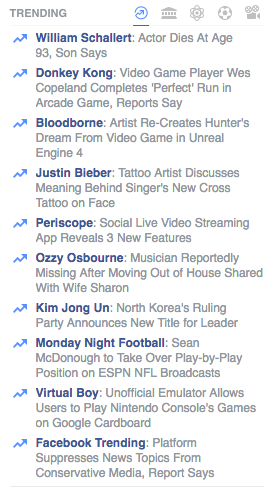 Well, for starters there’s less conservative news from conservative sources than one might expect. A recent
  ESPN’s decision to fire baseball commentator Curt Schilling is not an infringement of Schilling’s rights under the First Amendment. Companies have parted ways with high profile employees for all sorts of public statements or deeds that were at odds with the company’s image. A few that come to mind are:
 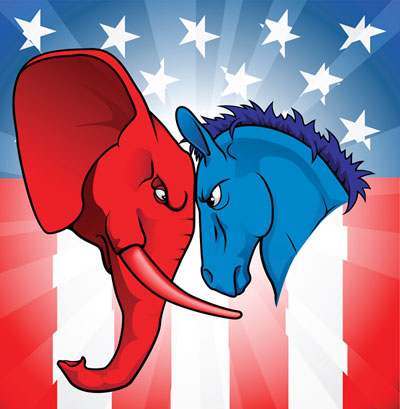 It’s an election year and my news feed is turning into a political brawl. Cable and network news shows are stoking the drama that seems to grow with every passing day. Presidential candidates are coming unhinged and saying things that would have never have been accepted just a decade or two ago. What used to be a fairly conventional, and even predictable, process has changed. And media may be part of the problem.
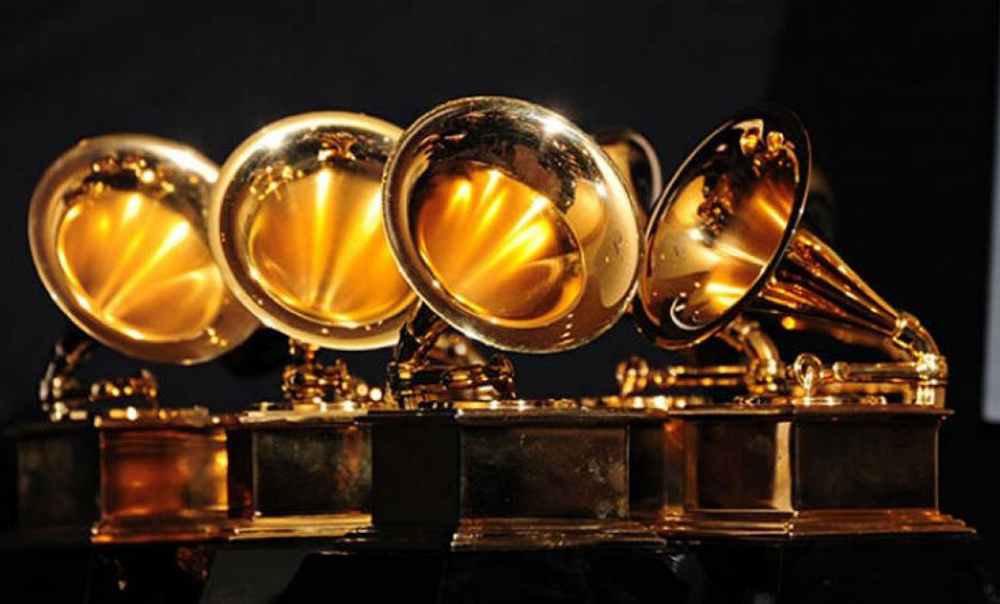 The 58th Grammy Awards show tomorrow night, Feb 15th, continues the awards show season that started with the Golden Globe Awards show broadcast on January 10th. Next up will be the movie industry’s gala, the 88th Academy Awards show, (aka, the Oscars), scheduled for February 28th. Two smaller awards programs, the iHeartRadio Music Awards show and the 51st Academy of Country Music Awards, will air in April. TV’s big night, the Emmy Awards, will air sometime in the fall season.