$167,000 per second

No, that’s not the growth rate of the national debt. It is the price for a TV spot. A 30-second ad will cost advertisers $5 million this coming Sunday. Super Bowl 50 (let’s just forget about that “L” thing for a moment) will likely have an audience of 115-120 million viewers, and this is a chance to pitch all 120 million of them with your brand or product. It is the only remaining mass media event that can pull a live audience of this size…and because of that it can command outrageous sums of money from brands that want/need that kind of exposure.

Here’s a video from last year that helps to explain…

When you’re spending this kind of money you want to maximize the effect and, if possible, increase exposure. One way is to release your ad on YouTube prior to the big day, and hope that you can build buzz online with social media. One Super Bowl ad that was very effective with this approach was VW’s The Force spot. This year Budweiser is trying it with a don’t-drink-and-drive spot featuring Helen Mirren. You can see it here…

https://www.youtube.com/watch?v=Rb2VXVmUga4

Selling Out

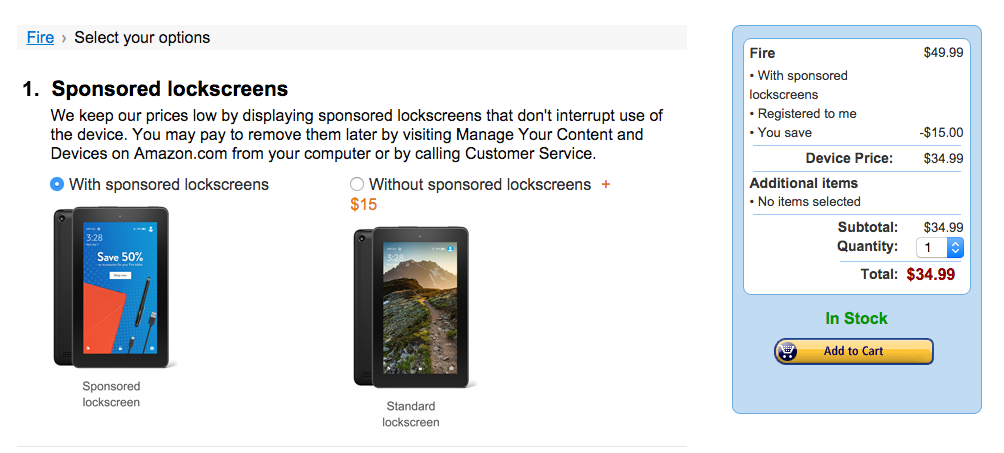
I bought an Amazon Fire tablet today for the ridiculously low price of $34.99. That’s $15 less than their usual ridiculously low price. Today’s special is not just a Black Friday “door buster” bargain. No, the additional $15 off is available to anyone who is willing to let Amazon place an ad on the tablet in place of the lockscreen image. That’s right, I sold the lockscreen on my tablet to Amazon, and invited them to use it to advertise to me so that I could save $15. I don’t know whether to feel like a smart shopper or a sell out. Actually I do, but I’d rather think of myself as a smart shopper.FireLockScreenAd

Are You Ready for Some Star Wars?

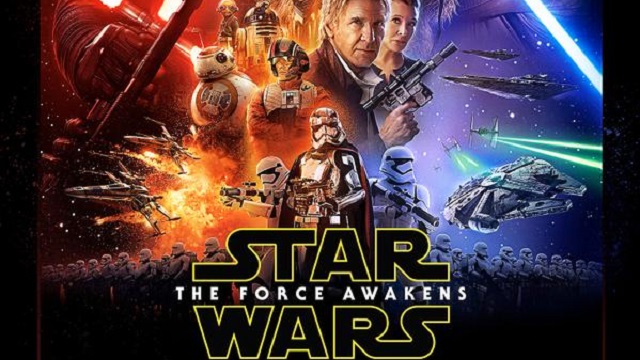
star-warsLast week’s Monday Night football game on ESPN was an excellent opportunity for Disney (parent company of ESPN) to promote its latest Star Wars movie. In case you didn’t know, Disney bought Lucas Films (creator of the Star Wars franchise) in 2012 for $4B. That acquisition was what happens, “when you wish upon a death star” according to one report.

Advertising is when one company pays another to promote its products. But if the company that wants to advertise is a media company, and it wants to promote its own products by using its own media space to do so, we call that promotions. TV networks promote specific programs to targeted demographics watching other programs. Radio stations promote themselves with their own airtime trying to build brand identity and loyalty. Even newspapers and magazines promote upcoming features or issues.

Disney using ESPN’s broadcast of NFL football to promote its upcoming film release is a no-brainer. NFL football is hugely popular…and a perfect audience for the new blockbuster. But this promotion actually worked both ways. The ESPN telecast actually saw a ratings spike as people tuned in to see the world-premiere of the latest trailer. That’s right, people tuned into the program to see the commercial! Now that’s marketing mojo. Theater servers crashed as fans rushed to pre-buy tickets for the latest installment. According to Josh Rottenberg of Tribune News, in the first hour after the half-time trailer, 1.3 million people interacted with it on Facebook and the Twitterverse lit up with some 17,000 tweets per minutes. AMC Theatres sold out more than 1,000 shows nationwide in less than 12 hours. Now THAT’s a force to be reckoned with!

You can see the buzz-generating promo on YouTube at https://youtu.be/sGbxmsDFVnE


The Beat Goes On

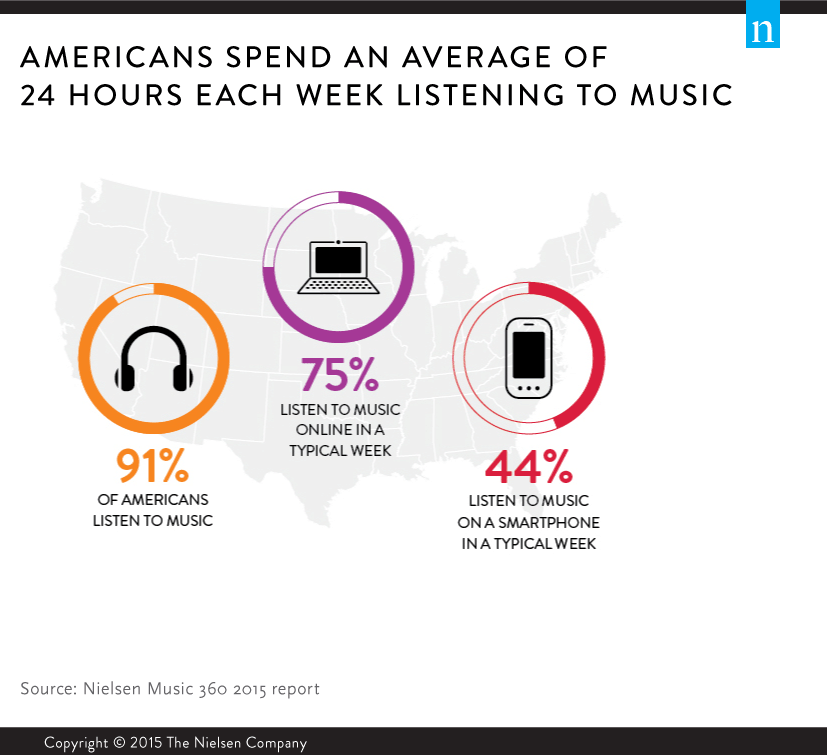
A new report from Nielsen confirms that music is still an important part of most Americans’ lives. The Music 360 2015 Report found that 91% of us listen to music and we spend an average of 24 hours each week listening. That’s an average of 3.4 hours/day…that’s more time than college and university students spend on work and related activities (2.5 hours) and even more time than they spend on educational activities (3.3 hours) (link).

According to Nielsen,

Radio continues to be the No. 1 source of music discovery in the U.S, with 61% of respondents saying they find out about new music from AM/FM or satellite radio, a 7% increase over last year. Word of mouth is also important, particularly for teens: 65% say they discover new music through family and friends, well above the average of 45%.

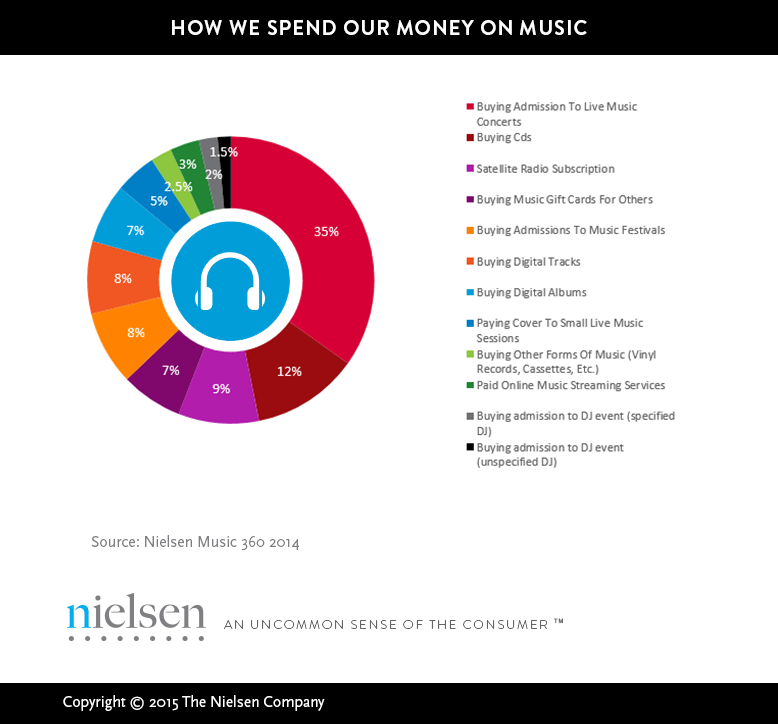
music-360-chartAccording to another report from Nielsen, “On average, U.S. consumers report spending $109 each year on music. So aside from albums, what other types of music options are consumers spending their money on? Surprisingly, live events are gaining momentum, as they now account for more than half of total music activity spending each year.”how-we-spend-money-on-music-final

The chart on the right shows how American music consumers are spending (or not spending) their dollars to acquire music. As you can see, live concerts and CDs are the top two ways of purchasing access to music. While this chart may not describe your spending patterns, it is interesting to note that traditional means of acquiring music are still important. And you may also be interested in knowing that two albums alone sold a combined 7 million units last year…dominating album sales. “Combined, Taylor Swift’s 1989 and the Frozen soundtrack accounted for almost half of the year’s top 10 album sales.”


Planned Parenthood’s PR Problem

You may have noticed that Planned Parenthood is in hot water. Now that a third undercover video has been released…this one featuring a PP official from Colorado discussing the selling of fetal organs…the crisis is moving from social media to front page news. But that is exactly what Planned Parenthood is trying to prevent by hiring a Public Relations firm. The firm is, according to Politico‘s website, attempting to keep media outlets from covering the story by claiming that the videos are a violation of patients’ privacy. That was the same tactic used to prevent the distribution of the Frederick Wiseman’s ground-breaking documentary Titicut Follies. That documentary was effectively banned for 24 years. Produced in 1967, the film eventually aired on PBS in 1992.

Another tactic being employed is to discredit the source of the leaked videos. According to a PR website,

Ferrero blasted the video publishers, the Center for Medical Progress, as a “well-funded group established for the purpose of damaging [PP’s] mission and services.” He said the video was heavily edited and falsely portrays the group’s participation in tissue donation programs.

This incident raises ethical questions about undercover reporting and agenda-driven journalism. Gotcha sound bites and crafty editing can be used to manipulate unsuspecting, or already convinced, audience members that this is an open and shut case. Perhaps it is…and time will tell if we can just sustain our focus and attention on the legitimate concerns.

Social media thrives on polarizing stories such as this one. With a catchy hashtag calling for the defunding of Planned Parenthood, i.e. #SToPP, social media will keep the debate front and center for at least a short time.

Rewiring my brain…this could take awhile

I’m approaching the mid-point of my year-long experiment. For 2015 I’m avoiding (as much as is professionally possible) all forms of electronic mass media. No TV news, no NPR or music on the radio, no podcasts, no Facebook or Twitter (except for an occasional post to the MCCNM department’s pages). Essentially I’m allowing myself print media. I resubscribed to the Pueblo Chieftain (newsprint edition) and have been reading a lot of books. (So far over 30, about 10,000 pages!) I continue to use email, course management software for classes, and I post content to various websites (this blog, YouTube, etc). I cannot turn off the switch entirely without taking a sabbatical from work.

I’m sure some of you may be wondering whether this constitutes professional malpractice for someone who is a professor in a Mass Communication department. Unplugging, while demanding that my students pay close attention to the media event or scandal du jour, may seem unfair or irresponsible. Perhaps you think that I’m just a curmudgeonly old fool, a closet Luddite, a technophobe, and a recluse. I can assure you that most (not all) of those assumptions are unfounded.

This has been, and continues to be, an experiment. It is not unique…many others have run this experiment before, and for many different reasons. And with such a small sample (n=1) you know that this qualitative experiment will have very little generalizability in the end. But it will matter to me. One way or the other I expect to learn a lot about myself, my media habits, my thinking process (with and without the constant barrage of media shrapnel), and my relationships.

Our discipline has a long history of media deprivation studies. Usually a researcher looks for a naturally occurring interruption in media services and uses the occasion to collect data on how people respond and react to the loss of service. Strikes by journalists or union workers who drive the delivery trucks, extended power outages, and natural disasters are all sources of media outages. Self-inflicted media blackouts are another matter altogether.

The reason for this experiment is to see if there has been a slow and steady decline in my thinking and my thought process as a result of my media consumption behavior over time. Reading Nicolas Carr’s prescient essay, Is Google Making Us Stupid, when it was published in 2008 initiated my concern. In the essay Carr bemoans his own ability to read deeply…and to think deeply about what he has read. For an academic, this is NOT good news. When I assigned Carr’s essay to students in my Media & Society class, they complained that it was too long…thus supporting Carr’s thesis. Can’t I have my internet, my social media, my podcasts, my news sound bites AND an intellectual capacity to contemplate the big issues? Not according to Carr.

A friend of mine who works with people with addictions tells me that it takes three years to change the mental processes that frequently drive compulsive behavior.  The big question that remains for me is whether this one year of partial withdraw will be sufficient to see a significant effect. I’ll keep you posted…just not on Twitter or Facebook!

What happened in Vegas…

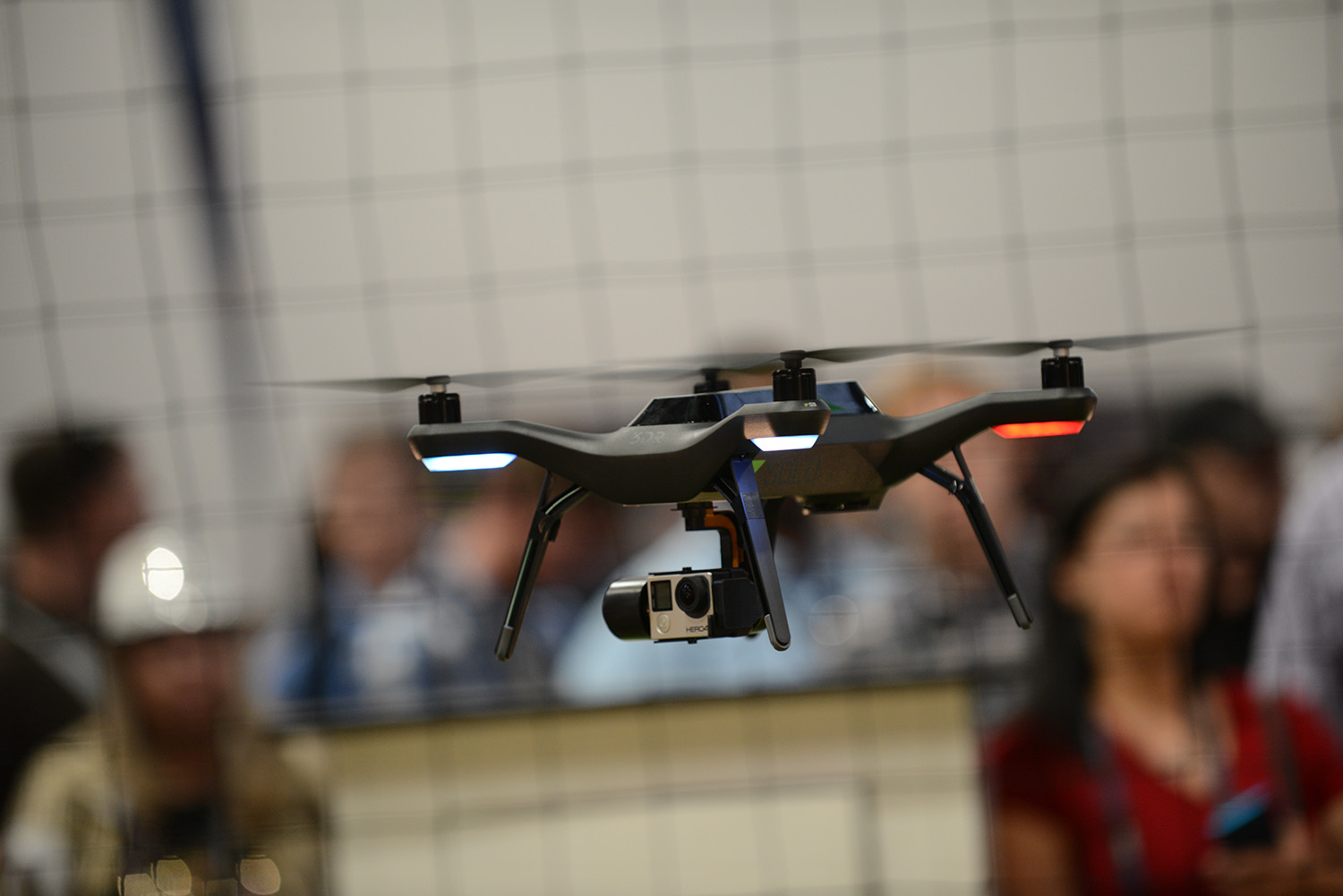
Many companies were demonstrating drone technology
Drone demo on the exhibit floor

Actually, it’s still happening. It’s the annual convention of the National Association of Broadcasters and it will be continuing through Thursday. According to their press release, “With more than 98,000 attendees from 150 countries and 1,700+ exhibitors, NAB Show is the ultimate marketplace for digital media and entertainment.” Conveniently for academics, the Broadcast Education Association annual convention runs concurrently and overlaps the NAB for a few days.

I, along with several of my colleagues from CSU-Pueblo, made presentations, attended sessions and workshops, and toured the more than 1 million square feet of exhibit space. Of course I didn’t see it all. Even if I had been there for the entire 4-day run I would have had a hard time seeing all of the booths, exhibits, and displays.

But I can tell you one thing…in just a few hours today I saw more pixels than some people see in a lifetime. There were 4K displays everywhere, and quite a few 8K displays as well. Monitor walls stretched from floor to ceiling, and there were $50,000 digital cinema cameras everywhere you looked. Companies (including: Adobe, Arri, Canon, Dolby Laboratories, GoPro,  Red Digital Cinema, Sony, and Zacuto, just to name a few) were showing off the latest and greatest hardware and, perhaps more important, software used by radio and TV broadcasters and media content producers. One of the highlights this year is the aerial robotics and done pavilion. Other buzz words for 2015 include UHD (Ultra High Definition), ATSC 3.0, Virtual Reality, and SVOD (Subscription Video On Demand, e.g. Netflix and Hulu+).

So, what was my ah-ha moment? During a State of the Industry report one of the speakers made the point that the media production/distribution industry was moving from hardware to software. More and more of the tools that we use to acquire, edit, manage, and distribute content are primarily software tools. Once media content is digital, software allows us to do any number of things to it in the process of making it available to our intended audience. The future of media production will be less about engineering breakthroughs and more about software development. And in the future most of our media and software will live in the cloud. It’s an exciting time to be in this business.

Net Neutrality and the Jester

Net neutrality, the idea that the internet should be an open network where internet service providers cannot restrict or prioritize content from any particular source, is one step closer to becoming the law of the land. FCC Chairman Tom Wheeler outlined his position in an editorial published by Wired magazine, and barring any last-minute hijinks it now appears that the Obama administration will prevail in a long, drawn-out, battle with those (mainly large telecom providers) who have argued that net neutrality will stifle technological innovation and reduce incentives for expanding service.

In late 2014 President Obama staked out his position in a short video calling for the FCC to act to implement net neutrality regulations. In order for the FCC to step in they would need to reclassify the internet as falling under Title II of the Telecommunications Act–essentially treating access to the internet as a public service utility not unlike your phone, water, or electric service. Many argue that the internet has become such an essential part of our daily lives that to be without it is unthinkable.

As I was reading an article in the WSJ about the ongoing debate I came across a paragraph that caught my eye…

At the same time, Mr. Ammori tried to build wider public support for net neutrality. Last May, he spoke with a researcher for “Last Week Tonight with John Oliver, ” the HBO comedy series. On June 1, Mr. Oliver unleashed a 13-minute rant in an episode of the show, comparing Mr. Wheeler to a dingo and encouraging viewers to bombard the FCC with comments.

If you’re not familiar with John Oliver, he was a former correspondent for The Daily Show.  Now that he has his own show he continues to poke fun at serious topics, just as he did when he worked for Jon Stewart. Below is the video by Oliver.

The video was produced and posted in the summer of 2014, so the framing of the debate does not take into account the developments that have transpired since. But the video does two things very well: 1) it explains in easily accessible terms the nature of the debate, and 2) it allows us a few laughs in the process. That may be the genius of Jon Stewart, Stephen Colbert, and now John Oliver. Like court jesters of old, they make their point and wield tremendous influence while we laugh along; while all too often remaining oblivious to the subtleties of their arguments.

Cord Cutters Gaining Options

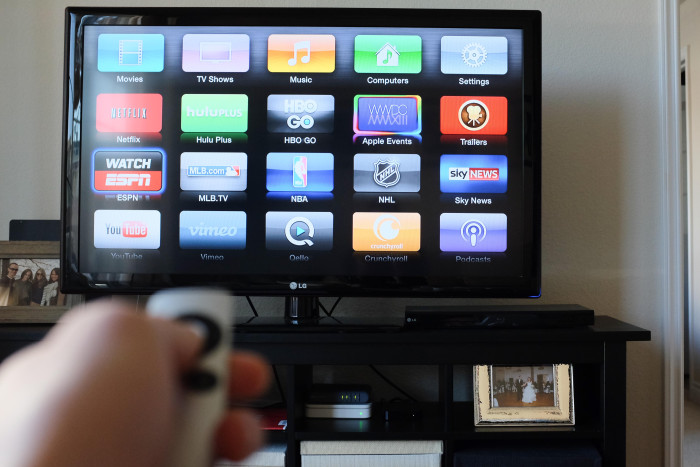
apple-tv-streamThe cable and satellite TV industry is beginning to face the inevitable. With broadband internet widely available on multiple screens, TV viewing options are morphing from the traditional fixed time and space (appointment TV in your living room) to flexible viewing (anytime, anywhere). Having resisted a la cart pricing for many years, cable and satellite TV providers are slowly coming to terms with the future…and hoping that they haven’t waiting too long to become viable players in a future where content is packaged by the buyer–not the seller.

In the past if you wanted access to broadcast and cable network programming you had, at most, only a few options. Depending on where you lived you could subscribe to cable (basic and tiered packages at prices ranging from $50-$100+ per month), satellite (pretty much the same deal but with a dish instead of a wire), or, in some markets, a variation known as wireless cable. Or, (see my earlier post), you might consider OTA (Over The Air) broadcast TV for only the cost of an antenna!

Most of these “packages” were available directly from the provider or bundled with your phone and/or internet service. Telecom and cable providers rushed to create packages of video, voice and data (i.e. television, telephone and internet) and the result was often a monthly bill between $100-$200.

But Millennials have been slow to buy in to these marketing plans. Tech savvy and often financially squeezed, they have looked for other, (read, less expensive) alternatives. These alternatives still required internet access or a data plan on their phones…but landline phones and cable/satellite TV were for older folks, e.g., their parents, and seemed redundant at best. With so many media options literally at their fingertips, younger consumers found that a mix of YouTube (seriously?, you need a link for YouTube?), Hulu, and Netflix provides a wealth of “television” programming without the sticker shock.

The problem is that, up until recently, live sports were seldom available online (unless you wanted to watch a choppy stream from some former Soviet-bloc website). But DiSH TV’s Sling TV (their slogan is Take Back TV), will soon be offering a basic package available for $20/month that will include ESPN, ESPN2, Disney Channel and CNN along with a handful of other popular networks. All you need is a smart TV or one of several streaming devices (e.g., Apple TV, Roku, Chromecast) and you’re in business. Or just sign up and watch on your computer, tablet or phone. In either case there is no long-term contract to sign. However, if you need your DVR’s time-shifting capability, or your weekly fix of Mad Men or The Walking Dead, Sling TV may not be for you. But others may find that it’s time to Take Back TV!

One other significant development is that cable networks and program providers are beginning to offer stand-alone streaming packages. In addition to deals announced last year by HBO, Showtime, and CBS, you can now subscribe to Nickelodeon, Comedy Central, and Sesame Street via Google’s Chromecast service, and the necessary hardware will only set you back a one-time fee of $35.

As you can see it will be fairly easy to cobble together some sort of TV programming package from a variety of sources to build a customized set of choices–and probably for a good bit less than you’d pay for a cable or satellite package.
Hacking, Journalism, and Moral Treason

The hack of Sony Pictures and subsequent release of salacious emails and other confidential information has been the talk of the town (read Hollywood) in recent days. Much of the information obtained by the hackers (aka Guardians of Peace) is very personal and potentially damaging to careers and reputations of employees, executives, and celebrities connected to Sony. Medical records, compensation packages and their private negotiations…even jokes about President Obama that have a racial component…are on display for all to see.

But the hackers alone cannot do serious damage to Sony without the willing participation of journalists. What the hackers have stolen, journalists are now distributing with the protection of the first amendment and the claim that these are important and relevant issues to be discussed in a public forum.

But not every one is willing to give the news media a pass when it comes to reporting this story. Appearing on Howard Stern’s radio show, Seth Rogen (co-star of The Interview) claimed that journalists are profiting from doing exactly what the criminals/hackers want.

Television writer Aaron Sorkin has been another outspoken critic saying, “Every news outlet that did the bidding of the Guardians of Peace is morally treasonous and spectacularly dishonorable.” Sorkin acknowledges, in his op-ed piece in the New York Times, the importance and role of the media when it comes to whistle-blowing and exposing wrong-doing, e.g. the Pentagon Papers. But he makes a clear distinction between that and these gossipy morsels that have little or no value for the preservation of democratic ideals.

As demented and criminal as it is, at least the hackers are doing it for a cause. The press is doing it for a nickel. ~Aaron Sorkin

I suppose one could argue that this hack reveals facts relevant to issues of importance: gender disparity for celebrity compensation, race-tinged jokes about the President by Sony execs who support him and gave to his political causes, and allegations of journalistic malpractice by New York Times columnist Maureen Dowd. But these exceptions are not what’s generating all the buzz on blogs and social media.

Not too long ago when nude celebrity pictures were hacked from the cloud “real” journalists were careful to keep their distance for fear of being seen as accomplices to the crime. But this time the “gift that keeps on giving” has fewer detractors and the benefit of readers’ fascination with celebrity culture. The hackers have promised a “Christmas gift” of new information while Sony’s lawyers are sending threatening letters to news organizations in an attempt to discourage further dissemination. But if there’s one thing on which we can be fairly certain, it’s that attacking journalists won’t go over well.

css.php